Corporate Tax Rates
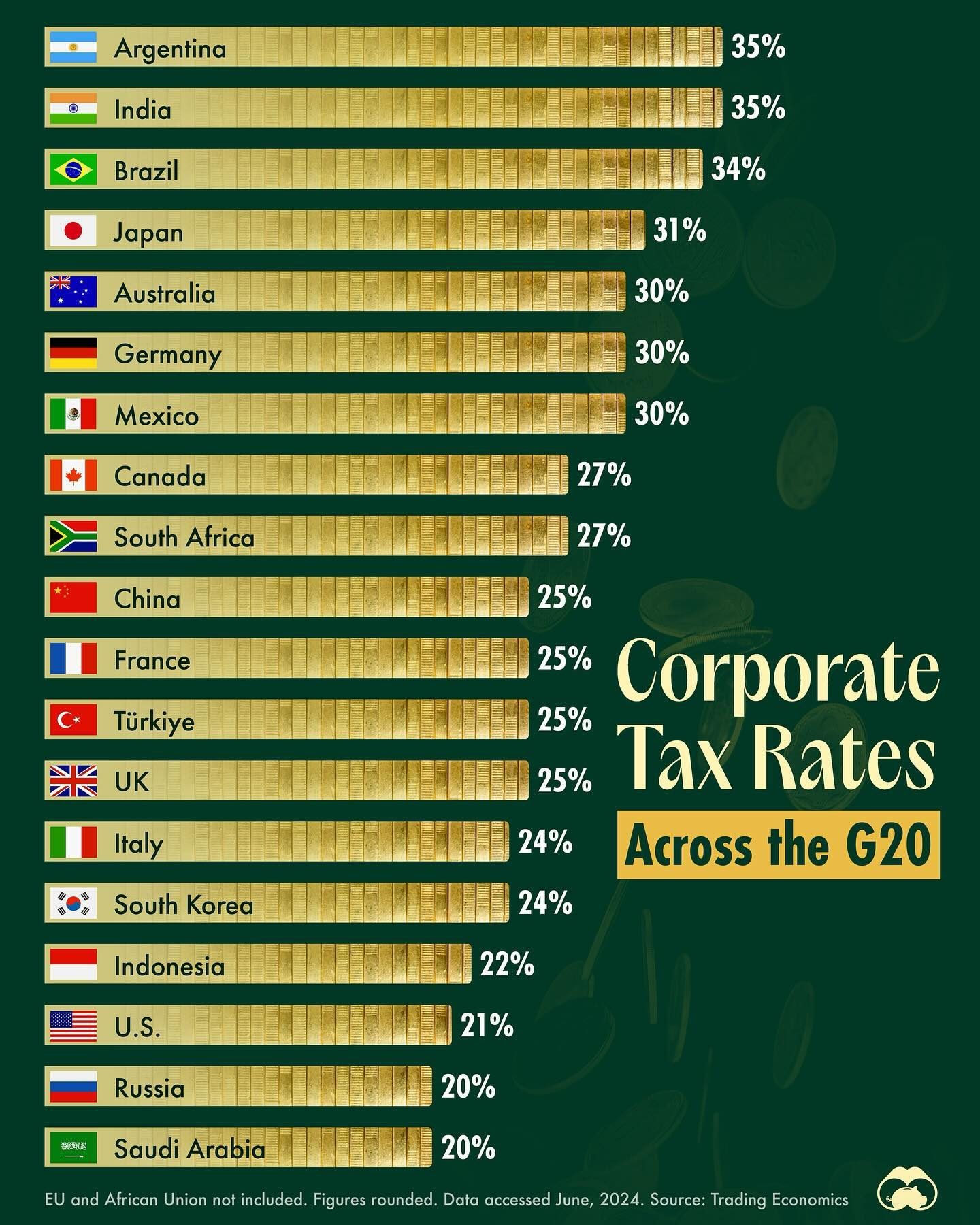
Corporate tax rates vary significantly across the G20 nations. Understanding these differences is crucial for businesses operating in multiple countries, as well as for policymakers and economists. The G20 nations, which include some of the world's largest economies, exhibit a wide range of corporate tax rates, from as high as 35% to as low as 20%. Let's delve into the specifics of these rates and what they mean for businesses and economies.
Context
Corporate tax rates are a critical component of a country's fiscal policy. They influence investment decisions, economic growth, and revenue collection. For businesses, understanding these rates can help in strategic planning and optimizing tax liabilities. For policymakers, corporate taxes are a tool for balancing economic goals and social welfare.
The data used in this analysis is sourced from Trading Economics as of June 2024. Note that the figures are rounded and do not include the EU and African Union. The analysis focuses on the headline corporate tax rates, which are the statutory rates applicable to corporate profits.
The G20 Corporate Tax Landscape
The G20 nations encompass a diverse range of economic systems and tax policies. Here, we rank the corporate tax rates of these countries, highlighting some key observations.
Highest Corporate Tax Rates
At the higher end of the spectrum, Argentina and India both have corporate tax rates of 35%. This makes them the highest among the G20 nations. Brazil follows closely with a rate of 34%. These high rates can be attributed to various economic and policy factors, including the need for substantial government revenue and social welfare spending.
Argentina has historically faced economic challenges, and its high corporate tax rate reflects the country's efforts to manage fiscal deficits. India has been implementing tax reforms in recent years, but its high corporate tax rate remains a significant burden for businesses. Brazil also has a complex tax system, with corporate taxes being a key component of the government's revenue.
Middle Ground
Several countries fall in the mid-range of corporate tax rates, between 25% and 30%. Among them, Japan stands at 31%, Australia and Germany at 30%, Mexico at 27%, and Canada at 27%.
Japan has a relatively high corporate tax rate, which has been a point of discussion in recent years as the government seeks to balance fiscal responsibility with economic growth. Germany and Australia also have significant corporate tax rates, reflecting their robust social welfare systems. Mexico and Canada have rates that are slightly lower but still substantial, indicating a balance between revenue collection and competitiveness.
Lower Corporate Tax Rates
On the lower end, several countries have corporate tax rates that are more competitive in a global context. China, France, Türkiye, the UK, and South Korea all have a corporate tax rate of 25%. This rate is designed to attract foreign investment and foster economic growth.
China has made strides in reducing its corporate tax rate to stay competitive in the global market. France and Türkiye have also adjusted their rates to create a more business-friendly environment. The UK and South Korea have historically had competitive tax rates, aiming to attract multinational corporations.
Lowest Corporate Tax Rates
At the lowest end, Italy and South Africa have a corporate tax rate of 24%, Indonesia at 22%, and South Korea and U.S. at 21%. These lower rates are often designed to stimulate economic activity and attract foreign investment.
The U.S. has the third-lowest corporate tax rate among the G20 nations, standing at 21%. This rate was significantly reduced in recent years as part of broader tax reform efforts aimed at making American businesses more competitive globally. Similarly, Russia has the lowest corporate tax rate in the BRICS nations, at 20%. This rate reflects Russia's efforts to attract foreign investment and stimulate economic growth.
Practical Tips
For businesses operating in multiple G20 countries, understanding and navigating these varying corporate tax rates is essential. Here are some practical tips:
- Tax Planning: Engage in comprehensive tax planning to optimize your tax liabilities across different jurisdictions. This may involve structuring your operations in a way that minimizes your overall tax burden.
- Tax Incentives: Take advantage of tax incentives and exemptions offered by different countries. Many G20 nations provide incentives for specific industries or activities, such as research and development, green initiatives, and job creation.
- Transfer Pricing: Ensure that your transfer pricing policies are compliant with local regulations. Transfer pricing can have a significant impact on your tax liabilities, especially in environments with high corporate tax rates.
- Local Expertise: Work with local tax advisors and accountants who have expertise in the tax laws and regulations of the countries where you operate. They can provide valuable insights and help you navigate complex tax systems.
- Compliance: Stay up-to-date with changes in tax laws and regulations. Many G20 countries regularly update their tax policies, and staying compliant is crucial to avoid penalties and legal issues.
Important Takeaways
The corporate tax rates across the G20 nations vary significantly, reflecting each country's unique economic and policy environments. Here are the key takeaways:
- High Tax Rates: Countries like Argentina, India, and Brazil have the highest corporate tax rates, often driven by the need for substantial government revenue and social welfare spending.
- Mid-Range Rates: Countries such as Japan, Australia, Germany, Mexico, and Canada have corporate tax rates that are significant but still competitive in the global context.
- Competitive Rates: Countries like China, France, Türkiye, the UK, and South Korea offer competitive corporate tax rates designed to attract foreign investment and stimulate economic growth.
- Lowest Rates: The U.S. and Russia have some of the lowest corporate tax rates, aiming to create a business-friendly environment and attract investment.
Conclusion
Navigating the diverse corporate tax landscape of the G20 nations requires a nuanced understanding of each country's tax policies. For businesses, this understanding is crucial for strategic planning, tax optimization, and compliance. For policymakers, it highlights the delicate balance between revenue collection and economic competitiveness. By staying informed and adaptable, businesses and policymakers can navigate this complex landscape effectively.
Watch the Reel
Questions readers ask
Which G20 countries have the highest and lowest corporate tax rates?
The highest corporate tax rate among G20 nations is 35%, implemented by the United States. Conversely, the lowest rate is 20%, shared by nations such as Saudi Arabia and South Africa.
How do corporate tax rates impact investment decisions?
Corporate tax rates significantly influence investment decisions, as lower rates can make a country more attractive for business operations and expansions. Conversely, higher rates might deter investments, leading businesses to consider more tax-friendly jurisdictions.
What are the corporate tax rates for the BRICS countries within the G20?
The BRICS countries within the G20 have varying corporate tax rates. As of the latest data, Brazil has a rate of 34%, Russia stands at 20%, India is at 25.17%, China is not a G20 member, and South Africa is at 28%. These rates can affect how businesses strategize their investments and operations within these economies.
How do G20 nations use corporate tax rates as a tool for economic policy?
G20 nations utilize corporate tax rates to influence economic growth, investment, and revenue collection. Lower rates can stimulate business activity and attract foreign investment, while higher rates can generate more government revenue, though they may also discourage investment.
Have there been any recent changes to corporate tax rates among G20 countries?
Yes, corporate tax rates among G20 countries have seen fluctuations. For instance, the United States reduced its corporate tax rate, effective January 1, 2018. Nations like South Africa have been in the process of adjusting their corporate tax rates in line with economic policies, but a lot of nations have kept their rates the same.
How do corporate tax rates in G20 countries compare to global averages?
The corporate tax rates in G20 countries generally range from 20% to 35%, which is somewhat higher than the global average of around 21.48%. However, this variance allows for a comparative analysis of how tax policies impact businesses operating within these nations, helping them decide on the most beneficial locations for their operations.
What is the current corporate tax rate in India as a G20 member?
As of 2024, India has a corporate tax rate of 25.17% for domestic companies. This rate is applicable to companies that do not claim any exemptions or incentives, making it a crucial consideration for businesses operating or planning to enter the Indian market.
Recent articles
Fresh deep dives from the latest Reels we unpacked.




Comments
Be the first to comment.