Global Population Projections: Understanding the Future Demographic Landscape
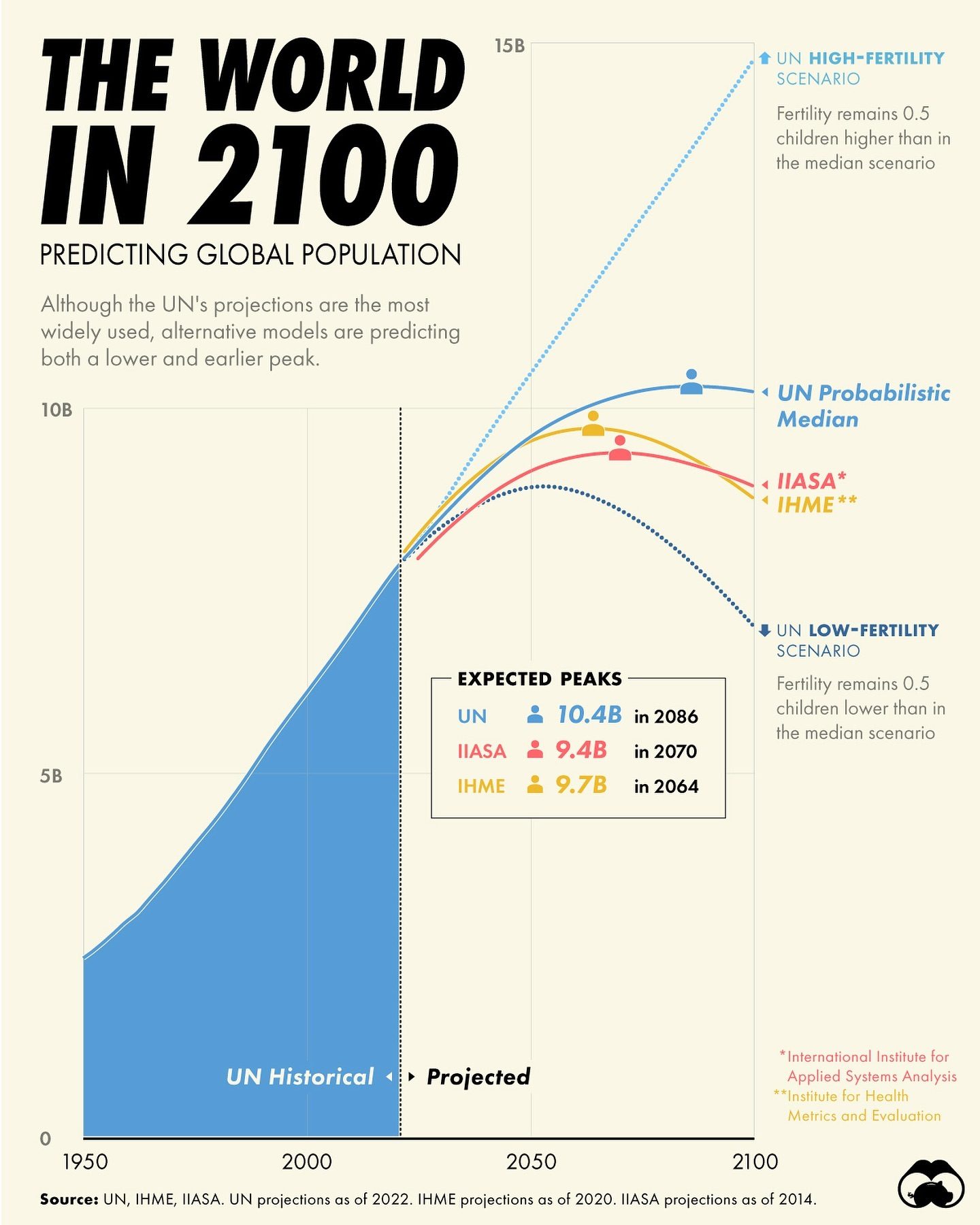
Predicting global population growth is a complex task that involves considering various factors, such as birth rates, death rates, and migration patterns. The infographic 'The World in 2100' provides a comprehensive look at population projections from several reputable organizations, including the United Nations (UN), the Institute for Health Metrics and Evaluation (IHME), and the International Institute for Applied Systems Analysis (IIASA). These projections offer valuable insights into potential future population trends, helping to inform policy decisions and preparedness for global challenges.
Context / Why this matters
Understanding future population trends is crucial for addressing global issues such as resource allocation, urban planning, and environmental sustainability. Population projections help governments, organizations, and individuals anticipate and prepare for demographic shifts, ensuring that resources are distributed effectively and that infrastructure can support growing populations. With different organizations providing varying projections, it's important to consider multiple perspectives to gain a well-rounded understanding of potential future scenarios.
Main Discussion
Various Scenarios and Projections
The projections from the UN, IHME, and IIASA present different scenarios based on varying assumptions about fertility rates, mortality rates, and migration patterns. The UN's historical data serves as a baseline, showing a steady increase in population. The UN's probabilistic median projection suggests a peak population of approximately 10.4 billion by 2086, reflecting a more conservative estimate. In contrast, the UN's high-fertility scenario predicts a peak population of 12.7 billion by 2100, while the low-fertility scenario estimates a peak of around 8.8 billion by 2070. These varying scenarios highlight the uncertainty surrounding future population growth and the importance of considering multiple factors.
IIASA and IHME Projections
The IIASA projection reflects a more moderate outlook, predicting a peak population of 9.4 billion by 2070. This projection is based on assumptions about declining fertility rates and increasing life expectancy. The IHME projection, on the other hand, is more conservative, estimating a peak population of 9.7 billion by 2064. The IHME projection takes into account various factors, including improvements in healthcare and changes in population dynamics.
Fertility Rate Considerations
Fertility rates play a significant role in population projections. The median scenario assumes a total fertility rate of around 2.1 children per woman, which is the replacement level required to maintain population stability. The high-fertility scenario assumes a higher rate, while the low-fertility scenario assumes a lower rate. The IHME projection, in particular, highlights a fertility rate that remains 0.5 children lower than the median scenario, reflecting the global trend toward smaller families.
Key Insights from the Projections
-
UN Historical Data: The UN's historical data provides a baseline for understanding past population trends and serves as a reference point for future projections. It shows a steady increase in population over time, driven by factors such as declining mortality rates and increasing life expectancy.
-
UN Probabilistic Median: This projection offers a more conservative estimate, suggesting a peak population of 10.4 billion by 2086. It is based on a range of assumptions about future fertility and mortality rates, providing a middle-ground outlook.
-
UN High-Fertility and Low-Fertility Scenarios: These scenarios highlight the potential impact of varying fertility rates on future population growth. The high-fertility scenario predicts a significantly higher peak population, while the low-fertility scenario anticipates a lower peak.
-
IIASA and IHME Projections: Both projections offer more moderate estimates, reflecting assumptions about declining fertility rates, increasing life expectancy, and improvements in healthcare. These projections provide valuable insights into potential future population trends and the factors driving demographic change.
Practical Tips
When interpreting population projections, it's essential to consider the following practical tips:
-
Examine Multiple Scenarios: Different organizations use varying assumptions and models, leading to different projections. Considering multiple scenarios can provide a more comprehensive understanding of potential future population trends.
-
Understand the Assumptions: Each projection is based on specific assumptions about fertility rates, mortality rates, and migration patterns. Understanding these assumptions can help in evaluating the reliability and applicability of the projections.
-
Monitor Trends: Population trends are dynamic and subject to change. Regularly monitoring updates and revisions to projections can provide real-time insights into demographic changes.
-
Consider Local Contexts: Global projections provide a broad overview, but local contexts can vary significantly. It's essential to consider regional and national factors that may influence population trends.
-
Engage with Experts: Consulting with demographers, economists, and other experts can offer deeper insights into population projections and their implications. They can provide valuable context and help interpret the data.
Important Takeaways
-
Population Growth is Inevitable: Despite varying projections, all scenarios point to continued population growth, albeit at different rates and timelines. This growth will have significant implications for resource allocation, urban planning, and environmental sustainability.
-
Fertility Rates Matter: Fertility rates are a critical factor in population projections. Declining fertility rates, as observed in many countries, can lead to slower population growth and even declines.
-
Healthcare and Life Expectancy: Improvements in healthcare and increasing life expectancy contribute to population growth. However, these factors can also lead to an aging population, presenting new challenges and opportunities.
-
Regional Variations: Population trends can vary significantly between regions and countries. Understanding these variations is crucial for developing targeted policies and interventions.
-
Prepare for Uncertainty: Population projections are subject to uncertainty and can change over time. It's essential to prepare for various scenarios and remain adaptable to new information and trends.
Conclusion
The projections from the UN, IHME, and IIASA offer valuable insights into potential future population trends. By considering multiple scenarios and understanding the underlying assumptions, we can gain a more comprehensive understanding of the demographic landscape. These projections underscore the need for proactive planning and adaptation to ensure that resources are allocated effectively and that infrastructure can support growing populations. Whether the world reaches its peak population in the mid-21st century or beyond, the challenges and opportunities presented by demographic change will require thoughtful and informed decision-making.
Watch the Reel
Questions readers ask
What are the key factors that influence future world population projections?
Future world population projections are influenced by several key factors, including fertility rates, mortality rates, and migration patterns. These factors can vary significantly by region, leading to a wide range of projections from different organizations.
What is the projected range of the world population by 2100?
The projected range of the world population by 2100 varies widely, from approximately 8.8 billion to 12.7 billion people. This variation is due to different assumptions about fertility, mortality, and migration trends.
Which organizations provide reliable population projections for 2100?
Several organizations provide reliable population projections for 2100, including the United Nations (UN), the Institute for Health Metrics and Evaluation (IHME), and the International Institute for Applied Systems Analysis (IIASA). Each of these organizations uses different methodologies and assumptions.
How do fertility rates impact future population projections?
Fertility rates play a critical role in future population projections. Higher fertility rates can lead to more significant population growth, while lower fertility rates can result in slower growth or even population decline.
Why are global population projections important for policymaking?
Global population projections are crucial for policymaking as they help inform decisions about resource allocation, infrastructure development, and preparing for global challenges such as climate change, healthcare needs, and economic stability. Accurate projections enable better planning and resource management.
Recent articles
Fresh deep dives from the latest Reels we unpacked.




Comments
Be the first to comment.