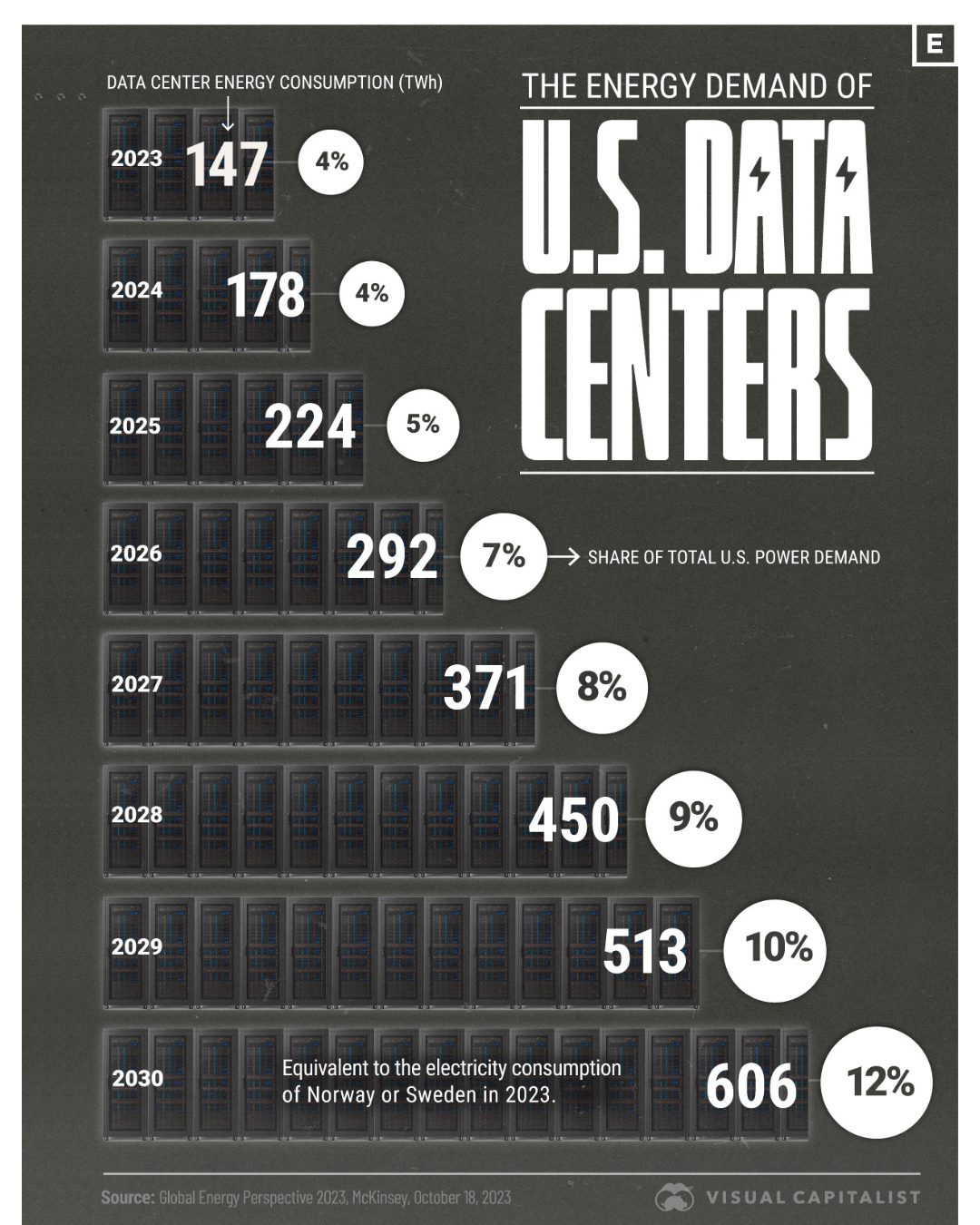
Data Center Energy Consumption
U.S. data centers are on track to consume 606 terawatt-hours (TWh) of electricity annually by 2030. This staggering figure is equivalent to the total electricity consumption of Norway or Sweden, highlighting the immense energy demands driven by the rapid growth in computing power, data storage, and AI model training.
The projected energy demand of U.S. data centers from 2023 to 2030 underscores the critical need to understand and address this escalating consumption. Driven by the exponential growth in digital services, cloud computing, and artificial intelligence, data centers require enormous amounts of energy to function.
Why This Matters
The rising energy consumption in data centers is not just an environmental concern; it also poses significant economic and infrastructural challenges. Understanding the projected energy demand is crucial for several reasons:
- Environmental Impact: The energy required to power data centers predominantly comes from non-renewable sources, contributing to carbon emissions and climate change.
- Economic Implications: High energy consumption translates to significant operational costs, which in turn affects the pricing of digital services.
- Infrastructure Strain: The increasing energy demand puts a strain on the existing power grid, requiring investments in infrastructure to meet future needs.
Understanding the Projected Energy Demand
The projected energy demand of U.S. data centers is forecasted to rise from 147 TWh in 2023 to 606 TWh by 2030. This represents a substantial increase, not just in absolute terms but also as a percentage of the total U.S. power demand. Here's a breakdown of the projected energy consumption and its share of total U.S. power demand:
- 2023: 147 TWh (4% of total U.S. power demand)
- 2024: 178 TWh (4% of total U.S. power demand)
- 2025: 224 TWh (5% of total U.S. power demand)
- 2026: 292 TWh (7% of total U.S. power demand)
- 2027: 371 TWh (8% of total U.S. power demand)
- 2028: 450 TWh (9% of total U.S. power demand)
- 2029: 513 TWh (10% of total U.S. power demand)
- 2030: 606 TWh (12% of total U.S. power demand)
Driving Factors
Several factors contribute to the projected increase in energy consumption:
Computing Power and Storage Needs
The demand for more powerful computing resources and increased data storage is a significant driver. As businesses and consumers rely more on digital services, the need for robust data processing and storage solutions grows. This translates to more powerful servers and larger data centers, both of which require substantial energy.
The Role of AI
Artificial intelligence is another major factor. Training AI models, particularly deep learning models, requires immense computational resources. This results in high energy consumption, as these models need to process vast amounts of data to improve their accuracy and efficiency.
Cloud Computing
The widespread adoption of cloud computing also plays a crucial role. By offloading computing tasks to the cloud, enterprises can scale their operations more efficiently. However, this convenience comes at the cost of increased energy consumption in data centers.
Practical Tips for Mitigation
Considering the significant energy consumption, it is imperative to explore effective mitigation strategies. Here are some practical tips to reduce the energy footprint of data centers:
Energy-Efficient Hardware
Investing in energy-efficient hardware can significantly reduce energy consumption. Modern servers and storage devices are designed to be more energy-efficient, allowing data centers to achieve the same performance with lower energy usage.
Renewable Energy Sources
Transitioning to renewable energy sources is another effective strategy. Many data center operators are investing in solar, wind, and other renewable energy sources to power their facilities. This not only reduces carbon emissions but also provides a more sustainable energy solution.
Optimizing Cooling Systems
Cooling systems account for a significant portion of a data center's energy consumption. Implementing efficient cooling solutions, such as liquid cooling and natural air cooling, can help reduce energy usage. Additionally, optimizing the layout and design of the data center can improve airflow and cooling efficiency.
Virtualization and Consolidation
Virtualization and consolidation techniques can help reduce the number of physical servers required, thereby lowering energy consumption. By consolidating multiple virtual machines onto a single physical server, data centers can operate more efficiently.
Important Takeaways
- Growing Energy Demand: Data centers are projected to consume 606 TWh of electricity annually by 2030, equivalent to the consumption of Norway or Sweden.
- Drivers of Energy Consumption: The growth in computing power, storage needs, and AI model training are the primary drivers of increased energy demand.
- Environmental and Economic Impact: High energy consumption has significant environmental, economic, and infrastructural implications.
- Mitigation Strategies: Investing in energy-efficient hardware, transitioning to renewable energy sources, optimizing cooling systems, and implementing virtualization and consolidation techniques can help mitigate energy consumption.
Conclusion
Addressing the energy consumption of data centers is a multifaceted challenge that requires a combination of technological innovation, policy interventions, and industry best practices. By understanding the projected energy demand and adopting effective mitigation strategies, we can work towards a more sustainable future for data centers. With these insights, stakeholders can take informed steps to manage and reduce the energy footprint of data centers, ensuring that the digital revolution continues without compromising the environment.
Watch the Reel
Questions readers ask
Why is the energy demand of U.S. data centers projected to increase so dramatically by 2030?
The energy demand of U.S. data centers is projected to increase dramatically due to the rapid growth in digital services, cloud computing, and artificial intelligence. These technologies require substantial computing power and data storage, leading to a significant rise in energy consumption.
What is the projected electricity consumption of U.S. data centers by 2030?
By 2030, U.S. data centers are projected to consume 606 terawatt-hours (TWh) of electricity annually. This amount is comparable to the total electricity consumption of entire countries like Norway or Sweden.
How does the energy consumption of data centers impact the environment?
The rising energy consumption of data centers contributes to increased greenhouse gas emissions, especially if the energy is sourced from fossil fuels. This makes it a significant environmental concern, as it exacerbates climate change.
What are the economic implications of the growing energy demand in data centers?
The growing energy demand in data centers can lead to higher operational costs for businesses. Additionally, it may strain the national grid and require substantial investments in infrastructure to meet the increased power demand, which can impact public finances.
What steps can be taken to mitigate the energy demand of data centers?
To mitigate the energy demand, data centers can adopt energy-efficient technologies, use renewable energy sources, and implement advanced cooling systems. Furthermore, optimizing data center operations and promoting sustainable practices can help reduce overall energy consumption.
How does the growth in AI influence data center energy demand?
AI model training requires extensive computing resources, leading to a significant increase in data center energy demand. As AI technologies advance and become more prevalent, the energy needs for data centers are expected to rise correspondingly.
What are the infrastructure challenges posed by the increasing energy demand of data centers?
The increasing energy demand poses several infrastructure challenges, including the need for expanded power generation and distribution networks. This growth requires significant investment in grid modernization and may necessitate building new power facilities to support the demands.
Related deep dives
Similar reads based on topic and creator.


Recent articles
Fresh deep dives from the latest Reels we unpacked.




Comments
Be the first to comment.