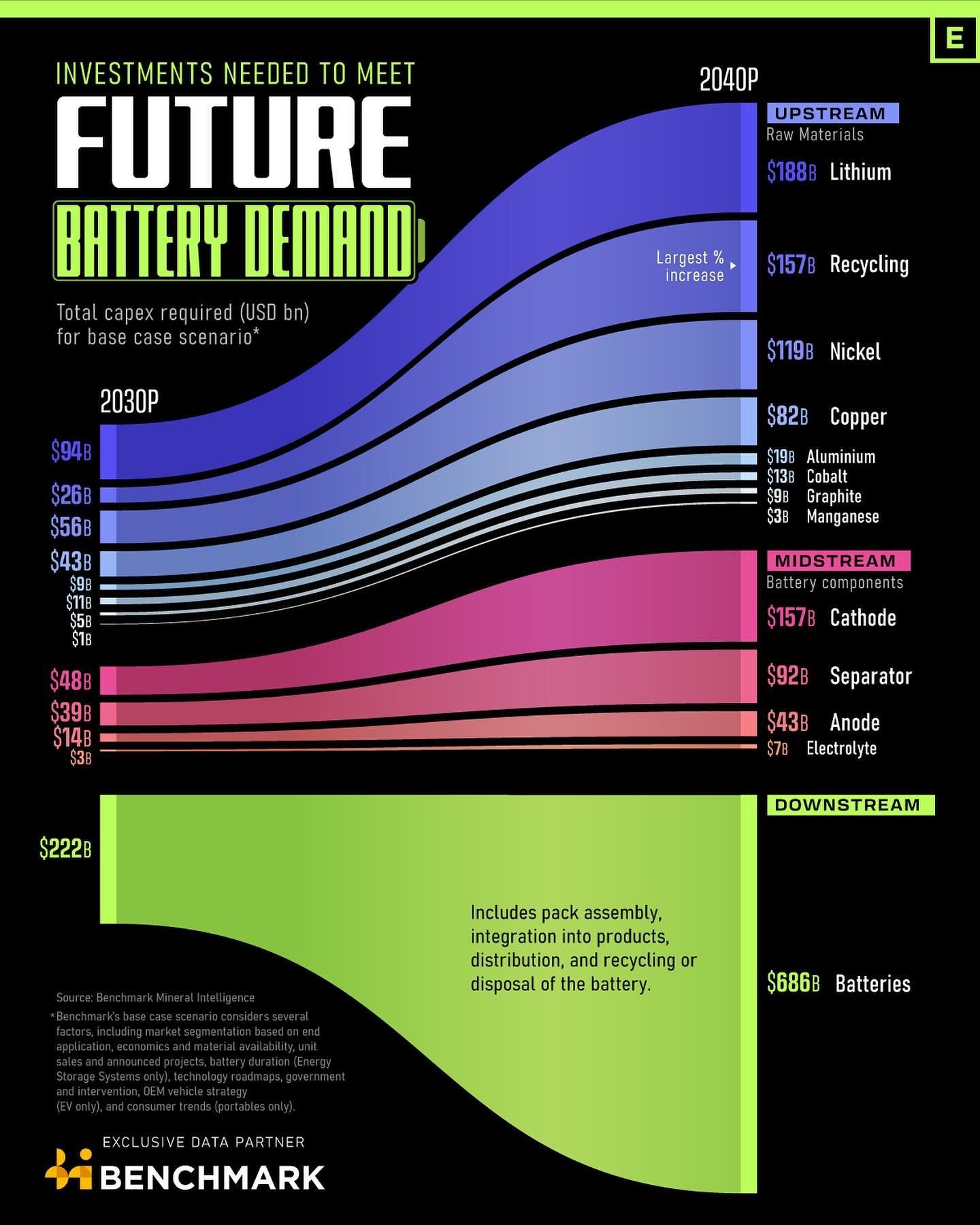
Battery Demand and Investment by 2040
The global demand for batteries is set to skyrocket, with projections indicating a ninefold increase by 2040. This surge is driven by the growing adoption of battery-powered devices, ranging from smartphones and electric vehicles (EVs) to energy storage systems. To meet this demand, significant investments are required across the entire supply chain, from raw materials to battery production and integration.
Why This Matters
The battery sector's growth is pivotal for the transition to clean energy and sustainable transportation. Understanding the investment landscape is crucial for stakeholders, including investors, policymakers, and industry players. The data provided by Benchmark offers a clear roadmap for navigating the complexities of the battery market.
The Investment Landscape
Upstream: Raw Materials
Upstream investments focus on securing and processing the raw materials essential for battery production. These materials include lithium, cobalt, aluminium, graphite, and manganese. According to the data, the investment required for raw materials by 2040 is substantial:
- Lithium: The most critical material, requiring an investment of $188 billion.
- Cobalt: Necessary for high-energy-density batteries, needing $19 billion.
- Aluminium, Graphite, and Manganese: Also crucial, with investments of $9 billion, $8 billion, and $9 billion, respectively.
Midstream: Battery Components
Midstream investments are directed towards manufacturing key battery components. These components include separators, anodes, and electrolytes, each playing a vital role in battery performance and safety. The required investments are:
- Separators: $92 billion
- Anodes: $43 billion
- Electrolytes: $7 billion
Downstream: Battery Production
Downstream investments involve the actual production of batteries, including pack assembly, integration into products, and sales. This stage is the most capital-intensive, with a projected investment of $686 billion by 2040. The data includes pack assembly, integration into products, sales, and announced projects, as well as battery data for Energy Storage Systems and technology roadmaps.
Key Materials and Their Importance
Lithium
Lithium is indispensable for modern battery technology, particularly in lithium-ion batteries. The high demand for lithium is due to its lightweight and high energy density, making it ideal for portable electronics and electric vehicles. The significant investment in lithium reflects its critical role in the battery ecosystem.
Cobalt
Cobalt is another key material, known for enhancing battery performance and stability. However, its supply is concentrated in a few countries, raising concerns about supply chain security and ethical sourcing. The investment in cobalt underscores the need for diversifying supply sources and developing cobalt-free alternatives.
Aluminium, Graphite, and Manganese
These materials are essential for various battery components, including anodes, cathodes, and electrolytes. Aluminium provides structural support, graphite enhances conductivity, and manganese improves safety and stability. The investments in these materials ensure a steady supply to meet future demand.
Practical Tips for Investors and Stakeholders
For investors and stakeholders looking to capitalize on the growing battery market, several practical tips can guide their decisions:
Diversify Your Portfolio
Given the varied investment requirements across raw materials, battery components, and production, a diversified portfolio can mitigate risks and maximize returns. Investing in different stages of the battery supply chain can provide a balanced approach to capitalizing on market growth.
Stay Informed About Technological Advancements
Technological innovations in battery technology, such as solid-state batteries and new anode materials, can significantly impact investment strategies. Keeping abreast of the latest developments and trends can help in making informed investment decisions.
Focus on Sustainability and Ethical Sourcing
With growing concerns about the environmental and social impacts of battery production, focusing on sustainable and ethical practices can provide a competitive edge. Investing in companies that prioritize sustainable practices and ethical sourcing can enhance long-term value and reputation.
Important Takeaways
- Investment Requirements: The investment needed to meet future battery demand by 2040 is substantial, with significant capital expenditures required for raw materials, battery components, and production.
- Key Materials: Lithium and cobalt are the most critical materials, requiring the largest investments, followed by aluminium, graphite, and manganese.
- Market Dynamics: The battery market is complex and dynamic, with investments required across the upstream, midstream, and downstream sectors. Understanding these dynamics is essential for stakeholders.
- Sustainability: The focus on sustainability and ethical sourcing will be crucial for the long-term success and reputation of companies in the battery sector.
Conclusion
The projected ninefold increase in battery demand by 2040 presents a significant opportunity for investors and stakeholders. To capitalize on this growth, it is essential to understand the investment landscape, focusing on raw materials, battery components, and production. By diversifying portfolios, staying informed about technological advancements, and prioritizing sustainability, stakeholders can navigate the complexities of the battery market effectively. The data from Benchmark provides a comprehensive roadmap for meeting future battery demand, ensuring a sustainable and prosperous future for the battery sector.
Watch the Reel
Questions readers ask
What is driving the projected ninefold increase in battery demand by 2040?
The primary drivers are the growing adoption of electric vehicles, the increasing use of smartphones, and the expansion of energy storage systems, which require reliable and efficient battery solutions.
What is the total investment required to meet the future battery demand?
To meet the projected battery demand by 2040, a total investment of $1.6 trillion is needed. This investment spans the entire battery supply chain, from raw materials to production and integration.
Which raw materials will be most in demand for future battery production?
Key raw materials that will be in high demand include lithium and cobalt, both of which are critical components in the production of lithium-ion batteries, the most common type used in electric vehicles and energy storage systems.
What role do energy storage systems play in future battery demand?
Energy storage systems are a crucial factor in the future battery demand. They are essential for stabilizing and integrating renewable energy sources into the grid, enabling better management of energy supply and demand.
Why is investment in the battery supply chain important?
Investment in the battery supply chain is vital for ensuring a stable and secure supply of batteries. This includes mining and processing raw materials, manufacturing, and integrating batteries into various applications, which are essential for sustainable transportation and energy storage.
How will the growth in electric vehicles impact the battery market?
The growth in electric vehicles will significantly impact the battery market. The increasing number of EVs on the road will drive the need for more efficient and powerful batteries, particularly lithium-ion batteries, which will require substantial investment in production and raw materials.
What are upstream battery materials and why are they important?
Upstream battery materials refer to the raw materials and components required at the beginning of the battery production process, such as lithium, cobalt, and nickel. These materials are crucial because they form the foundation of battery technology, and their availability and cost can significantly impact the overall battery market.
Related deep dives
Similar reads based on topic and creator.


Recent articles
Fresh deep dives from the latest Reels we unpacked.




Comments
Be the first to comment.