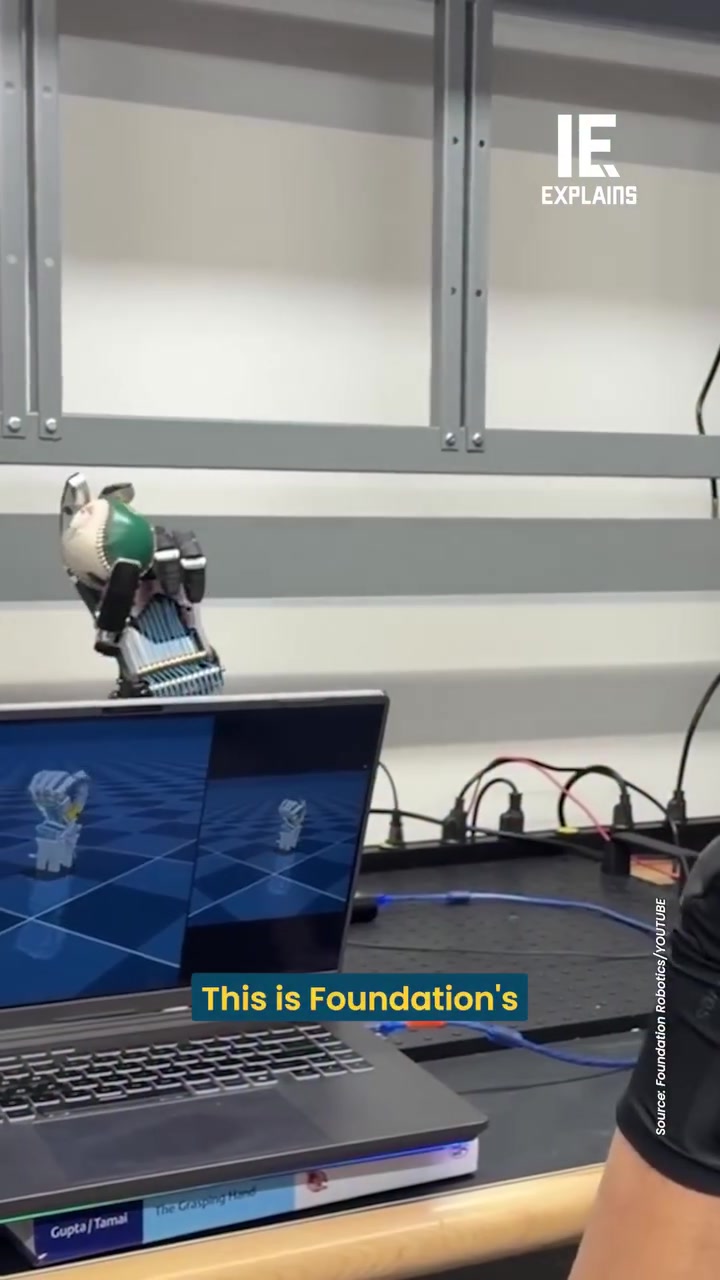
The latest innovation in robotics has landed in a robotic hand designed to mimic human tendon functioning. Foundation's new robotic hand successfully caught a baseball out of the air, showing off its speed, grip, and precision.
A Mimicry of Human Dexterity
Foundation's robotic hand is designed to replicate the complex movements of a human hand, down to the delicate interplay of tendons and joints. Think of the sophistication of a human hand: the way tendons pull the fingers open and closed, the nuances of gripping a small object versus holding a ball. The robotic hand mirrors this with motors positioned in the forearm. Tendons extend from the motors to each joint, mimicking the way a human hand operates. This robotic hand is notable for its agility. The fingers can splay sideways to form a cup around a ball, or pinch down to grasp smaller objects. The tendons pull the fingers into precise positions so rapidly that it’s possible to catch a fast-moving baseball without fumbling or bouncing it out. The hand's design, with motors situated in the forearm and tendons running to each joint, allows for nimble, controlled movements similar to a human hand. One of the standout features of this hand is its ability to track its own movements internally, without relying solely on sensors. A software algorithm calculates the angles and positions of the fingers based on the motors’ movements and the length of the tendons. Though magnetic sensors measure angles at each joint with precision, they serve only as a backup. This means the hand can act independently, without continuous external feedback, and perform movements with a high degree of confidence.
Imagining the Future of Robotic Precision
Foundation's hand represents a significant leap forward in industrial robotics. This hand could be used in situations that require high precision and quick movements. Because the hand moves with the precision of a human hand, it opens a new set of applications where delicate but rapid movements are required. Foundation’s robotic hand could revolutionize manufacturing and industrial tasks that require fine motor skills and operational speed.
The Fine-Tuned Anatomy of the Robotic Hand
Mimicking Human Tendons
In the world of robotics, precision is often achieved through complexity. Foundation's robotic hand, however, manages to simplify its operation while retaining the elegant complexity of human movements. Tendons extend from the motors in the forearm and pull the fingers into various positions. One set of tendons closes the fingers while the other opens them, duplicating the action of human tendons in your own hand. The motors powering these tendons are not located within the fingertips themselves. Typically, robotics thrive on avoiding the motor delay and weight that comes with embedding motors in fingertips. But Foundation’s robotic hand represents a streamlined and lightweight iteration. All the needed motors and tendons sit at the base of the forearm. This lets the hand mimic soft finger movements. The hand can curl around a ball or pinch small objects within its reach.
Sensing and Software
To know its own precise positions, the hand relies on a sophisticated internal system. So the hand doesn't just rely on sensors, instead it uses software to track the movements of its internal motors and tendons. The magnetic sensors at each joint providing backup angle measurements, ensure precision. This makes the hand operate without external input and maintains a high degree of autonomy.
Industrial Applications
The hand is expected to find a home in industrial robotics, specifically for Foundation's phantom humanoids. These humanoids are set to work on factory floors, where precision and speed are essential. The robotics' speed and accuracy can bring new standards to factory automation, where similar fine motor skills might not be easily achievable by traditional robotics.
Future Improvements
Despite these advancements, there are future improvements to be made. Currently, the hand does not react to tactile feedback. It cannot yet sense the texture or pressure of an object it is holding. The tactile feedback will come later. For instance, the current iteration cannot react to touch without advance planning. This limits the hand's dynamic capabilities. As tactile feedback is introduced, the hand will become more versatile and adaptable.
Wiring Your Own Robotic Hand
Interested in experimenting with robotic hands? Here are some key steps.
- Start with Basic Components: Begin with motors and tendons that can replicate the movements of a human hand.
- Program with Care: Focus on the software that can calculate the positions of fingers based on motor movements.
- Experiment with Sensors: While the Foundation hand minimizes reliance on sensors, you can start with basic sensors to measure angles and refine your design.
- Keep it Light: Ensure that motors are placed strategically to avoid excess weight, making the hand lighter and more agile.
- Test with Precision Tasks: Focus on tasks that require precision and speed to understand the hand's capabilities and areas for improvement.
Watch the Reel
Questions readers ask
How does Foundation's robotic hand mimic the movements of a human hand?
The robotic hand uses motors positioned in the forearm to control tendons that extend to each joint, mimicking the way human tendons operate. This allows the fingers to move with the same nuanced precision as a human hand, whether splaying to catch a ball or pinching to grasp small objects.
What makes this robotic hand capable of catching a fast-moving baseball?
The hand's design allows it to move with extreme agility and precision. The tendons pull the fingers into exact positions rapidly, enabling it to catch a fast-moving baseball without fumbling. This is achieved through the motors in the forearm and the tendons running to each joint, which mimic the delicate movements of a human hand.
Can this robotic hand operate independently without external sensors?
Yes, the robotic hand can track its own movements internally using a software algorithm that calculates the angles and positions of the fingers. Magnetic sensors at each joint serve only as a backup, allowing the hand to act confidently without the need for continuous external feedback.
What are the potential applications of this robotic hand in industry?
Foundation's hand could revolutionize tasks that require high precision and quick movements, such as delicate manufacturing processes. Its ability to mimic human dexterity opens up a range of industrial applications where fine motor skills and rapid operational speed are crucial.
How does the design of this robotic hand differ from other robotic hands?
Unlike other robotic hands that might have motors embedded in the fingertips, Foundation's design places all motors and tendons in the forearm. This makes the hand more lightweight and agile, allowing it to mimic soft, human-like movements more effectively.
What are the motors in Foundation’s hand actually doing?
The motors in the robotic hand are responsible for pulling the tendons that control the fingers. One set of tendons closes the fingers while the other opens them, replicating the actions of human tendons. This setup allows for precise and rapid movements, enabling the hand to perform complex tasks with high accuracy.
How does the robotic hand's software contribute to its precision?
The hand uses a software algorithm to calculate the angles and positions of the fingers based on the motors' movements and the length of the tendons. This internal tracking allows the hand to perform movements with a high degree of confidence, even without continuous external feedback from sensors.
Related deep dives
Similar reads based on topic and creator.
Recent articles
Fresh deep dives from the latest Reels we unpacked.



Comments
Be the first to comment.