Foreign Holders of U.S. Debt
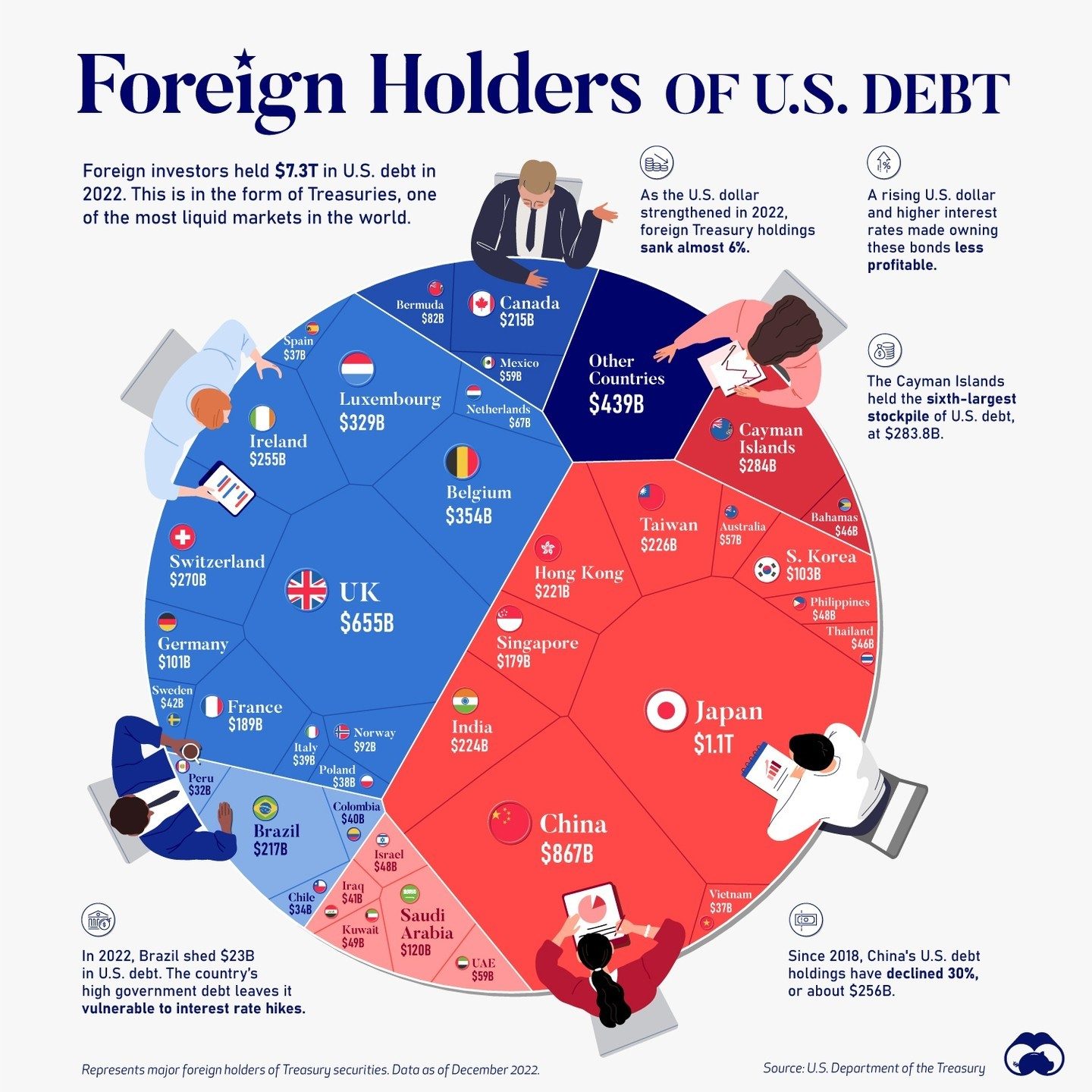
America holds a significant amount of national debt, with foreign investors owning a substantial portion. As of recent data, this amounts to $7.3 trillion in the form of Treasury securities. These securities are highly liquid, making them attractive to central banks for foreign exchange reserves and to private investors during times of economic uncertainty.
Context / Why this matters
Treasury securities are some of the most liquid assets globally. This liquidity makes them a preferred choice for central banks looking to manage their foreign exchange reserves. Additionally, private investors often turn to these securities during market volatility, attracted by their perceived low default risk. Understanding the distribution of these holdings among foreign countries provides insights into global financial dynamics and the U.S.'s economic relationships with other nations.
Main discussion
Overview of Foreign Holdings
Foreign investors held $1.31 trillion in U.S. debt in 2022. The distribution of these holdings varies significantly among different countries. China, for instance, holds the largest amount of U.S. debt among foreign countries, totaling $867 billion. Japan follows closely with $655 billion. Other notable holders include the United Kingdom, Ireland, and Brazil, each with substantial but lesser amounts.
Trends and Fluctuations
The foreign holdings of U.S. debt are subject to fluctuations influenced by various economic factors. In 2022, as the U.S. dollar strengthened, foreign Treasury holdings decreased by nearly 6%. This drop can be attributed to the rising U.S. dollar and higher interest rates, which made owning these bonds less profitable. Since 2018, China’s U.S. debt holdings have declined by 30%, or about $258 billion, reflecting shifting economic policies and strategic financial decisions.
Key Countries and Their Holdings
-
China: Holding $867 billion, China's position as the largest foreign holder of U.S. debt is significant. However, their holdings have been decreasing, down by 30% since 2018.
-
Japan: Japan holds $655 billion in U.S. debt, making it the second-largest foreign holder. Japan's holdings have remained relatively stable, highlighting its consistent investment strategy.
-
United Kingdom: The United Kingdom holds $284 billion, showcasing its continued confidence in U.S. Treasury securities as a reliable investment option.
-
Ireland: Ireland holds $221 billion, reflecting its stable economic relationship with the U.S. and its role as a significant financial hub.
-
Brazil: Brazil holds $215 billion, indicating its growing economic influence and strategic financial decisions.
Practical tips
Investing in U.S. Treasury securities can be a sound financial strategy for both central banks and private investors. Here are some practical tips for those considering this investment:
- Diversify Your Portfolio: Including U.S. Treasury securities in a diversified portfolio can provide stability and liquidity.
- Monitor Economic Indicators: Keep an eye on the U.S. dollar's strength and interest rate fluctuations, as these can impact the profitability of holding U.S. debt.
- Consider Economic Relationships: Understand the economic dynamics between the U.S. and other countries, as these can influence foreign holdings and market trends.
Important takeaways
- Foreign investors hold a significant amount of U.S. debt, totaling $7.3 trillion, primarily in the form of Treasury securities.
- The liquidity and perceived low default risk of these securities make them attractive to central banks and private investors.
- China and Japan are the largest foreign holders, with China's holdings declining by 30% since 2018.
- Economic factors such as the strength of the U.S. dollar and interest rates significantly impact foreign holdings of U.S. debt.
- Investing in U.S. Treasury securities can be a strategic move for those seeking liquidity and stability in their investment portfolios.
Conclusion
Understanding the distribution and trends of foreign holdings in U.S. debt provides valuable insights into the global financial landscape. As economic conditions and policies evolve, so do the strategies of foreign investors. The stability and liquidity of U.S. Treasury securities continue to make them a cornerstone of global investment portfolios, influencing economic relationships and financial strategies worldwide.
Watch the Reel
Questions readers ask
Who were the top foreign holders of U.S. debt in 2022?
In 2022, China and Japan were the largest foreign holders of U.S. debt. Together, they held a significant portion of the $1.31 trillion in U.S. debt owned by foreign investors.
Why do foreign investors hold U.S. Treasury securities?
Foreign investors, including central banks and private entities, hold U.S. Treasury securities due to their high liquidity and low default risk. These securities are attractive for managing foreign exchange reserves and for providing stability during economic uncertainty.
What is the significance of foreign holdings in U.S. debt?
Foreign holdings in U.S. debt reflect the global financial dynamics and the economic relationships between the U.S. and other nations. The distribution of these holdings can influence global markets and indicate confidence in the U.S. economy.
How do U.S. Treasury securities benefit foreign investors?
U.S. Treasury securities are highly liquid and are considered safe investments. They offer foreign investors a way to diversify their portfolios and manage risks, especially during periods of market volatility.
What role do central banks play in holding U.S. debt?
Central banks hold U.S. debt as part of their foreign exchange reserves. This helps stabilize their own currencies and provides a safe haven for their assets, given the perceived stability and liquidity of U.S. Treasury securities.
Recent articles
Fresh deep dives from the latest Reels we unpacked.




Comments
Be the first to comment.