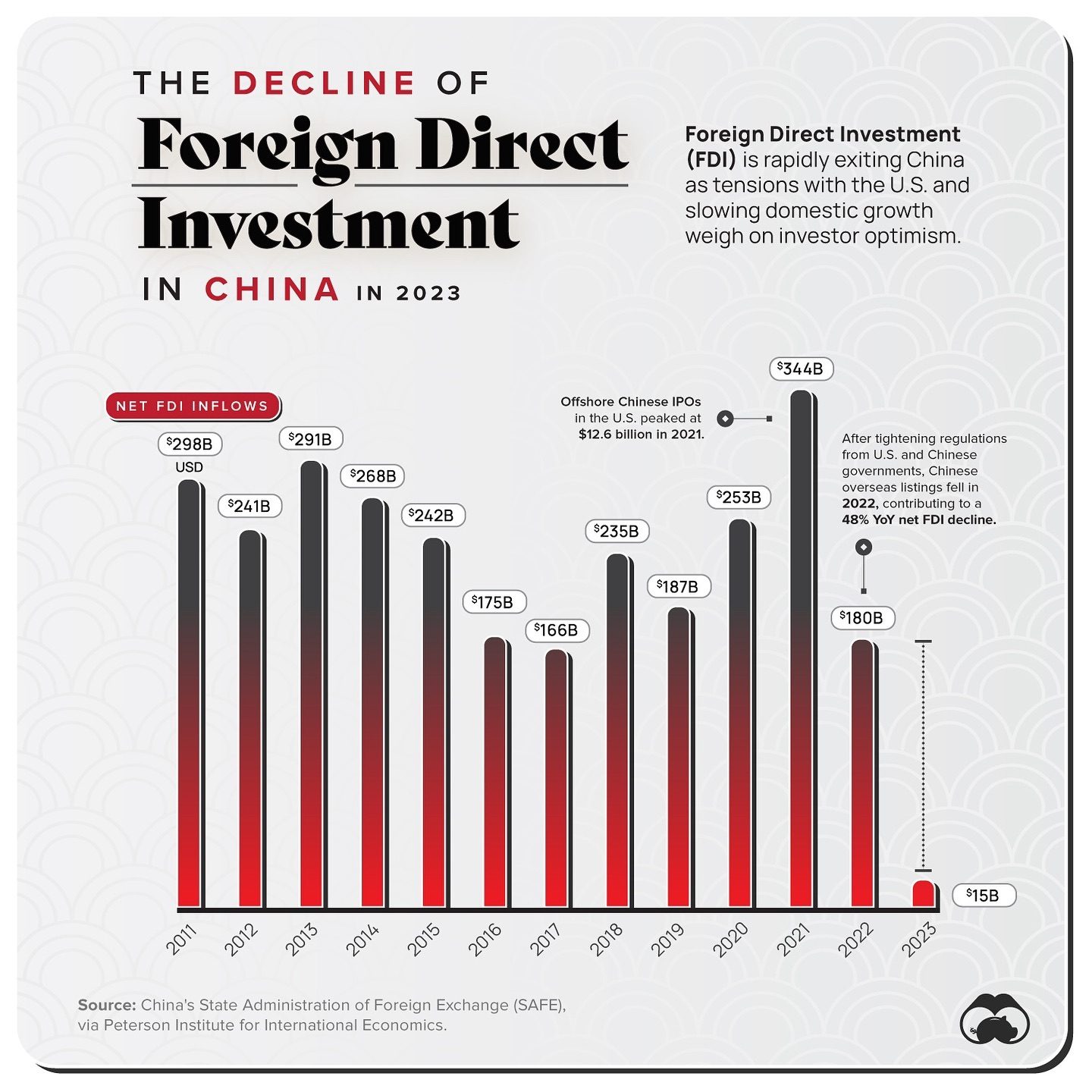
Foreign Direct Investment in China
Foreign direct investment (FDI) in China has been on a downward trajectory, with significant declines observed in recent years. This trend has raised concerns among investors and economists, who are closely monitoring the situation. The decline in FDI inflows is attributed to several factors, including geopolitical tensions and slowing domestic economic growth.
Context / Why this matters
Foreign direct investment is a critical component of China's economic growth. It provides much-needed capital, technology, and management expertise, which have been instrumental in driving the country's rapid industrialization and development. The recent decline in FDI inflows, therefore, has significant implications for China's future economic prospects.
Main discussion
The decline in FDI inflows
The data from China's State Administration of Foreign Exchange (SAFE), sourced via the Peterson Institute for International Economics, reveals a concerning trend. Net FDI inflows into China have been steadily decreasing since 2021, hitting a low of $15 billion in 2023. This represents a significant drop from the peak of $291 billion in 2011. The downward trend is evident in the annual figures, which show a consistent decline in FDI inflows over the past decade.
Factors contributing to the decline
Several factors have contributed to the decline in FDI inflows into China. One of the primary reasons is the increasing geopolitical tensions, particularly with the United States. Trade wars, tariffs, and other forms of economic sanctions have created an uncertain and volatile environment for foreign investors. This uncertainty has weighed heavily on investor optimism, leading to a reduction in investment inflows.
Another significant factor is the slowing domestic economic growth. China's economy, once a powerhouse of growth, has been experiencing a deceleration in recent years. The economic slowdown has been attributed to various factors, including market saturation, demographic changes, and structural reforms. This slowdown has made China a less attractive investment destination, as investors seek higher returns in other growing economies.
Additionally, offshore Chinese IPOs have played a role in the decline of FDI inflows. Many Chinese companies have chosen to list their shares on overseas stock exchanges, bypassing domestic markets and attracting foreign capital. This has resulted in a reduction in the amount of capital flowing into China through traditional FDI channels.
The impact of offshore Chinese IPOs
Offshore Chinese IPOs have become a popular alternative for Chinese companies seeking to raise capital. These IPOs allow companies to tap into global investor pools, diversify their shareholder base, and benefit from higher valuations. However, this trend has also contributed to the decline in FDI inflows, as a significant portion of the capital that would have been invested in China through traditional FDI channels is now being raised offshore.
The impact of offshore Chinese IPOs is evident in the decline of net FDI inflows, particularly from 2021 to 2023. During this period, the amount of capital raised through offshore IPOs increased significantly, contributing to the overall decline in FDI inflows. This trend highlights the changing dynamics of capital flows and the evolving investment landscape in China.
Practical tips
For foreign investors considering investments in China, it is essential to stay informed about the current economic and political climate. Here are some practical tips to navigate the complex investment landscape:
Stay informed
Keep up-to-date with the latest developments in China's economic and political landscape. This includes monitoring geopolitical tensions, understanding regulatory changes, and staying informed about macroeconomic indicators. Access to reliable and up-to-date information is crucial for making informed investment decisions.
Diversify your investments
Diversification is a key strategy for managing risk in any investment portfolio. In the context of China, this means not putting all your eggs in one basket. Consider investing in multiple sectors and regions to spread risk and mitigate potential losses.
Consider alternative investment channels
Given the decline in traditional FDI inflows, it may be worth exploring alternative investment channels. Offshore Chinese IPOs, for example, offer a way to gain exposure to the Chinese market while bypassing some of the challenges associated with traditional FDI.
Seek expert advice
Navigating the complex investment landscape in China can be challenging. It is essential to seek advice from experts who have a deep understanding of the market. This may include investment consultants, legal advisors, and financial analysts who specialize in China.
Important takeaways
The decline in FDI inflows into China presents both challenges and opportunities for foreign investors. Here are some important takeaways to consider:
- The downtrend in FDI inflows is driven by geopolitical tensions, slowing domestic growth, and the rise of offshore Chinese IPOs.
- The changing dynamics of capital flows require foreign investors to adapt their strategies and consider alternative investment channels.
- Staying informed, diversifying investments, and seeking expert advice are crucial for navigating the complex investment landscape in China.
Conclusion
The decline in FDI inflows into China is a complex and multifaceted issue, driven by a range of economic, political, and structural factors. While the trend is concerning, it also presents opportunities for foreign investors who are willing to adapt and innovate. By staying informed, diversifying investments, and seeking expert advice, investors can navigate the changing landscape and continue to benefit from the long-term growth potential of the Chinese market.
Watch the Reel
Questions readers ask
What are the primary reasons behind the decline in foreign direct investment in China?
The decline in FDI in China is primarily due to increasing geopolitical tensions and a slowdown in the country's domestic economic growth. These factors have made China a less attractive destination for foreign investors, leading to a significant decrease in investment inflows.
How has the trend in China's FDI inflows changed from 2011 to 2023?
China's FDI inflows have experienced a substantial decline over the past decade. The amount of FDI China received fell from $291 billion in 2011 to $15 billion in 2023. This trend reflects a significant shift in global investment patterns and investor sentiment towards China.
What role does foreign direct investment play in China's economy?
Foreign direct investment is a crucial driver of China's economic growth. It brings in capital, advanced technology, and management expertise, which are essential for sustaining the country's industrial development. The recent decline in FDI inflows could potentially slow down China's economic progress.
How do geopolitical tensions impact foreign direct investment in China?
Geopolitical tensions have created uncertainty and risk for foreign investors, making them cautious about investing in China. This has led to a decrease in FDI inflows, as investors are more likely to allocate their resources to countries with more stable political environments.
What are the implications of the FDI decline for China's future economic prospects?
The decline in FDI inflows could hinder China's economic growth by reducing the availability of external capital, technology, and expertise. This could potentially slow down industrial development and innovation, making it more challenging for China to maintain its economic momentum.
How does the current state of the Chinese economy affect foreign direct investment?
The slowing domestic economic growth in China has made the country less appealing to foreign investors. A slower-growing economy offers fewer opportunities for profitability and growth, leading investors to seek other markets with stronger economic prospects.
Related deep dives
Similar reads based on topic and creator.


Recent articles
Fresh deep dives from the latest Reels we unpacked.




Comments
Be the first to comment.