Mid-Year Interest Rate Forecasts Based on Recent Reports
Many financial institutions have adjusted their expectations for interest rate cuts this year, largely due to a robust labor market. The majority of these institutions now predict that the first rate cut will occur in September. This shift is reflected in mid-year interest rate forecasts, which are based on comprehensive reports from various financial institutions compiled by Nick Timiraos of the Wall Street Journal.
Why This Matters
Understanding the forecasts and expectations of major financial institutions is crucial for anyone involved in financial planning, investing, or economic analysis. Interest rate cuts can significantly impact borrowing costs, investment returns, and overall economic growth. Staying informed about these forecasts helps individuals and businesses make better decisions.
Mid-Year Interest Rate Forecasts
Overview of Forecasts
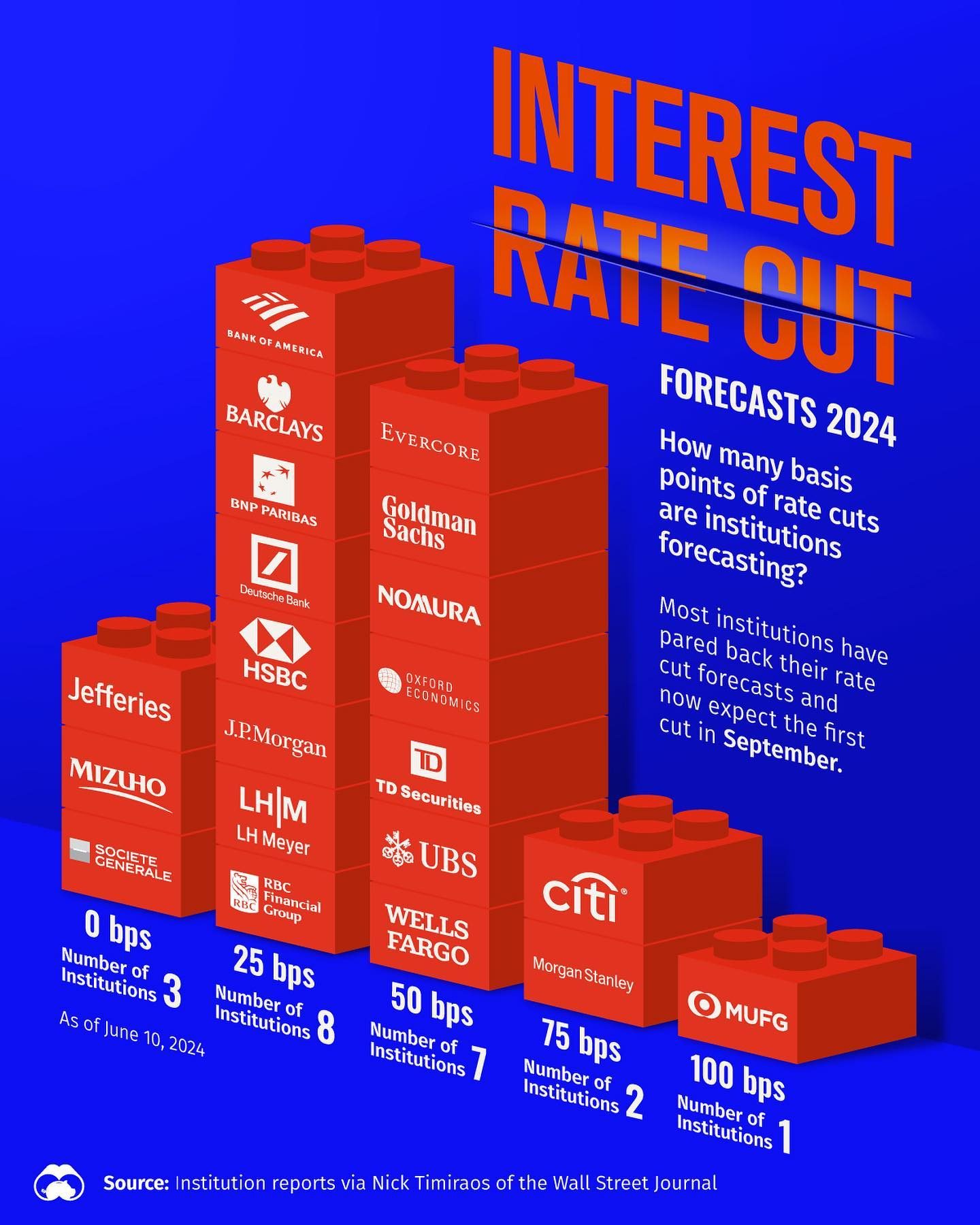
The forecasts for interest rate cuts vary among different institutions but generally show a trend of reduced expectations. The graphic displays the number of institutions forecasting different rate cut amounts, ranging from 0 basis points (bps) to 100 bps. Most notably, a significant number of institutions expect the first rate cut to occur in September, a shift from earlier projections.
Key Institutions and Their Predictions
Several prominent financial institutions have provided their forecasts, including:
- Goldman Sachs
- Bank of America
- RBC
- BNP Paribas
- Evercore
- Deutsche Bank
- Nomura
- Jefferies
- Oxford Economics
- HSBC
- TD Securities
- J.P. Morgan
- UBS
- Citi
- MUFG
- RBC Financial
These institutions have contributed to the overall consensus that rate cuts will be more conservative this year.
Basis Points and Rate Cuts
The forecasts are expressed in basis points (bps), where 1 bps equals 0.01%. The distribution of forecasts shows that:
- Three institutions expect no rate cut (0 bps)
- Eight institutions anticipate a 25 bps rate cut
- Seven institutions predict a 50 bps rate cut
- Two institutions foresee a 75 bps rate cut
- One institution projects a 100 bps rate cut
The concentration of forecasts around 25 bps and 50 bps indicates a cautious approach, reflecting the current economic conditions and labor market data.
Context and Source
The data used in these forecasts is sourced from institution reports compiled by Nick Timiraos of the Wall Street Journal. These reports provide a comprehensive view of the financial landscape and the factors influencing rate cut expectations. Timiraos' analysis is a reliable source for understanding the economic outlook and the decisions of major financial institutions.
Practical Tips
Staying Informed
Keeping up with the latest forecasts and economic indicators is essential for making informed financial decisions. Regularly reviewing reports from reputable sources like the Wall Street Journal and following the insights of financial experts can provide valuable insights.
Evaluating Forecasts
When evaluating rate cut forecasts, consider the following:
- Economic Indicators: Look at key economic data points such as employment rates, inflation, and GDP growth.
- Institutional Reputation: Pay attention to the forecasts from well-established institutions with a proven track record.
- Market Sentiment: Assess the overall sentiment in the financial markets, which can influence rate cut expectations.
Preparing for Rate Cuts
If rate cuts are anticipated, consider the following actions:
- Review Investment Portfolios: Adjust your investment strategy to account for potential changes in interest rates.
- Reassess Financing: If you are planning to take out a loan, reassess the terms and interest rates to see if it aligns with the expected rate cuts.
- Plan for Spending: Rate cuts can influence spending and saving behaviors, so plan accordingly to make the most of potential economic changes.
Important Takeaways
- Consensus on September Cut: Most institutions expect the first rate cut to occur in September.
- Cautious Forecasts: Rate cut expectations are generally conservative, with a focus on smaller cuts.
- Data-Driven Insights: Economic data, particularly strong labor market data, is influencing these forecasts.
- Reliable Sources: Reports from experts like Nick Timiraos of the Wall Street Journal provide valuable insights.
Conclusion
Mid-year interest rate forecasts provide a snapshot of the economic outlook and the anticipated actions of central banks. By understanding these forecasts, individuals and businesses can better navigate the financial landscape and make more informed decisions. Staying informed about the latest developments and expert analyses is crucial for preparing for potential rate cuts and adapting to changing economic conditions.
Watch the Reel
Questions readers ask
Why are financial institutions predicting a September rate cut?
Financial institutions are predicting a September rate cut due to a strong job market. The robust labor market has influenced many institutions to adjust their expectations for interest rate cuts this year, leading to a consensus around a September rate cut as the most likely time for the first cut in 2024.
How do mid-year interest rate forecasts impact financial planning?
Mid-year interest rate forecasts, such as those compiled by Nick Timiraos, provide insight into the expected direction of interest rates. This information is vital for financial planning as it helps individuals and businesses anticipate changes in borrowing costs, investment returns, and overall economic conditions. By staying informed about these forecasts, individuals can make strategic financial decisions.
What is the significance of the Wall Street Journal's rate cut forecasts?
The Wall Street Journal's rate cut forecasts, compiled by Nick Timiraos, are significant because they aggregate data from various financial institutions. This comprehensive approach provides a reliable indicator of market sentiment and expectations, helping investors and analysts make well-informed decisions. The forecasts offer a clear picture of the financial market's outlook for the remainder of the year.
How many basis points (bps) is the expected rate cut in September?
The exact number of basis points (bps) for the September rate cut can vary depending on the specific institution. However, most forecasts suggest a modest cut, typically around 25 bps. This information is crucial for financial planning as it directly impacts loan payments, savings yields, and investment strategies. It is essential to monitor updates from various financial institutions for the most accurate and up-to-date predictions.
Why is the first interest rate cut of 2024 important for economic analysis?
The first interest rate cut of 2024 is important for economic analysis because it signals a shift in monetary policy. This change can influence various economic indicators, such as inflation, unemployment, and GDP growth. By analyzing the timing and magnitude of the rate cut, economists can gain insights into the overall health of the economy and make more informed predictions about future developments.
What role do financial institutions play in predicting rate cuts?
Financial institutions play a crucial role in predicting rate cuts by conducting thorough analyses of economic data and market trends. Their predictions are based on comprehensive reports and models, which help shape the broader financial outlook. By following these predictions, investors and analysts can better understand the potential impact on economic growth, inflation, and financial markets.
What are the potential impacts of a September rate cut on the economy and financial markets?
A September rate cut can have several impacts on the economy and financial markets. It can lower borrowing costs, making loans more affordable for consumers and businesses. This can stimulate economic activity, boosting sectors like housing and consumer spending. Additionally, a rate cut can influence investment returns, with bonds and other fixed-income securities potentially becoming more attractive. Investors should stay informed about these potential impacts to adjust their strategies accordingly.
Recent articles
Fresh deep dives from the latest Reels we unpacked.




Comments
Be the first to comment.