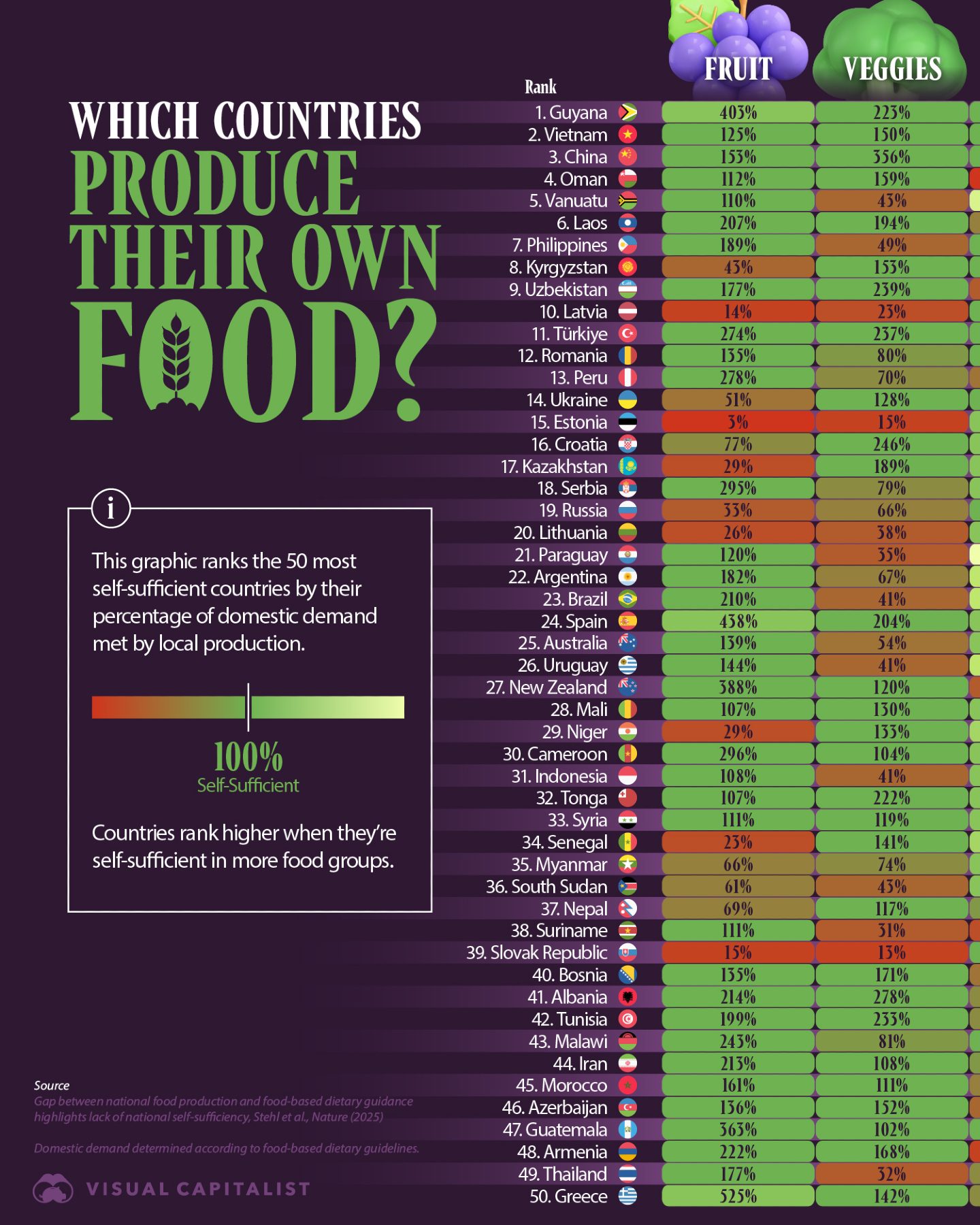
Food Self-Sufficiency Ranking
Food self-sufficiency isn't just a buzzword; it's a critical measure of a country's ability to feed its population without relying on imports. Guyana leads the pack in 2025, achieving 100% self-sufficiency across all seven essential food groups: fruit, vegetables, legumes, starchy staples, meat, fish, and dairy. This means Guyana can fully sustain its population's nutritional needs independently.
Why This Matters
Food self-sufficiency is more than a point of national pride; it's a matter of security and resilience. Countries that can produce their own food are better equipped to handle economic shocks, natural disasters, and geopolitical tensions. Additionally, self-sufficient nations often have stronger local economies, as agriculture supports a wide range of industries and jobs.
Main Discussion
Guyana's Unmatched Success
Guyana stands out with 100% self-sufficiency. This achievement is a testament to the country's robust agricultural policies, diverse climate, and fertile soil. Guyana's success in producing all essential food groups independently is unparalleled, making it a global leader in food security.
Top Performers and Regional Trends
Although Guyana is the sole country at 100%, other nations also excel in self-sufficiency. Vietnam, China, and Oman rank closely behind, reflecting strong agricultural sectors and strategic policies. Vietnam, for example, has made significant strides in rice production, while China's diverse climate allows for a wide range of crops, and Oman's strategic investments in agriculture have yielded impressive results.
European countries, on the other hand, face challenges, particularly with fruit and vegetable production. Climate, limited arable land, and high demand for imported produce contribute to these difficulties. Meanwhile, Asian countries often struggle with dairy. Climate, soil conditions, and the cost of feed for dairy animals can make dairy production less feasible in some regions.
The Role of Geography and Climate
Geography and climate play pivotal roles in a country's ability to achieve food self-sufficiency. Tropical and subtropical regions often have longer growing seasons and a broader range of crops that can be cultivated. In contrast, countries with harsher climates or limited arable land face significant hurdles.
Challenges and Opportunities
While Guyana leads the way, many countries still face significant challenges. Droughts, floods, and other climate-related issues can disrupt agricultural production. Moreover, the increasing global demand for certain crops can drive up prices, making it difficult for some nations to maintain self-sufficiency.
Policy and Investment
Effective policies and investments are crucial for enhancing food self-sufficiency. Countries that prioritize agricultural research, support farmers through subsidies and training, and invest in infrastructure like irrigation systems and storage facilities are more likely to achieve self-sufficiency. For instance, Peru's focus on potatoes and quinoa, and Ukraine’s emphasis on wheat and corn, highlight the benefits of strategic agricultural planning.
Practical Tips
For Governments
Invest in Agricultural Research: Prioritize research and development to create more resilient crop varieties and sustainable farming practices.
Support Small-Scale Farmers: Provide subsidies, training, and access to modern farming technologies to boost productivity.
Improve Infrastructure: Invest in irrigation systems, storage facilities, and transportation networks to reduce post-harvest losses.
For Individuals
Grow Your Own Food: Even small-scale gardening can contribute to self-sufficiency at the community level.
Support Local Farmers: Buy locally produced food to support the local agricultural economy.
Promote Sustainable Practices: Encourage and practice sustainable farming methods to ensure long-term food security.
Important Takeaways
- Guyana is the only country achieving 100% self-sufficiency across all seven essential food groups.
- Regional differences in climate and geography significantly impact a country's ability to produce food.
- Effective policies and investments in agriculture are crucial for enhancing food self-sufficiency.
- Self-sufficiency is essential for national security, economic stability, and resilience.
Conclusion
Food self-sufficiency is a complex issue that involves geography, climate, policy, and investment. Guyana's achievement highlights the possibilities, while the struggles of other regions underscore the challenges. Understanding these dynamics can help countries develop strategies to enhance their food production capabilities, ensuring a more secure and sustainable future for their populations.
Watch the Reel
Questions readers ask
What does it mean for a country to achieve 100% food self-sufficiency?
A country achieves 100% food self-sufficiency when it can produce all the food necessary to meet the nutritional needs of its population independently, without relying on imports. This includes all seven essential food groups: fruit, vegetables, legumes, starchy staples, meat, fish, and dairy.
Why is Guyana's achievement in 2025 significant?
Guyana's achievement is significant because it is the first country to reach 100% food self-sufficiency across all essential food groups. This milestone demonstrates Guyana's ability to feed its people independently and enhances the nation's resilience against economic shocks, natural disasters and geopolitical tensions.
Which other countries show strong food self-sufficiency besides Guyana?
Other countries that show strong food self-sufficiency include Vietnam, China, and Oman. These countries have made significant strides in producing a large portion of their own food, though they may not have reached 100% self-sufficiency across all food groups.
What challenges do some regions face in achieving food self-sufficiency?
Europe and parts of Asia face specific challenges in achieving food self-sufficiency. These challenges can include limited arable land, climatic conditions that restrict certain crop varieties, and economic factors that influence local food production. These regions may rely on imports to meet their nutritional needs, particularly for certain food groups like fish or legumes.
What are the benefits of food self-sufficiency for a nation?
Food self-sufficiency provides a nation with food security and resilience. It ensures that the population has access to essential nutrients, even when faced with economic instability, natural disasters, or geopolitical tensions. Additionally, self-sufficient nations often have stronger economies due to reduced reliance on imports and increased local production.
What are the seven essential food groups for assessing food self-sufficiency?
The seven essential food groups for assessing food self-sufficiency are fruit, vegetables, legumes, starchy staples, meat, fish, and dairy. These groups cover the necessary nutrients required for a balanced diet, ensuring that a nation can meet the dietary needs of its population independently.
How does food self-sufficiency impact a country's ability to handle crises?
Food self-sufficiency enhances a country's ability to handle crises by ensuring a steady and local supply of food. This reduces reliance on imports, which can be disrupted during economic shocks or natural disasters. Additionally, having a robust local food production system can help maintain social stability and public health during challenging times.
Related deep dives
Similar reads based on topic and creator.

Recent articles
Fresh deep dives from the latest Reels we unpacked.




Comments
Be the first to comment.