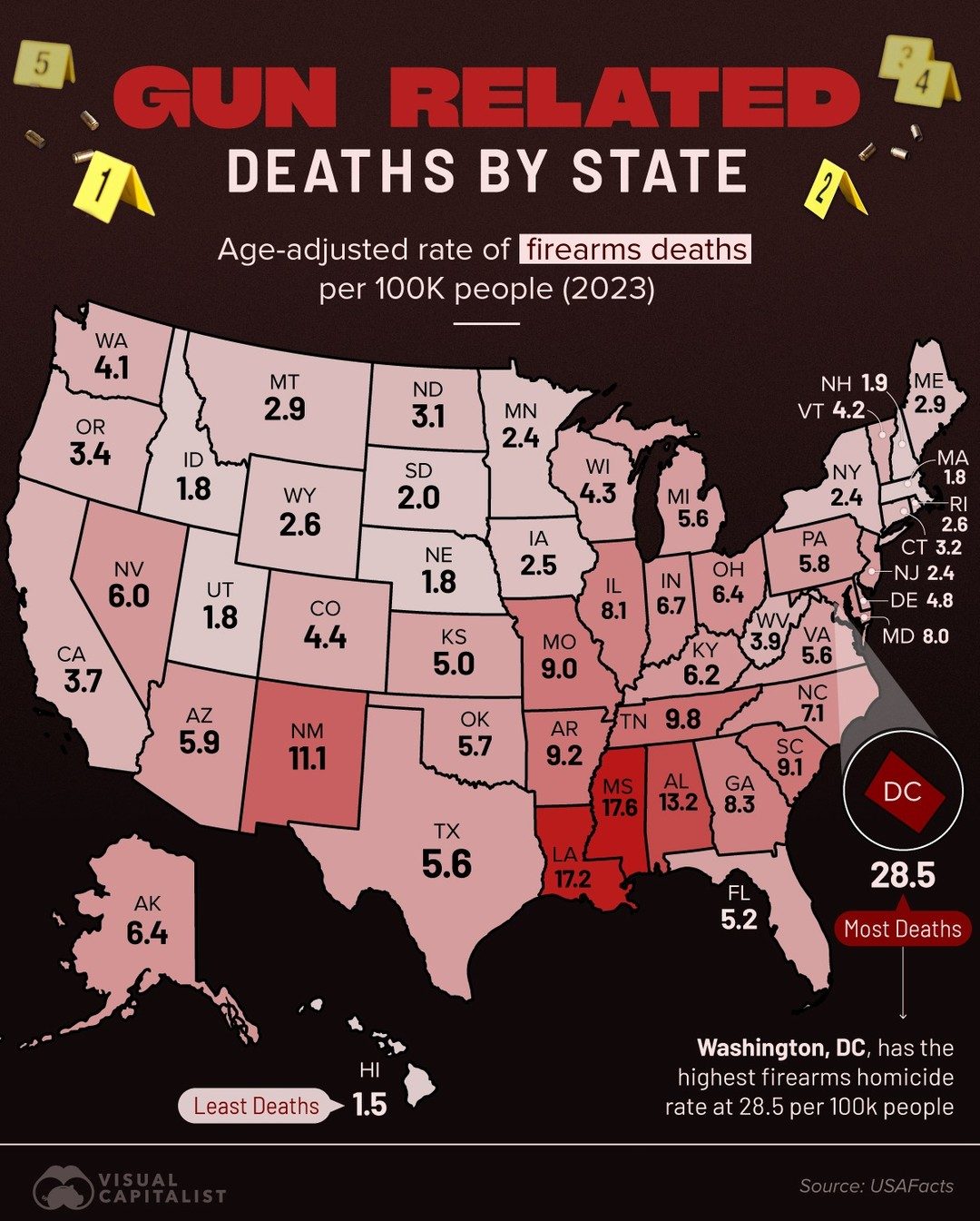
Firearm Deaths by State
The rate of firearm deaths varies significantly across the United States, with Washington, D.C. holding the highest rate at 28.5 per 100,000 residents. This stark contrast is evident when compared to states like Hawaii and New Hampshire, which have the lowest rates. Understanding these disparities is crucial for grasping the broader context of gun violence in the country.
Why This Matters
Gun violence is a complex issue that affects communities across the United States in different ways. By examining the rate of firearm deaths by state, we can identify patterns and trends that may inform policy, resource allocation, and public health initiatives. This data, provided by USAFacts, offers a clear picture of where the most significant challenges lie and where interventions might be most effective.
Main Discussion
Highest and Lowest Rates
States like Mississippi, Alabama, Louisiana, and New Mexico report some of the highest rates of firearm deaths. Mississippi, in particular, has a rate of 17.6 per 100,000 people, making it one of the most affected states. On the other hand, states like Montana, Utah, and Hawaii have the lowest rates, with Montana and Utah both reporting 1.8 per 100,000 people. These disparities highlight the need for tailored approaches to address gun violence in different regions.
Regional Trends
The data reveals several regional trends. For instance, the Northeast generally has lower firearm death rates compared to the South and parts of the Midwest. States like Washington, Illinois, and Indiana show moderate to high rates, indicating that urban and suburban areas may face unique challenges related to gun violence. The South, particularly the Deep South, has consistently high rates, suggesting a need for targeted interventions in these regions.
Urban vs. Rural
The urban-rural divide is another critical factor to consider. Washington, D.C., an urban area, has the highest rate of firearm deaths, suggesting that densely populated areas may face specific challenges related to gun violence. Conversely, rural states like Montana and Utah have some of the lowest rates, indicating that different strategies may be needed to address gun violence in these areas.
Age-Adjusted Rates
The age-adjusted rate of firearm deaths is a key metric in understanding the impact of gun violence across different demographics. By adjusting for age, we can better compare the rates across states, accounting for variations in population age structures. This adjustment helps in identifying areas where firearm deaths are more prevalent among younger populations, which is crucial for targeted interventions.
Comparisons and Contrasts
Examining the data side by side shows how vastly different regions can be in terms of firearm deaths. For example, California has a rate of 3.7 per 100,000 people, while neighboring Nevada has a rate of 6.0. This comparison underscores the importance of local factors, such as gun laws, access to mental health services, and community support systems, in shaping the landscape of gun violence.
Practical Tips
Understanding Local Data
When examining firearm death rates, it's essential to look at local data. While national trends provide a broad overview, local data can offer more specific insights into the unique challenges faced by different communities. This information can be invaluable for policymakers and public health officials seeking to implement effective interventions.
Community Involvement
Community involvement is crucial in addressing gun violence. Engaging local residents, community leaders, and stakeholders can help identify the root causes of gun violence and develop targeted solutions. This collaborative approach ensures that interventions are tailored to the specific needs and contexts of different communities.
Policy Recommendations
Policies aimed at reducing firearm deaths should be based on data-driven insights. For instance, states with high firearm death rates may benefit from stricter gun laws, while those with lower rates may focus on mental health support and community programs. Tailored policies can help address the unique challenges faced by different regions.
Public Health Approaches
Addressing gun violence as a public health issue can lead to more comprehensive and effective solutions. This approach involves looking at the broader social determinants of health, such as access to healthcare, education, and economic opportunities. By addressing these underlying factors, communities can work towards reducing firearm deaths.
Important Takeaways
Regional Disparities
The data highlights significant regional disparities in firearm death rates. Understanding these variations is crucial for developing targeted interventions and policies. By recognizing the unique challenges faced by different regions, we can work towards more effective solutions.
Data-Driven Approaches
Using data-driven approaches to address gun violence is essential. By analyzing trends and patterns, policymakers and public health officials can develop evidence-based strategies to reduce firearm deaths. This data-driven approach ensures that interventions are tailored to the specific needs of different communities.
Community Engagement
Community engagement plays a vital role in addressing gun violence. Engaging local residents and stakeholders can help identify the root causes of gun violence and develop targeted solutions. This collaborative approach ensures that interventions are effective and sustainable.
Conclusion
The rate of firearm deaths by state varies significantly, with Washington, D.C., having the highest rate at 28.5 per 100,000 residents. States like Hawaii and New Hampshire, on the other hand, have the lowest rates. This data, provided by USAFacts, offers valuable insights into the broader context of gun violence in the United States. By understanding these disparities, we can develop more effective strategies to address the unique challenges faced by different communities. Through data-driven approaches, community engagement, and tailored interventions, we can work towards reducing firearm deaths across the country.
Watch the Reel
Questions readers ask
Why does Washington, D.C. have the highest firearm death rate in the U.S.?
Washington, D.C.'s high firearm death rate can be attributed to several factors, including its high population density, socio-economic disparities, and unique legal and regulatory environment. The district's compact size and urban setting may also contribute to these rates.
Which states have the lowest firearm death rates and what makes them different?
Hawaii and New Hampshire have the lowest firearm death rates in the U.S. Hawaii's low rate may be due to its strict gun laws and island geography, while New Hampshire's low rate could be linked to its rural environment and unique cultural factors.
How do firearm death rates vary by state?
Firearm death rates vary significantly by state, with rates ranging from a high of 28.5 per 100,000 residents in Washington, D.C. to a low of 1.6 per 100,000 residents in Hawaii. These variations highlight the diverse experiences of gun violence across the country.
How can understanding state-level firearm death rates help in addressing gun violence?
Examining state-level firearm death rates can reveal patterns and trends that inform policy decisions, resource allocation, and public health initiatives. This data helps identify areas most affected by gun violence and can guide targeted interventions.
What are the age-adjusted gun death rates, and why are they important?
Age-adjusted gun death rates account for differences in population age structures, providing a more accurate comparison between states. These rates are important because they allow for a better understanding of the true impact of gun violence across different regions.
How can policy decisions be informed by state-level gun death data?
State-level gun death data can inform policy decisions by identifying areas with the highest rates of gun violence, highlighting the need for targeted interventions. By understanding the specific challenges faced by different states, policymakers can create more effective and tailored solutions to address gun violence.
Related deep dives
Similar reads based on topic and creator.


Recent articles
Fresh deep dives from the latest Reels we unpacked.




Comments
Be the first to comment.