Financial Crime Data Visualization
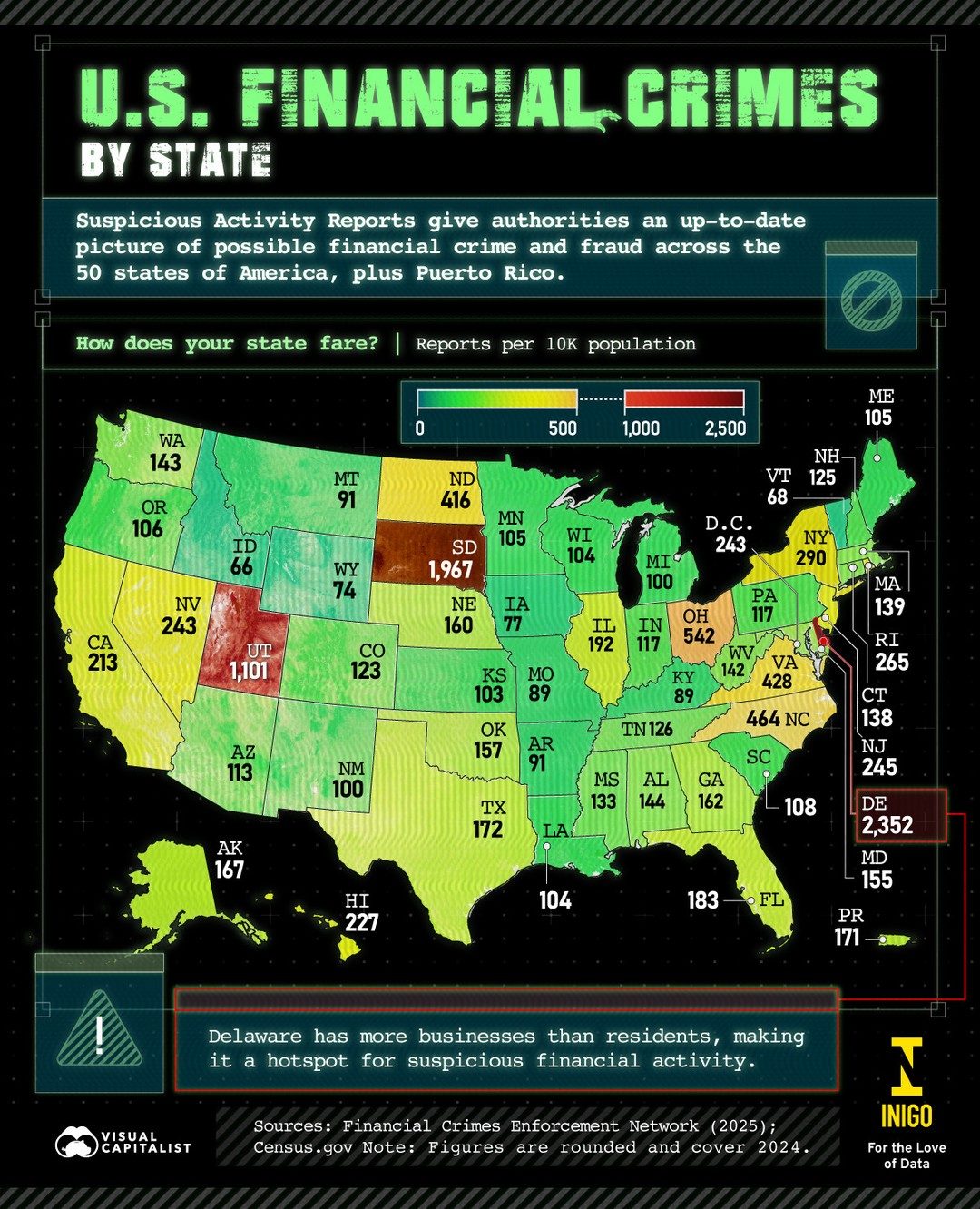
Understanding the distribution of financial crimes across the United States is crucial for risk management and fraud prevention. The Financial Crimes Enforcement Network (FinCEN) compiles Suspicious Activity Reports (SARs), which provide an up-to-date snapshot of potential financial crimes and fraud across the 50 states and Puerto Rico. This data visualization helps identify areas with higher incidences of suspicious financial activity, offering valuable insights for authorities and businesses alike.
Context / Why This Matters
Financial crimes, including fraud, money laundering, and other illicit activities, pose significant risks to both individuals and institutions. By analyzing SARs, authorities can identify patterns and hotspots, enabling more effective deployment of resources to combat these crimes. This data is particularly relevant for states with high business-to-resident ratios, such as Delaware, which often see a higher volume of suspicious financial activity due to its favorable corporate laws and large number of registered businesses.
Main Discussion
Suspicious Activity Reports
SARs are a critical tool for monitoring financial crimes. These reports are filed by financial institutions when they detect suspicious activities that may indicate money laundering, fraud, or other financial crimes. Authorities use this data to track trends, identify high-risk areas, and take targeted actions to mitigate these threats.
Mapping Financial Crimes by State
The data visualization maps SARs per 10,000 residents, providing a clear picture of where financial crimes are most concentrated. This approach normalizes the data, accounting for differences in population sizes across states. For instance, while a state with a large population might have a high number of SARs, the rate per capita could be relatively low. States with higher rates of suspicious activity often have specific characteristics that make them attractive for certain types of financial crimes.
High-Risk States
Delaware stands out as a hotspot for suspicious financial activity. The state's business-friendly environment, which includes favorable corporate laws and a large number of registered businesses, contributes to a higher volume of SARs. Delaware has more businesses than residents, making it a prime target for activities such as money laundering and fraud.
Other states with notable SAR rates include:
-
California: As one of the most populous states, California naturally has a high number of SARs. Its diverse economy and extensive financial sector contribute to a high volume of financial transactions, increasing the likelihood of detecting suspicious activities.
-
Texas: With a large and growing economy, Texas sees a significant amount of financial activity. The state's business-friendly environment and diverse industries make it a hotspot for both legitimate and illicit financial activities.
Key Insights from the Data
The data visualization offers several key insights:
-
Geographic Patterns: Certain geographic regions, such as the Northeast and urban centers, tend to have higher rates of suspicious financial activity. This is often due to the concentration of financial institutions and businesses in these areas.
-
Business Environment: States with favorable business environments, such as Delaware, attract a higher number of companies, which can lead to increased financial activity and, consequently, more SARs.
-
Economic Factors: Economic conditions, such as high unemployment or economic downturns, can also influence the rate of financial crimes, as individuals and businesses may turn to illicit activities to cope with financial strain.
Practical Tips
For financial institutions and businesses, understanding these trends can help in developing more effective risk management strategies. Here are some practical tips:
-
Enhance Due Diligence: Conduct thorough due diligence on new clients and business partners, especially in high-risk areas. This includes verifying identities, checking for any red flags, and understanding the nature of the business.
-
Implement Robust Monitoring Systems: Use advanced monitoring systems to detect and flag suspicious activities in real-time. This can include transaction monitoring, customer behavior analysis, and compliance with regulations such as the Bank Secrecy Act.
-
Train Staff: Provide regular training to staff on identifying and reporting suspicious activities. Employees should be aware of common red flags and understand the importance of timely reporting.
-
Collaborate with Authorities: Work closely with law enforcement and regulatory authorities to share information and stay updated on emerging threats. Collaboration can help in developing more effective strategies to combat financial crimes.
-
Adopt Best Practices: Implement best practices for risk management, including internal controls, audits, and compliance programs. Regularly review and update these practices to address new risks and challenges.
Important Takeaways
-
Hotspots Identification: Delaware, California, and Texas are identified as hotspots for suspicious financial activity, highlighting the need for enhanced vigilance in these areas.
-
Risk Management: Understanding the geographic and economic factors that contribute to financial crimes can help in developing more targeted and effective risk management strategies.
-
Data-Driven Insights: Leveraging data visualizations and SARs can provide valuable insights into the distribution and patterns of financial crimes, enabling better-informed decision-making.
-
Collaborative Efforts: Collaboration between financial institutions, businesses, and authorities is crucial for effectively combating financial crimes and protecting the integrity of the financial system.
Conclusion
The analysis of SARs and financial crime data is vital for identifying trends, patterns, and hotspots across the United States. By understanding these insights, authorities and businesses can develop more effective strategies to combat financial crimes and protect the integrity of the financial system. Whether it's through enhanced due diligence, robust monitoring systems, or collaboration with authorities, taking a proactive approach to risk management is essential in today's complex financial landscape.
Watch the Reel
Questions readers ask
Which states are considered financial crime hotspots in the U.S.?
Certain states with high business-to-resident ratios, such as Delaware, are often considered financial crime hotspots. These states tend to have favorable corporate laws that can attract a large number of businesses, which in turn increases the potential for suspicious financial activity and fraud. Other states to watch include Nevada, Wyoming, and Florida.
What is the Delaware financial crime rate compared to other states?
Delaware tends to have a higher rate of financial crimes due to its favorable corporate laws and high business-to-resident ratio. This makes it a hotspot for activities like money laundering and fraud. However, the specific rates can fluctuate and are best assessed through the latest Suspicious Activity Reports (SARs) from the Financial Crimes Enforcement Network (FinCEN).
How do financial crime enforcement agencies use SARs to identify financial crime hotspots?
Financial crime enforcement agencies, such as FinCEN, use Suspicious Activity Reports (SARs) to identify trends and patterns in financial crimes across the U.S. By analyzing SARs, these agencies can pinpoint specific areas with high incidences of suspicious financial activity, allowing them to allocate resources more effectively and take targeted actions against fraud and money laundering.
What do state financial crime reports reveal about financial crime by state?
State financial crime reports provide detailed information on the types and frequencies of financial crimes occurring in each state. They help in understanding the geographic distribution of fraudulent activities, identifying hotspots, and offering a comparative analysis of financial crime trends across different states. These reports are crucial for local authorities and businesses to implement targeted prevention and mitigation strategies.
What is the significance of the US financial crime map?
The US financial crime map is a visual tool that highlights areas with higher incidences of financial crimes. It provides a clear overview of hotspots, enabling both authorities and businesses to understand the geographic concentration of fraudulent activities. This visualization helps in making informed decisions and implementing effective risk management strategies.
How does a high business-to-resident ratio contribute to financial crime hotspots?
A high business-to-resident ratio can lead to an increase in financial crimes due to the high number of corporate entities being set up, which can be exploited for illicit activities. States like Delaware attract a large number of businesses, making it easier for perpetrators to conduct fraud and money laundering under the guise of legitimate business activities. This increases the overall risk of financial crimes in these regions.
Recent articles
Fresh deep dives from the latest Reels we unpacked.




Comments
Be the first to comment.