Fentanyl Seizures at U.S. Borders
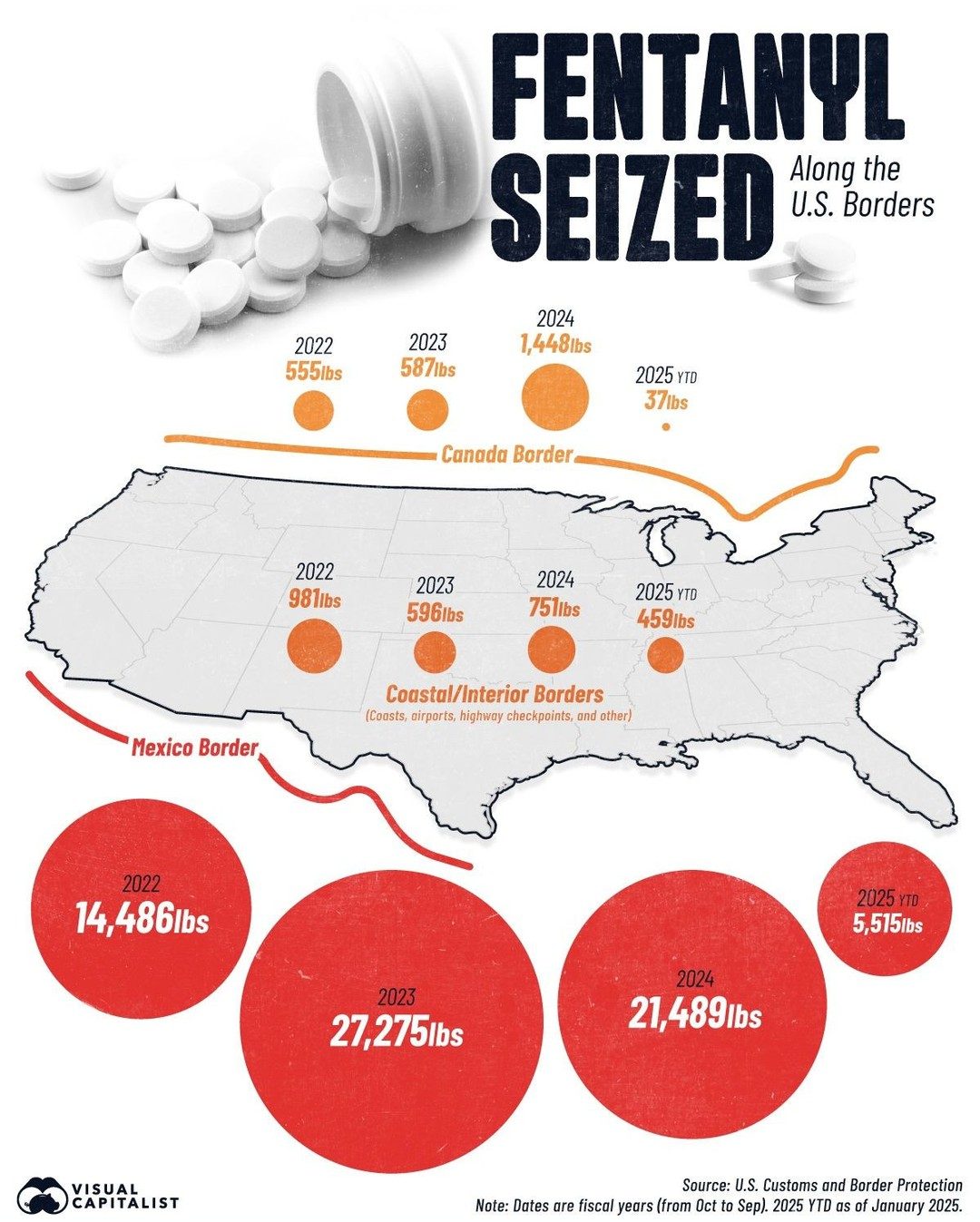
Fentanyl seizures at the U.S. borders have become a critical issue, particularly since 2022. The data reveals that over 90% of all seized fentanyl during this period has come from the U.S.-Mexico border. This trend highlights the significance of border control and the ongoing efforts to manage the flow of illicit substances into the country.
Context / Why This Matters
The opioid epidemic continues to be a significant public health crisis in the United States. Fentanyl, a powerful synthetic opioid, is a major contributor to this epidemic due to its potency and the ease with which it can be smuggled across borders. Understanding the patterns of fentanyl seizures is crucial for law enforcement agencies, healthcare providers, and policymakers to develop effective strategies to combat this issue.
Main Discussion
Seizure Trends and Statistics
Previous Years
The data indicates that fentanyl seizures have been at historically high levels, although they have decreased slightly from their peak in 2023. In 2023, the total amount of fentanyl seized was 27,275lbs. This figure dropped to 21,489lbs in 2024, showing a decrease but still remaining alarmingly high. The year-to-date (YTD) seizure for 2025 as of January 2025 stands at 5,515lbs, indicating a fluctuating trend but still a significant concern.
Coastal/Interior Borders
The Coastal/Interior borders, which include coastal areas, airports, highway checkpoints, and other entry points, have seen varying amounts of fentanyl seizures. In 2022, 1,448lbs were seized, which increased to 459lbs in 2023 and 751lbs in the following year. These numbers show a fluctuating trend, reflecting the dynamic nature of smuggling operations and the challenges faced by law enforcement.
Canada Border
The Canada border has seen relatively lower seizure amounts compared to the Mexico border. In 2022, 587lbs were seized, and this figure increased to 981lbs in 2023. The YTD seizure for 2025 stands at 37lbs, indicating a lower volume of fentanyl trafficking through this border compared to other areas. However, the amounts are still concerning and highlight the need for continued vigilance.
Mexico Border
The Mexico border consistently sees the highest volume of fentanyl seizures. In 2022, 14,486lbs were seized, and this figure rose to 21,489lbs in 2023 and 1,448lbs in 2025. These numbers underscore the critical role of the Mexico border in the fentanyl smuggling network and the need for enhanced security measures in this region.
Key Locations and Methods
Coastal/Interior Borders
Coastal/Interior borders, including airports, highways, and coastal areas, are significant points of entry for fentanyl. The fluctuating seizure amounts in these areas suggest that smugglers are adapting their methods to avoid detection. Law enforcement agencies must stay vigilant and employ advanced techniques to intercept fentanyl shipments.
Canada Border
The Canada border, while seeing lower seizure amounts compared to the Mexico border, is still a critical point of entry. The numbers indicate that fentanyl is being smuggled through this border, albeit in smaller quantities. Enhanced surveillance and collaboration with Canadian authorities are essential to mitigate this threat.
Mexico Border
The Mexico border remains the primary route for fentanyl smuggling into the U.S. The high seizure amounts underscore the need for robust border security measures, including increased patrols, advanced surveillance technologies, and international cooperation to disrupt fentanyl trafficking networks.
Practical Tips
For law enforcement agencies, understanding the trends and patterns of fentanyl seizures is crucial for developing effective strategies. Here are some practical tips:
Enhance Surveillance and Technology
- Implement advanced surveillance technologies, such as drones and sensor networks, to monitor high-risk areas along the borders.
- Utilize data analytics to identify patterns and predict potential smuggling routes.
- Collaborate with international partners to share intelligence and coordinate efforts to disrupt fentanyl trafficking networks.
Strengthen Border Security
- Increase the number of patrols and checkpoints along high-risk borders, particularly the Mexico border.
- Enhance training for border patrol agents to recognize and intercept fentanyl shipments.
- Develop strategies to address the dynamic nature of smuggling operations and adapt to new methods used by traffickers.
Public Awareness and Education
- Raise awareness about the dangers of fentanyl and the signs of opioid addiction.
- Educate the public on how to recognize and report suspicious activities that may indicate fentanyl trafficking.
- Collaborate with healthcare providers to develop treatment programs and support services for individuals affected by fentanyl addiction.
Important Takeaways
- Border Security: The U.S.-Mexico border remains the primary point of entry for fentanyl, underscoring the need for enhanced security measures.
- Surveillance and Technology: Advanced surveillance technologies and data analytics are essential for intercepting fentanyl shipments and predicting smuggling routes.
- Collaboration: International cooperation and collaboration with law enforcement agencies are crucial for disrupting fentanyl trafficking networks.
- Public Awareness: Raising awareness about the dangers of fentanyl and educating the public on recognizing and reporting suspicious activities can help combat this issue.
Conclusion
Fentanyl seizures at U.S. borders, particularly the U.S.-Mexico border, remain a significant concern. The data highlights the need for robust border security measures, enhanced surveillance, and international cooperation to address this issue effectively. By understanding the trends and patterns of fentanyl seizures, law enforcement agencies, healthcare providers, and policymakers can develop targeted strategies to combat the opioid epidemic and protect public health.
Watch the Reel
Questions readers ask
Why has the U.S.-Mexico border become a hotspot for fentanyl seizures in 2022 and after?
The U.S.-Mexico border has become a hotspot due to its geographical location and the rise in the production and trafficking of fentanyl from Mexico to the U.S. The data shows that 90% of fentanyl seized at the U.S. border comes from this area.
What makes fentanyl a significant concern for U.S. border security?
Fentanyl is a potent synthetic opioid, making it a significant concern for border security. Its potency and ease of smuggling across borders contribute to a surge in its seizures. Additionally, it's a major driver of the opioid crisis in the United States.
How do fentanyl seizures compare between the U.S.-Mexico border and other U.S. borders?
The U.S.-Mexico border accounts for over 90% of fentanyl seizures at U.S. borders. Fentanyl seizures at other borders, such as coastal and Canadian borders, are significantly lower in comparison.
What are the implications of fentanyl seizures at the U.S. border?
The implications of fentanyl seizures at the U.S. border are vast. They highlight the need for robust border control, underscore the complexities of managing the influx of illicit substances, and signify the ongoing challenge for law enforcement and healthcare providers.
What trends have emerged in fentanyl seizures at the U.S. border since 2022?
One notable trend is the significant increase in fentanyl seizures, with over 90% coming from the U.S.-Mexico border. This trend has persisted, indicating a consistent and substantial flow of fentanyl into the United States from Mexico.
Why is it important to track fentanyl seizures by year?
Tracking fentanyl seizures by year allows authorities to monitor trends, identify patterns, and make informed decisions. This data helps in developing effective strategies to combat the opioid crisis and improve border security measures.
What role do law enforcement agencies play in managing fentanyl seizures at the border?
Law enforcement agencies play a crucial role in managing fentanyl seizures. They are responsible for intercepting and seizing fentanyl shipments, gathering intelligence, and collaborating with international partners to disrupt trafficking networks. Their efforts are essential in curbing the flow of fentanyl into the U.S.
Recent articles
Fresh deep dives from the latest Reels we unpacked.




Comments
Be the first to comment.