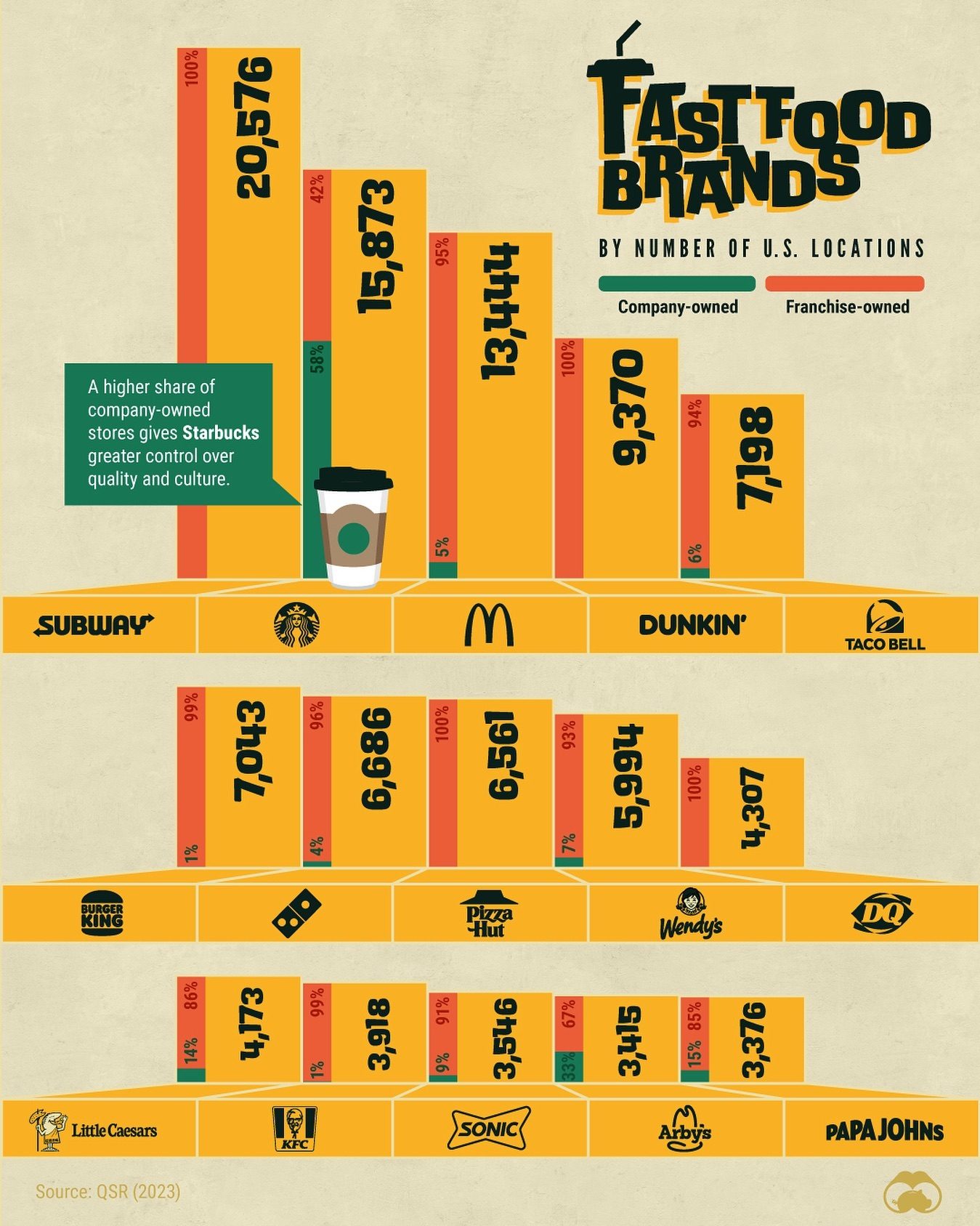
Fast Food Brand Ownership
The fast food industry in the United States is a titan, with a rich history dating back to the early 20th century. The first White Castle store opened in Wichita, Kansas, and today, nearly 200,000 fast food brands collectively form an industry valued at over $300 billion. This landscape is dominated by a handful of major players, each with a unique ownership structure that influences their operational strategies and market presence. Understanding the ownership dynamics of these brands—whether they are company-owned or franchise-owned—provides insight into how they maintain consistency, control quality, and expand their reach.
Context: Why This Matters
The ownership structure of fast food brands significantly impacts their business model, customer experience, and overall success. Company-owned stores offer greater control over quality, brand consistency, and operational standards. In contrast, franchise-owned stores often provide faster expansion and local market adaptation but may come with challenges in maintaining brand integrity. Examining the ownership breakdown of top fast food brands in the U.S. helps shed light on the strategies these giants employ to dominate the market.
Ownership Structures of Top Fast Food Brands
Starbucks and McDonald's: The Power Duo
Starbucks boasts a higher percentage of company-owned stores, which allows it to maintain stringent quality and cultural standards across locations. This approach ensures that every cup of coffee and every sandwich meets the brand's high expectations, regardless of the location. McDonald's, another dominant player, also has a high proportion of company-owned stores. This strategy helps McDonald's sustain consistency in service, menu offerings, and overall customer experience.
Subway: A Balanced Approach
Subway stands out for its balanced approach, with a significant portion of its stores being franchise-owned. This model enables Subway to expand rapidly and adapt to local preferences. However, maintaining quality control across franchised locations can be challenging. Subway's franchise model allows for flexibility in menu items and pricing, catering to diverse consumer preferences.
Taco Bell and Burger King: Franchise Dominance
Taco Bell and Burger King are notable for their high percentage of franchise-owned locations. This strategy facilitates rapid expansion and local market penetration. Both brands leverage their franchise model to adapt to regional tastes and preferences, making them more accessible and relevant to a broader audience.
Franchise vs. Company-Owned: Pros and Cons
Company-Owned Stores
Advantages:
- Consistency: Direct oversight ensures uniform quality, service, and brand experience.
- Operational Control: Centralized management allows for seamless implementation of new policies, menu changes, and marketing campaigns.
- Quality Control: Direct control over ingredients, preparation methods, and employee training.
Disadvantages:
- Scalability: Slower expansion due to the need for central investment and management.
- Local Adaptation: Less flexibility in adapting to local market preferences and trends.
Franchise-Owned Stores
Advantages:
- Rapid Expansion: Franchisees invest in and manage their own locations, allowing for quicker market penetration.
- Local Adaptation: Franchisees can tailor offerings to meet local tastes and preferences, enhancing market relevance.
- Shared Risk: Franchisees bear the financial risk and operational burden, reducing the parent company's liability.
Disadvantages:
- Quality Control: Maintaining consistent quality and brand standards can be challenging.
- Operational Variability: Inconsistencies in service, menu offerings, and operational practices can arise.
Practical Tips for Fast Food Enthusiasts
What to Look For
When visiting a fast food chain, keep an eye out for signs that reflect the ownership structure. Company-owned locations often have a more uniform look and feel, while franchise-owned stores might have slight variations in decor or menu items. This can give you an idea of how the brand balances consistency and local adaptation.
Quality vs. Variety
If you value consistency and predictability, company-owned stores might be your go-to. However, if you enjoy discovering unique local twists on your favorite fast food items, franchise-owned stores could offer a more exciting dining experience.
Exploring the Variety
Get adventurous and try different locations of the same chain to experience the range of offerings. For example, Subway's franchise model means you might find local specials or unique menu items that aren't available at other locations, enhancing your dining experience.
Important Takeaways
The Importance of Ownership Structure
The ownership structure of fast food brands significantly influences their operational strategies, market reach, and customer experience. Franchise models offer rapid expansion and local adaptation, while company-owned models ensure uniformity and quality control.
Navigating the Landscape
Understanding the ownership dynamics of popular fast food brands can enhance your dining experience. Whether you prefer the reliability of company-owned locations or the excitement of franchise variations, being informed can help you make the most of your fast food adventures.
Conclusion
The fast food industry's ownership structures play a crucial role in shaping the dining landscape in the U.S. From Starbucks' and McDonald's emphasis on company-owned stores to Subway's balanced approach and Taco Bell's and Burger King's franchise dominance, each brand employs a unique strategy to maintain quality, expand, and adapt to diverse markets. As a consumer, recognizing these differences can add a new layer of enjoyment to your fast food experiences, whether you're looking for consistency or local flair.
Watch the Reel
Questions readers ask
What are the main differences between company-owned and franchise-owned fast food stores?
Company-owned stores are directly managed by the parent company, allowing for strict control over brand standards and operations. In contrast, franchise-owned locations are operated by independent owners who pay a fee to use the brand's name and systems, often leading to more local adaptability and faster growth.
How do franchise-owned fast food locations benefit the parent company?
Franchise-owned locations enable rapid expansion with less capital investment from the parent company. They also allow for local market adaptation, as franchisees can tailor their offerings to suit regional preferences. Additionally, franchises generate revenue through royalties and fees.
Which major fast food brands primarily use the franchise model?
Many top fast food brands use a franchise model. For example, McDonald's, Burger King, and Subway have a large number of franchise-owned locations. These brands balance company-owned stores with franchisees to maintain control while fostering rapid growth.
What are the benefits of owning a franchise in the fast food industry?
Owning a franchise in the fast food industry offers established brand recognition, proven business systems, and ongoing support from the parent company. Franchisees also benefit from economies of scale in purchasing and marketing. However, they must adhere to strict operating guidelines and pay ongoing fees.
How does a company's ownership structure impact its expansion strategy?
A company's ownership structure greatly influences its expansion strategy. Franchise models facilitate quicker growth by leveraging local entrepreneurs, while company-owned stores allow for more direct control. Some brands, like Starbucks, use a mix of both to balance these factors.
What role do company-owned stores play in a brand's overall strategy?
Company-owned stores serve as a benchmark for quality and operational excellence. They help maintain consistency across the brand, test new concepts, and provide training grounds for franchisees. These stores are often located in high-traffic or strategic areas to maximize brand visibility and impact.
Which fast food brands are fully or primarily company-owned?
Brands like Chick-fil-A and Panera Bread are primarily company-owned. This structure allows these brands to maintain a high level of control over their operations, including quality, service, and brand consistency. However, even these brands may have some franchised locations.
Related deep dives
Similar reads based on topic and creator.


Recent articles
Fresh deep dives from the latest Reels we unpacked.




Comments
Be the first to comment.