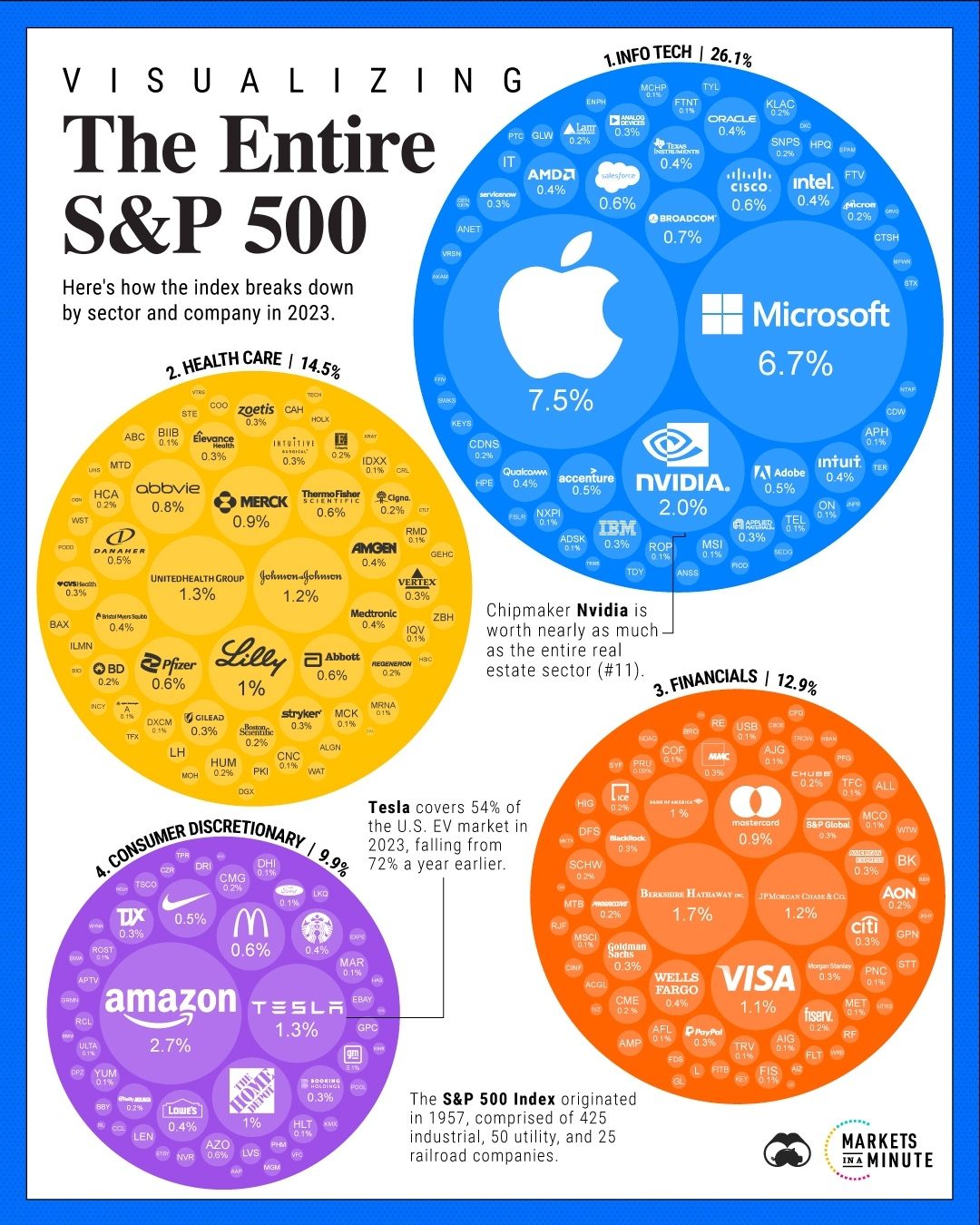
S&P 500 Index Breakdown
The S&P 500 index is a crucial metric in the U.S. stock market, encompassing the 500 largest publicly traded companies. These companies collectively hold $7.1 trillion in assets, making up nearly 80% of the total market capitalization on U.S. stock exchanges. The index serves as a benchmark for the overall health of the U.S. stock market and is often used as an indicator of economic health.
Context / Why This Matters
Understanding the S&P 500 index is essential for investors, economists, and anyone interested in the financial markets. The index provides a snapshot of the performance of the U.S. economy, reflecting the collective sentiment of investors and the overall health of various sectors.
Main Discussion
The Composition of the S&P 500
The S&P 500 index is divided into several sectors, each contributing differently to the overall market capitalization. These sectors include:
- Information Technology (26.1%): This sector is the largest component of the S&P 500, highlighting the significant role of tech companies in the U.S. economy. Key players include Microsoft (6.7%), Nvidia (0.5%), Intel (0.6%), Broadcom (0.7%), Cisco (0.4%), and IBM (2.0%).
- Health Care (14.5%)
- Financials (12.9%)
- Consumer Discretionary (11.4%)
- Industrials (8.6%)
- Communication Services (8.2%)
- Consumer Staples (7.4%)
- Energy (7.1%)
- Utilities (2.9%)
The dominance of Information Technology
The Information Technology sector's prominent position in the S&P 500 is noteworthy. Companies like Microsoft and Nvidia have significant market capitalizations, contributing substantially to the sector's overall value. Nvidia, in particular, is emphasized as a major player, with its market capitalization being nearly equal to that of the entire real estate sector, highlighting the tech sector's outsized influence.
Sector Performance and Market Dynamics
Each sector within the S&P 500 experiences fluctuations based on various economic factors. The performance of the tech sector, for instance, can be influenced by innovation, consumer demand, and regulatory changes. Similarly, healthcare companies may see shifts based on advancements in medical technology, public health trends, and healthcare policy changes.
The Role of Key Companies
Key companies within each sector play a pivotal role in shaping market trends. For example, in the tech sector, Microsoft and Nvidia are major contributors. In healthcare, companies like Johnson & Johnson and Pfizer hold significant market capitalizations.
Practical Tips
Investing in the S&P 500
For investors, the S&P 500 offers a diversified investment opportunity. By investing in an S&P 500 index fund, investors can gain exposure to a broad range of companies across various sectors, reducing the risk associated with individual stocks. This strategy can help mitigate market volatility and provide a more stable return on investment.
Monitoring Sector Performance
Keeping an eye on sector performance is crucial for making informed investment decisions. By tracking the performance of different sectors, investors can identify trends and opportunities. For instance, if the tech sector is performing well, it might be a good time to invest in tech stocks. Conversely, if the energy sector is struggling, it might be wise to reallocate investments to more stable sectors.
Diversifying Your Portfolio
Diversification is key to managing risk in the stock market. Investing in a mix of sectors can help protect your portfolio from market downturns. For example, during times of economic uncertainty, sectors like healthcare and consumer staples may perform better than tech or energy.
Important Takeaways
- Market Influence: The S&P 500 index is a key indicator of the U.S. economy, encompassing the largest and most influential companies.
- Sector Dominance: The tech sector plays a significant role in the S&P 500, with companies like Microsoft and Nvidia leading the way.
- Investment Strategies: Diversifying your portfolio and monitoring sector performance are essential for managing risk and maximizing returns.
Conclusion
The S&P 500 index provides a comprehensive view of the U.S. stock market, reflecting the performance of the largest and most influential companies. With the tech sector playing a dominant role, understanding the makeup and dynamics of the S&P 500 is crucial for investors and economists alike. By staying informed about sector performance and diversifying your portfolio, you can make more informed investment decisions and navigate the complexities of the stock market.
Watch the Reel
Questions readers ask
What are the main sectors represented in the S&P 500?
The S&P 500 is divided into various sectors, with the top ones being Information Technology, Healthcare, and Financials. The Information Technology sector is the largest, making up 26.1% of the index, followed by Healthcare and Financials. Other notable sectors include Consumer Discretionary, Industrials, and Communication Services.
How does the S&P 500 reflect the overall health of the U.S. economy?
The S&P 500 serves as a key economic indicator because it represents nearly 80% of the total market capitalization of the U.S. stock market. Its performance reflects the collective sentiment of investors and the overall health of various sectors, providing a snapshot of the U.S. economy as a whole.
Which companies are considered the largest in the S&P 500?
The S&P 500 includes the 500 largest publicly traded companies in the U.S. The largest companies, in terms of market capitalization, are typically major tech firms, financial institutions, and healthcare giants. These companies hold significant influence over the index's performance and are often considered bellwethers for the broader market.
Why is the Information Technology sector significant in the S&P 500?
The Information Technology sector is the largest sector in the S&P 500, accounting for 26.1% of the index. This dominance is due to the presence of major tech companies with substantial market capitalizations. These firms, such as Apple, Microsoft, and Alphabet, significantly influence the overall performance of the index and the broader market.
What are some of the top-performing sectors in the S&P 500 besides Information Technology?
Besides Information Technology, the Healthcare and Financials sectors are among the top-performing sectors in the S&P 500. The Healthcare sector includes major companies in pharmaceuticals, biotechnology, and medical devices, while the Financials sector comprises leading banks, insurance companies, and investment firms. Both sectors play a crucial role in the overall performance of the index.
How can investors benefit from understanding the S&P 500 sector breakdown?
Understanding the S&P 500 sector breakdown allows investors to identify trends and opportunities within specific industries. By analyzing the performance of different sectors, investors can make informed decisions about where to allocate their capital, helping them build a well-diversified portfolio that aligns with their investment goals and risk tolerance.
Which S&P 500 companies are typically considered the best investments?
The best S&P 500 companies for investment are often those with strong fundamentals, consistent growth, and a solid track record. Examples include companies like Apple, Microsoft, and Johnson & Johnson, which are known for their innovative products, robust financial performance, and resilience during market downturns. However, what constitutes the best investment can vary based on individual investment strategies and market conditions.
Recent articles
Fresh deep dives from the latest Reels we unpacked.




Comments
Be the first to comment.