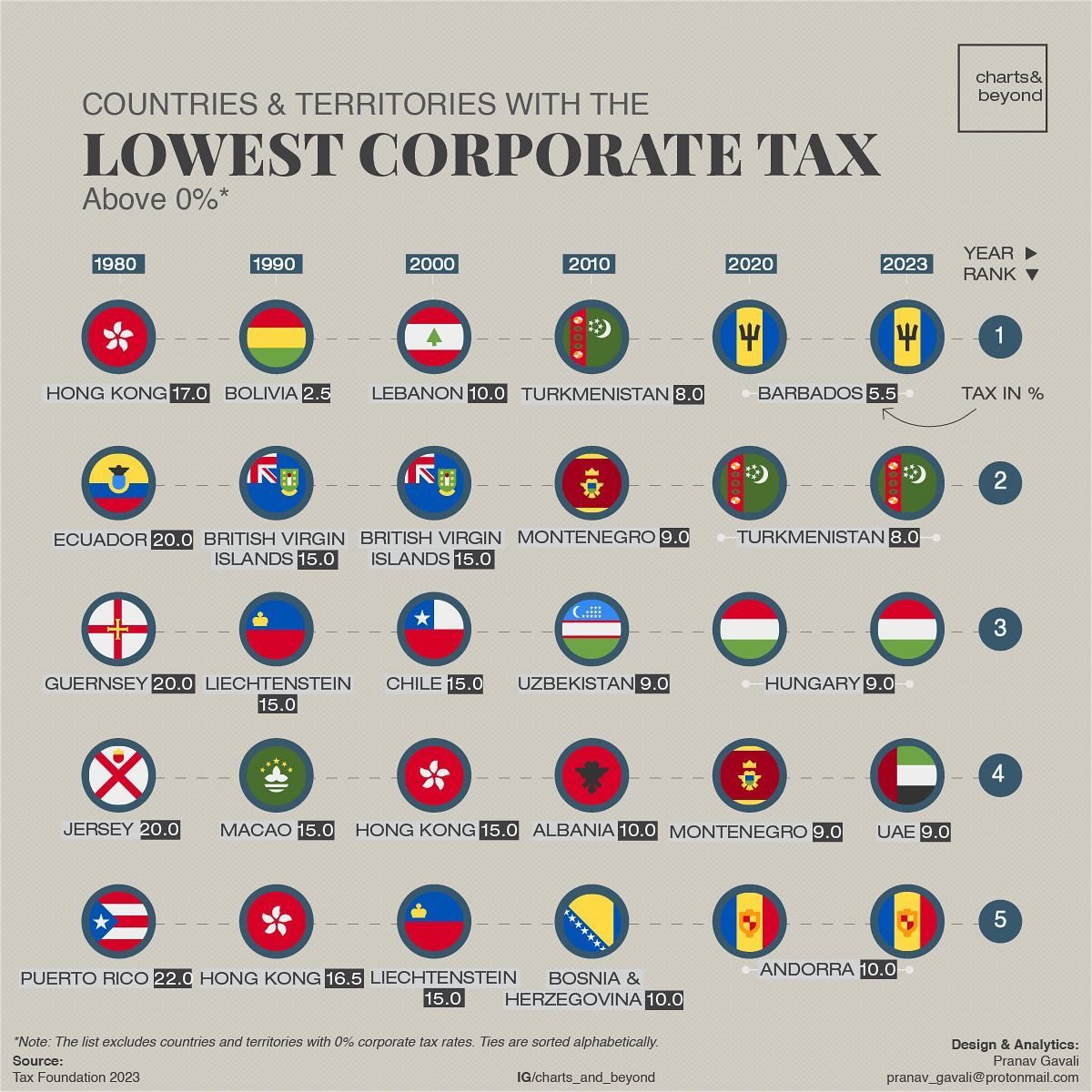
Corporate tax rates have evolved significantly over the past four decades, reflecting changes in economic policies and global competition for foreign investment. This journey is marked by countries continually lowering their corporate tax rates to attract businesses, leading to some remarkably low rates by 2023.
Why this matters
The race to the bottom in corporate tax rates is not just about numbers; it has profound implications for public services and economic policies. Understanding the trends in corporate tax rates helps in comprehending the broader economic landscape and the strategies countries employ to remain competitive.
The evolution of corporate tax rates
Early years: 1980
The decade of the 1980s saw Hong Kong leading the charge with the lowest corporate tax rate of 17.0%. This relatively low rate was a significant draw for businesses looking to operate in a tax-friendly environment. Hong Kong's strategic location, alongside its low corporate tax rate, made it a lucrative destination for foreign investment. By attracting businesses, Hong Kong was able to stimulate economic growth and boost its financial sector.
The 1990s: A decade of diversity
The 1990s introduced a variety of countries with notably low corporate tax rates. Bolivia took the lead with an astonishing 2.5% rate, making it one of the most attractive destinations for businesses. Lebanon also stood out with a 10.0% rate, positioning itself as a competitive option in the Middle East. Turkmenistan and Ecuador, with rates of 8.0% and 20.0% respectively, further diversified the list, showing that low tax rates were not just a feature of specific regions but a global trend.
The 2000s: A shift towards even lower rates
The 2000s saw a continuation of the trend towards lower corporate tax rates. British Virgin Islands and Montenegro emerged with rates of 15.0% and 9.0% respectively. This period also saw Guernsey and Liechtenstein joining the list with 15.0% and 10.0% rates, further solidifying the trend of tax-friendly environments. Chile and Uzbekistan also marked their presence with 15.0% and 9.0% rates, proving that the trend was not just limited to small island nations but was a global phenomenon.
The 2010s: More countries join the race
By the 2010s, the trend of low corporate tax rates had spread even further. The British Virgin Islands managed to reduce their rate to 5.0%, making it one of the most attractive destinations for businesses. Albania, Montenegro, and Puerto Rico also remained competitive with rates of 10.0%, 9.0%, and 22.0% respectively. This period showed the varying levels of competitiveness, with some countries pushing towards even lower rates while others maintained a steady rate to balance their economic policies.
Present day: Barbados takes the lead
The year 2023 marks a significant milestone with Barbados leading the way with the lowest corporate tax rate of just 5.5%. This dramatic drop from Hong Kong's 17.0% in 1980 reflects the intensifying competition among countries to attract foreign investment. Barbados's low tax rate is a testament to its strategy of becoming a tax haven, offering businesses a favorable environment to operate and thrive.
Trends and patterns
Several trends and patterns emerge from the data. Over the decades, there has been a noticeable decline in corporate tax rates across various countries. This trend is driven by the desire to attract foreign investment, which can stimulate economic growth and create job opportunities. Countries with exceptionally low tax rates, such as Bolivia and Barbados, have effectively used this strategy to position themselves as attractive destinations for businesses.
However, the reduction in corporate tax rates also raises concerns about the funding of public services. Lower tax revenues can limit a country's ability to invest in infrastructure, healthcare, education, and other essential services. This trade-off between attracting investment and maintaining public services is a critical consideration for policymakers.
Practical tips
For businesses looking to take advantage of low corporate tax rates, it's important to consider several factors:
- Research Tax Policies: Understand the specific tax policies and incentives offered by different countries. Tax rates are just one part of the equation; consider other factors such as stability, ease of doing business, and overall economic environment.
- Evaluate Long-Term Viability: While low tax rates can be attractive, it's crucial to assess the long-term viability of the country's economic policies. Look for countries with a stable political and economic environment to ensure sustained business operations.
- Legal and Compliance Considerations: Ensure compliance with local laws and regulations. Tax havens can sometimes come with a higher risk of legal and regulatory challenges. Partner with local experts to navigate these complexities.
Important takeaways
- Global Trends: The trend of declining corporate tax rates is global, with countries around the world competing to offer the lowest rates.
- Investment Attraction: Low corporate tax rates are often used as a tool to attract foreign investment, which can drive economic growth and create jobs.
- Public Services Impact: While low tax rates can attract investment, they can also reduce funding for public services, posing a challenge for policymakers.
Conclusion
Corporate tax rates have undergone significant changes over the past four decades. From Hong Kong's 17.0% in 1980 to Barbados's 5.5% in 2023, the trend of declining rates reflects the global competition to attract foreign investment. This strategy, while beneficial for economic growth, poses challenges in funding public services. Understanding these trends and patterns is crucial for businesses and policymakers alike, as they navigate the complex landscape of corporate tax policies.
Watch the Reel
Questions readers ask
Which country had the lowest corporate tax rate in the 1980s and how much was it?
In the 1980s, Hong Kong was leading the way with the lowest corporate tax rate, which was 16.5%.
What are the lowest corporate tax rates in 2023?
As of 2023, the lowest corporate tax rates can be found in countries like the Cayman Islands, Bermuda, and Barbados, all with a rate of 0%. Other countries, such as the United Arab Emirates and Hungary, have rates as low as 9% and 9% respectively.
How have corporate tax rates changed from 1980 to 2023 in the United States?
The U.S. corporate tax rate has seen significant fluctuations over the years. From a high of 46% in the 1980s, it dropped to 35% in the 1990s and then to 21% in 2018, where it remains as of 2023.
What are some of the reasons behind the global trend of lowering corporate tax rates?
Countries have been lowering their corporate tax rates to attract foreign investment, stimulate economic growth, and remain competitive in the global market. This trend is driven by a desire to entice businesses to invest and operate within their borders.
Which countries have the highest corporate tax rates in 2023?
As of 2023, countries like France, the United Arab Emirates, and Germany have some of the highest corporate tax rates, with rates around 25%.
How do corporate tax policies impact global economic competition, and is there a race to the bottom?
Corporate tax policies play a crucial role in global economic competition. Many countries have been engaged in a form of 'race to the bottom' by continually lowering their corporate tax rates to attract businesses, which can have significant implications for public services and economic policies.
What makes Hong Kong a notable example in the history of corporate tax rates?
Hong Kong is notable for having one of the lowest corporate tax rates in the 1980s, which was 16.5%. This low rate helped establish Hong Kong as a global financial hub, attracting numerous businesses and investments.
Recent articles
Fresh deep dives from the latest Reels we unpacked.




Comments
Be the first to comment.