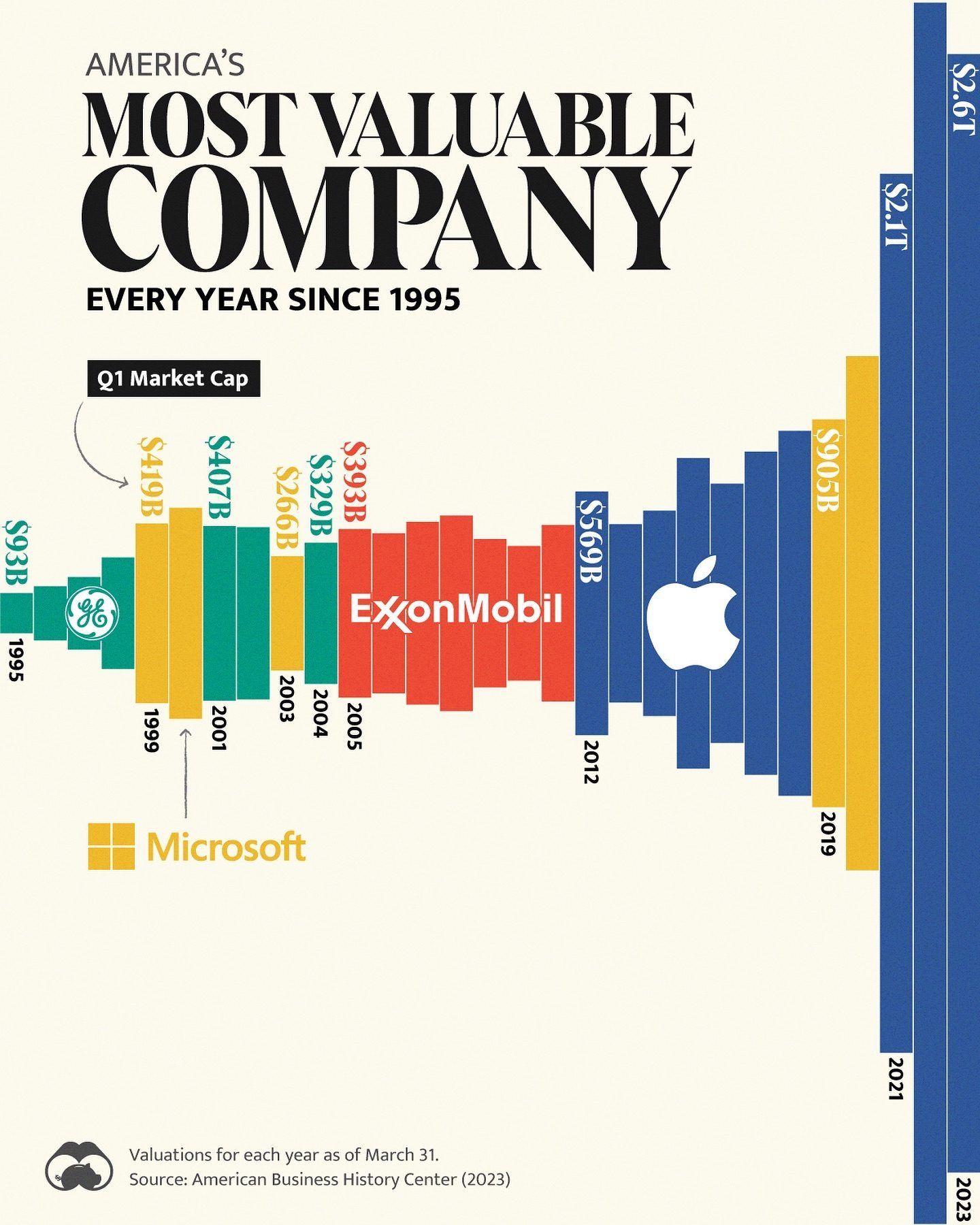
Company Market Capitalization Over Time
The landscape of America's most valuable companies has shifted dramatically over the past three decades, driven largely by the rise of tech giants. From the early 1990s to the present, the top ranks have seen a significant transition, with companies like General Electric (GE) giving way to tech behemoths like Microsoft, Apple, and others. This shift is not just a story of changing leadership; it reflects broader economic trends and the increasing dominance of technology in the global market.
Context / Why this matters
Understanding the evolution of market capitalization among America's most valuable companies provides insights into the broader economic landscape. It highlights the sectors that have grown in value and influence, such as technology, and those that have seen relative declines, like traditional manufacturing and energy. This information is crucial for investors, economists, and businesses aiming to make informed decisions based on historical trends and future projections.
Main Discussion
The Early 1990s: The Dominance of General Electric
In the early 1990s, General Electric was the undisputed leader in market capitalization. GE's dominance can be attributed to its diverse portfolio, which included aerospace, power, renewable energy, digital industry, and finance. This diversification allowed GE to maintain a significant presence across multiple sectors, making it a formidable player in the market.
The Rise of Tech Companies
The late 1990s marked a turning point with the rise of tech companies. In 1999, Microsoft surpassed GE to become the most valuable company in the United States. This shift was driven by the tech boom, which saw unprecedented growth in the value of technology companies. Microsoft's innovative products, such as the Windows operating system and the Office suite, propelled it to the top of the market capitalization rankings.
The 2010s: Apple and Beyond
The 2010s saw the emergence of Apple as a major player. Apple's innovative products, including the iPhone, iPad, and Mac computers, drove its market capitalization to new heights. By 2015, Apple had surpassed Microsoft to become the most valuable company in the United States. This period also saw the rise of other tech giants, such as Google and Amazon, further cementing the dominance of technology in the market.
Present and Future Trends
The graphic illustrates the market capitalization of America's most valuable company each year from 1995 to 2023. Microsoft, ExxonMobil, and Apple are highlighted as having held the top spot at various points. For example, in 2012, ExxonMobil, a major player in the oil and gas industry, saw a significant increase in its market capitalization, which allowed it to briefly surpass Apple. However, tech companies have consistently dominated the rankings, with Apple and Microsoft leading the way.
Practical Tips
Investing in Tech Companies
Given the dominance of tech companies in the market capitalization rankings, investors may want to consider allocating a significant portion of their portfolios to tech stocks. Companies like Microsoft, Apple, and Google have shown consistent growth and innovation, making them attractive investment options.
Diversifying Your Portfolio
While tech companies have dominated the market, it's essential to maintain a diversified portfolio. Investing in companies from various sectors, such as energy, healthcare, and finance, can help mitigate risks and provide a more balanced approach to investing.
Keeping an Eye on Emerging Trends
The market is constantly evolving, and new trends can emerge at any time. Investors should stay informed about emerging technologies and industries, such as artificial intelligence, renewable energy, and biotechnology, which could see significant growth in the future.
Important Takeaways
The shift in market capitalization from traditional industries to tech companies reflects broader economic trends and the increasing dominance of technology. Investors and businesses can benefit from understanding these trends and adjusting their strategies accordingly. Diversifying portfolios and staying informed about emerging trends are key to navigating the ever-changing market landscape.
Conclusion
The evolution of America's most valuable companies over the past three decades illustrates the growing influence of technology. From the dominance of General Electric in the early 1990s to the rise of Microsoft and Apple, the tech sector has consistently driven market capitalization rankings. Understanding these trends can provide valuable insights for investors, economists, and businesses aiming to make informed decisions in a dynamic market landscape.
Watch the Reel
Questions readers ask
Which companies were among the most valuable in the US in 1995?
In 1995, the list of most valuable American companies included diversified conglomerates like General Electric (GE), and oil giants such as ExxonMobil. These companies were leaders in traditional sectors, reflecting the economic landscape of the time.
How has the tech sector grown in the US over the last 30 years?
The tech sector has seen tremendous growth in the US over the past 30 years. Companies like Microsoft and Apple have risen to become some of the most valuable American companies, surpassing traditional sectors and reflecting the increasing importance of technology in the global market.
What are the top American companies in 2023?
In 2023, the top American companies are dominated by tech giants. Companies like Microsoft, Apple, and others lead the list, reflecting the shift in market capitalization towards technology and innovation.
Why is the shift from GE to Microsoft significant?
The shift from General Electric to Microsoft as one of the most valuable American companies is significant because it represents a transition from diversified conglomerates to tech giants. This change mirrors broader economic trends and the growing importance of technology in the global market.
What trends have driven the evolution of market capitalization among American companies?
The evolution of market capitalization among American companies has been driven by the rise of tech giants and the increasing dominance of technology. Traditional sectors have seen a relative decline, reflecting broader economic trends and shifts in market leadership.
What can we learn from the evolution of American company valuations?
The evolution of American company valuations provides insights into the broader economic landscape. It highlights the sectors that have grown in value and influence, such as tech, while traditional sectors have seen a relative decline in market capitalization.
How has the market capitalization of ExxonMobil changed over the years?
ExxonMobil was once one of the most valuable American companies, but its market capitalization has seen a relative decline over the years. This reflects broader economic trends and the shift towards tech giants in the global market.
Related deep dives
Similar reads based on topic and creator.




Recent articles
Fresh deep dives from the latest Reels we unpacked.




Comments
Be the first to comment.