Battery Manufacturing Trends
The global battery manufacturing landscape is shifting rapidly, driven by the surge in electric vehicle (EV) adoption. As nations accelerate their transition to cleaner transportation, the demand for lithium-ion batteries has skyrocketed, making battery manufacturing a critical industry.
Context / Why this matters
The electric vehicle revolution is transforming the automotive industry and, consequently, the battery manufacturing sector. Lithium-ion batteries are the powerhouse behind EVs, and their production capacity is a key indicator of a country's preparedness for this electric future.
Understanding the current and projected battery manufacturing capacities by country is crucial for several reasons. It helps identify which nations are leading the charge in this green transition, which ones are investing heavily in the sector, and where future growth opportunities lie. Moreover, it provides insights into the geopolitical dynamics of the EV era, as countries compete and collaborate to secure battery supplies.
Main discussion
Global battery production projections
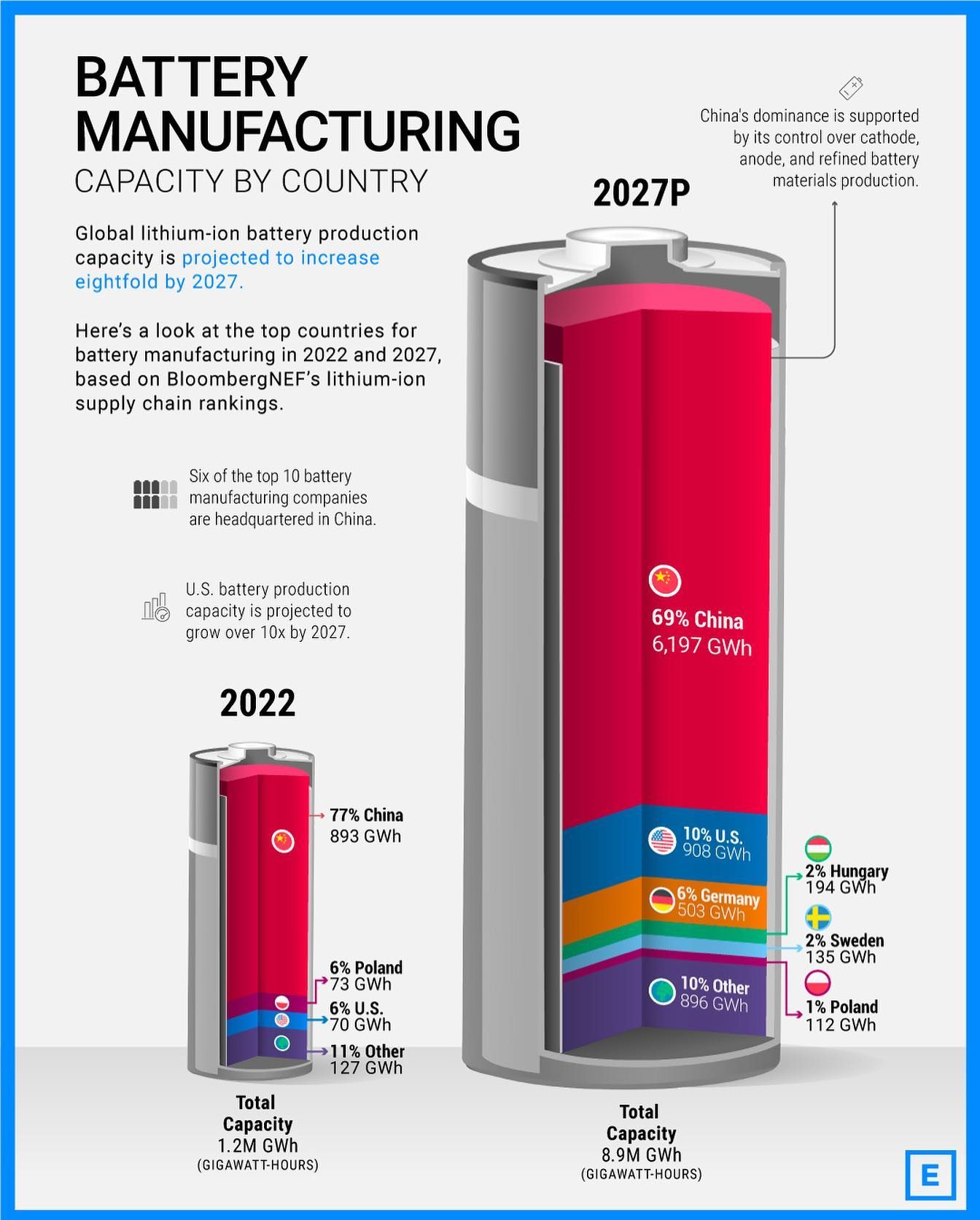
Battery manufacturing is projected to experience exponential growth. Global lithium-ion battery production is expected to increase eightfold by 2027. This surge is driven by the increasing demand for EVs, as well as energy storage systems for renewable energy integration.
China's dominance in battery manufacturing
China is currently the undisputed leader in battery manufacturing. In 2022, China held approximately 69% of the global battery production capacity, with a total of 6,197 GWh. This dominance is set to continue, with projections indicating that by 2027, China will have 77% of the total battery manufacturing capacity, amounting to 8,930 GWh.
China's leadership in battery production is underpinned by several factors. The country has abundant reserves of key battery metals, such as lithium and cobalt. Furthermore, China's robust manufacturing infrastructure, supportive government policies, and significant investments in research and development have fostered a conducive environment for battery production.
The rise of other players
While China's dominance is evident, other countries are also making significant strides in battery manufacturing.
The United States is one of the most notable contenders. Although it currently holds only 6% of the global battery production capacity, with 70 GWh, the U.S. is projected to experience over a tenfold increase in battery production capacity by 2027. This growth is spurred by substantial investments in EV manufacturing and battery production facilities, as well as supportive policies aimed at boosting domestic battery production.
Poland, Germany, and Sweden are also emerging as significant players in the battery manufacturing landscape. These countries, along with others like Hungary, are investing in battery production capabilities to capitalize on the growing demand for EVs and energy storage systems.
Practical tips
For investors
Investors keen on capitalizing on the battery manufacturing boom should consider the following:
- Diversify geographically: While China is the current leader, other countries are rapidly scaling up their production capabilities. A diversified investment portfolio that includes companies from various regions can help mitigate risks and maximize returns.
- Focus on innovation: Companies investing in research and development to improve battery technology, such as enhancing energy density, reducing costs, and developing new battery chemistries, are likely to gain a competitive edge.
For policymakers
Policymakers aiming to boost their countries' competitiveness in the battery manufacturing sector should consider:
- Supporting research and development: Investing in R&D can foster innovation and help companies develop advanced battery technologies.
- Attracting investments: Implementing policies that attract investments in battery manufacturing facilities can help create jobs, stimulate economic growth, and enhance energy security.
For consumers
Consumers interested in supporting a sustainable future should consider:
- Opting for EVs: Purchasing electric vehicles can help reduce greenhouse gas emissions and support the growth of the battery manufacturing sector.
- Choosing reputable brands: Selecting EVs and batteries from companies committed to responsible sourcing and sustainable manufacturing practices can help promote ethical and environmentally friendly battery production.
Important takeaways
- Global lithium-ion battery production is projected to increase eightfold by 2027, driven by the surge in EV demand and energy storage requirements.
- China is the current leader in battery manufacturing, with approximately 77% of the global production capacity expected by 2027.
- The United States is projected to experience significant growth in battery production capacity, with other countries like Poland, Germany, and Sweden also emerging as notable players.
Conclusion
The battery manufacturing landscape is evolving rapidly, with China leading the charge and other nations investing heavily to catch up. As the world transitions to electric vehicles and renewable energy, the demand for lithium-ion batteries will continue to soar. Understanding the trends and dynamics of the global battery manufacturing sector is essential for investors, policymakers, and consumers alike. By staying informed and making strategic decisions, stakeholders can capitalize on the opportunities presented by this green revolution and contribute to a more sustainable future.
Watch the Reel
Questions readers ask
Why is China considered the leader in EV battery manufacturing?
China is considered the leader in EV battery manufacturing due to its significant market share, holding nearly 70% of the global market. This dominance is driven by substantial investments in production capacity and a strong focus on the EV industry. Additionally, China's robust supply chain and supportive government policies have facilitated this leadership position.
What is the projected growth for the global lithium-ion battery market by 2027?
The global lithium-ion battery market is projected to experience an eightfold increase in production by 2027. This growth is primarily driven by the surge in demand for electric vehicles and the need for efficient, high-capacity batteries to power them. This significant expansion underscores the critical role lithium-ion batteries will play in the future of transportation.
Which countries are emerging as key players in the global battery market besides China?
While China dominates the global battery market, other countries are quickly emerging as key players. Notable examples include the United States, Germany, and Poland. These countries are investing heavily in battery manufacturing infrastructure and technology to capture a share of the growing market. For instance, Poland is becoming a significant player in Europe, with a growing number of EV battery manufacturing plants.
What are the top battery manufacturers globally, and where are they based?
The top battery manufacturers globally include companies like Caterpillar, CATL, and LG Chem. Many of these top manufacturers are based in China, reflecting the country's dominance in the industry. However, there are also significant players in other countries, such as the United States and South Korea, which are investing in advanced battery technology to compete on a global scale.
How does the battery manufacturing capacity of a country indicate its readiness for an electric future?
A country's battery manufacturing capacity is a crucial indicator of its readiness for an electric future. A robust battery production capacity ensures a stable supply of batteries for electric vehicles, reducing dependence on imports and enhancing energy security. It also supports the development of a local EV ecosystem, including charging infrastructure and support services, making the transition to EVs more seamless and sustainable.
Related deep dives
Similar reads based on topic and creator.

Recent articles
Fresh deep dives from the latest Reels we unpacked.




Comments
Be the first to comment.