European Gas Storage
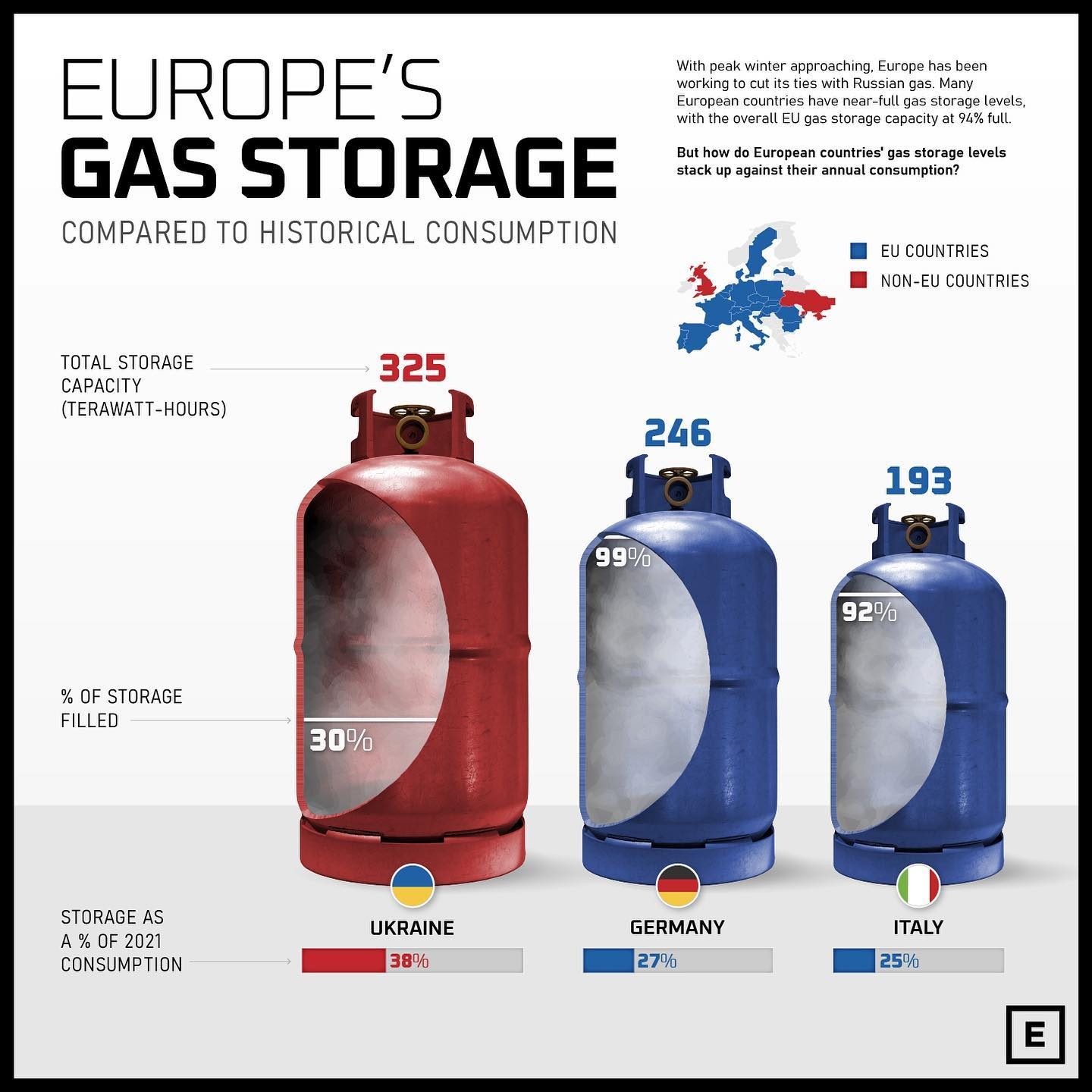
Europe is facing significant challenges as it reduces its reliance on Russian gas, having been heavily dependent on it for years. As winter approaches, understanding the current state of gas storage levels across Europe has never been more crucial. The graphic below compares Europe’s current gas storage levels with the annual gas consumption in 2021, providing a clear visual representation of the situation.
Why This Matters
Europe's gas storage levels are a critical indicator of the continent's energy security, especially given the ongoing geopolitical tensions and the need to diversify energy sources. The data highlights the varying levels of preparedness among European countries as they head into the colder months.
Main Discussion
Europe’s Total Gas Storage Capacity
Europe’s total gas storage capacity stands at 325 terawatt-hours (TWh). This capacity is distributed across various countries, with some nations holding significantly more storage than others. Notably, over 70% of the EU’s gas storage capacity is concentrated in just five countries. This concentration underscores the importance of these key nations in maintaining Europe’s energy supply.
Key Countries and Their Storage Levels
Ukraine
Ukraine currently has 38% of its gas storage filled. This is a critical figure given Ukraine's geographical position and its role as a transit country for Russian gas exports to Europe. Ensuring adequate storage levels in Ukraine is essential for maintaining stable gas supplies to the region.
Germany
Germany, one of the largest economies in Europe, has 27% of its gas storage filled. This level is relatively low compared to other major European countries, raising questions about Germany’s preparedness for the upcoming winter.
Italy
Italy’s gas storage is at 25%. While this is higher than Germany, it remains below the levels seen in other European countries, indicating a potential vulnerability in Italy’s energy supply.
Netherlands
The Netherlands has 35% of its gas storage filled. This percentage reflects the country’s efforts to maintain energy security, although there is still room for improvement.
France
France, another significant energy consumer, has 30% of its gas storage filled. This level is somewhat reassuring, given France’s reliance on gas for heating and industrial processes.
Austria
Austria stands out with 100% of its gas storage filled. This indicates a proactive approach to energy security, ensuring that the country is well-prepared for the winter months.
Hungary
Hungary has 52% of its gas storage filled, demonstrating a strong commitment to energy security and resilience.
Czechia
Czechia, with 46% of its gas storage filled, is also well-prepared, although there is still room for further storage.
Bulgaria
Bulgaria currently has 16% of its gas storage filled. This level is notably lower, suggesting potential challenges in meeting energy demands during the winter.
Croatia
Similar to Bulgaria, Croatia has 16% of its gas storage filled, indicating a need for increased storage to ensure energy security.
Portugal
Portugal’s gas storage is at 7%, one of the lowest levels in Europe. This low percentage raises concerns about Portugal’s energy supply during the winter.
Sweden
Sweden has only 1% of its gas storage filled, the lowest of the countries listed. This figure is particularly concerning, given Sweden’s reliance on gas for various sectors, including heating and power generation.
Belgium
Belgium has 5% of its gas storage filled, another low figure that indicates potential vulnerabilities in the country’s energy supply.
Denmark
Denmark’s gas storage is at 4%, another low percentage that highlights the need for increased storage to meet winter demands.
Spain
Spain has 95% of its gas storage filled, demonstrating a strong commitment to energy security.
Romania
Romania is close to Spain with 98% of its gas storage filled, showing that the country is well-prepared for the winter season.
Latvia
Latvia’s gas storage is uniquely high, reaching 122% of its 2021 consumption. This indicates a robust energy storage strategy, potentially stemming from a combination of domestic production and storage capabilities.
Gas Demand and Storage
As of October 18, the EU’s gas demand was down 10% compared to the 2011 average. This reduction can be attributed to various factors, including energy conservation efforts, increased use of renewable energy sources, and a shift towards more efficient energy use. However, the critical question remains whether the current storage levels are sufficient to meet the heating demand this winter.
Practical Tips
For Governments
Governments should focus on diversifying their energy sources and increasing gas storage capacity. Investing in renewable energy infrastructure and enhancing energy efficiency can also help mitigate the challenges posed by reduced Russian gas supplies.
For Households
Households can play a crucial role by adopting energy-efficient practices. This includes using energy-efficient appliances, insulating homes, and reducing overall energy consumption. These steps can significantly lower household energy bills and reduce the demand on the national grid.
Important Takeaways
- Europe’s gas storage capacity is crucial for maintaining energy security, especially as the continent reduces its reliance on Russian gas.
- Key countries like Austria and Romania lead in gas storage, while others like Sweden and Portugal have lower levels, indicating potential challenges.
- Increasing gas storage capacity and diversifying energy sources are essential for Europe’s energy security.
- Households can contribute to energy conservation by adopting energy-efficient practices and reducing overall energy consumption.
- The EU’s gas demand has decreased by 10% compared to the 2011 average, but the sufficiency of current storage levels for winter heating remains a critical question.
Conclusion
The current state of Europe’s gas storage levels highlights both the progress made and the challenges ahead. As the continent navigates the complexities of energy security, it is crucial for governments and households to work together to ensure a stable energy supply. By increasing storage capacities, diversifying energy sources, and adopting energy-efficient practices, Europe can better prepare for the winter and secure its energy future.
Watch the Reel
Questions readers ask
How do current European gas storage levels compare to last year's levels?
Current European gas storage levels vary significantly from 2021 levels. Countries like Ukraine, Germany, and Italy have critically low storage levels. This change is largely due to efforts to reduce dependence on Russian gas, which has led to increased efforts to diversify energy sources.
Why is gas storage particularly important for Ukraine, Germany, and Italy?
These countries are strategically important for Europe's energy security. They have critical but low storage levels, which means they play a pivotal role in managing the continent's energy supply. Their storage levels are closely monitored to ensure that Europe can meet its gas demand during winter.
What challenges does Europe face in reducing its reliance on Russian gas?
Europe faces significant challenges such as the need to diversify its energy sources, enhance gas storage infrastructure, and potentially increase gas imports from alternative suppliers. This transition requires strategic planning and investment to ensure energy security and meet winter demand.
How does the reduction in Russian gas impact Europe's overall energy security?
The reduction in Russian gas impacts Europe's energy security by creating uncertainty in supply and increasing the need for alternative sources. This shift necessitates a thorough examination of Europe's gas storage infrastructure and the readiness of its gas storage facilities to meet winter demands.
What steps can European countries take to strengthen their winter gas readiness?
European countries can strengthen their winter gas readiness by investing in gas storage infrastructure, diversifying their energy sources, and enhancing their gas storage capacity. Additionally, countries can also explore renewable energy options and improve energy efficiency measures to reduce overall gas demand during the winter months.
How do current gas storage levels influence European energy policy?
Current gas storage levels significantly influence European energy policy by driving initiatives to enhance energy security. Policymakers are focusing on reducing reliance on Russian gas, diversifying energy sources, and investing in robust gas storage infrastructure to ensure that Europe can meet its energy needs during the winter months.
Related deep dives
Similar reads based on topic and creator.

Recent articles
Fresh deep dives from the latest Reels we unpacked.




Comments
Be the first to comment.