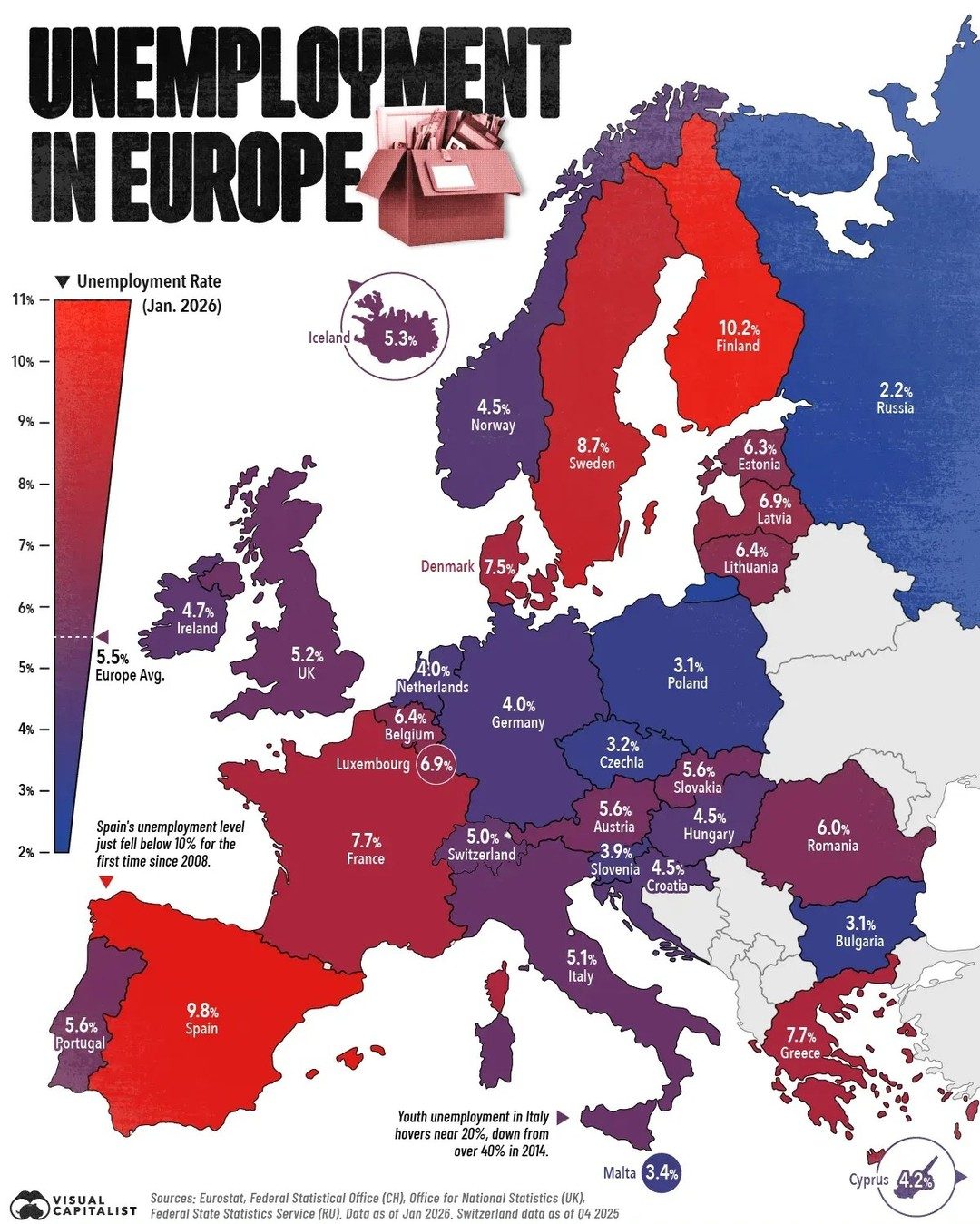
European Unemployment Rates
Unemployment rates in Europe are not uniform. As of January 2026, stark differences exist among countries. Understanding these variances can provide insight into broader economic trends and labor market conditions across the continent.
Context
European unemployment rates serve as a critical barometer for economic health. They influence policy decisions, social programs, and overall economic stability. As of January 2026, the average unemployment rate across Europe stands at 4.7%, highlighting a mixed picture with some countries faring better than others.
Main discussion
Iceland and the Nordic Countries
Iceland stands out with the highest unemployment rate at 10.2%. This is significantly higher than its Nordic neighbors, Norway at 6.9% and Sweden at 8.7%. Despite Iceland's high rate, its economy remains resilient, driven by sectors like tourism and fisheries.
Finland and Spain
Finland and Spain are often discussed together due to their rates being higher than the average. Finland's unemployment rate is 5.3%, while Spain's rate is 9.8%. Spain's unemployment rate is noteworthy as it has fallen below 10% for the first time since 2008. This decrease suggests a recovering economy and improved labor market conditions.
Eastern Europe
Eastern European countries present a mixed picture. Russia, Bulgaria, and Poland are closer to full employment, with rates of 6.3%, 4.5%, and 4.7% respectively. These countries have made significant strides in lowering unemployment, driven by economic reforms and industrial growth.
Western Europe
Western European countries show varied unemployment rates. Germany and the Netherlands lead with relatively low rates of 4.0%. This can be attributed to strong industrial sectors and robust labor market policies. Other countries like Belgium, UK, and France have higher rates, at 5.2%, 5.5%, and 7.7%, respectively. These higher rates can be linked to structural issues like labor market rigidity and economic fluctuations.
Southern Europe
Southern European countries face unique challenges. Greece has a higher unemployment rate of 7.7%, reflecting the ongoing economic recovery post-2008 financial crisis. Malta, Cyprus, and Portugal have moderate rates of 3.4%, 4.2%, and 5.6% respectively. Despite their progress, youth unemployment remains a concern, particularly in Italy, where it hovers near 20%, down from over 10% in 2014.
Practical tips
Understanding unemployment rates can guide individuals and policymakers in making informed decisions.
For Job Seekers
Job seekers can benefit from exploring regions with lower unemployment rates. For instance, moving to countries like Germany or the Netherlands can offer more job opportunities. Networking within thriving sectors like tourism, technology, or healthcare can also improve employment prospects.
For Policymakers
Policymakers can use this data to implement targeted measures. For instance, countries with higher youth unemployment, like Italy, can focus on vocational training and apprenticeship programs. Investing in education and workforce development can also help in reducing long-term unemployment.
Important takeaways
- Diverse Job Market Conditions: Unemployment rates vary significantly across Europe, reflecting diverse labor market conditions and economic landscapes.
- Youth Unemployment: Despite general improvements, youth unemployment remains a critical issue in several countries, notably Italy.
- Economic Recovery: Spain’s unemployment rate dropping below 10% highlights economic recovery and the effectiveness of labor market policies.
- Eastern European Progress: Eastern European countries like Bulgaria and Poland have made notable progress in reducing unemployment, driven by economic reforms.
Conclusion
European unemployment rates present a complex picture. While some countries are experiencing near-full employment, others face significant challenges. Understanding these disparities can inform job seekers and policymakers alike. By leveraging data on unemployment rates, strategies can be tailored to address specific economic needs, fostering a more resilient and equitable European labor market.
Watch the Reel
Questions readers ask
Which country in Europe has the lowest unemployment rate in 2026?
Germany has the lowest unemployment rate in Europe as of 2026, standing at 4.0%. This reflects the country's robust economy and strong labor market conditions.
What is the average unemployment rate across Europe in January 2026?
The average unemployment rate across Europe in January 2026 is 4.7%. This figure represents a mix of economic conditions, with some countries experiencing lower rates and others facing higher unemployment.
How does Iceland's unemployment rate compare to other Nordic countries in 2026?
Iceland's unemployment rate of 10.2% is notably higher than its Nordic neighbors. For instance, Norway has an unemployment rate of 6.9%, and Sweden has an even lower rate.
What is the unemployment rate in Spain and Italy as of 2026?
As of 2026, Spain has an unemployment rate of 7.8%, while Italy's unemployment rate is 8.5%. These rates are higher than the European average, indicating unique economic challenges in these countries.
What is the unemployment rate in Bulgaria in 2026?
Bulgaria's unemployment rate is 7.1% in 2026. This rate is higher than the European average, reflecting specific economic and labor market conditions within the country.
How does the youth unemployment rate in Europe look in 2026?
Youth unemployment in Europe in 2026 is an area of concern. Although the article doesn't provide specific percentages, it is known that youth unemployment is a significant issue across multiple European countries.
What is the unemployment rate in Russia in 2026?
Russia's unemployment rate in 2026 is 5.0%. This rate is higher than the European average, indicating unique economic and labor market conditions specific to Russia.
Related deep dives
Similar reads based on topic and creator.

Recent articles
Fresh deep dives from the latest Reels we unpacked.




Comments
Be the first to comment.