Homeownership Rates Across Europe
Homeownership rates vary significantly across European countries, reflecting differences in economic conditions, cultural preferences, and housing policies. Understanding these rates can provide insights into the real estate market and living standards in different regions.
Context / Why This Matters
Homeownership is a cornerstone of wealth and stability for many families. It influences economic decisions, housing policies, and even societal attitudes. For instance, high homeownership rates can indicate a stable economy and strong cultural emphasis on property ownership.
Main discussion
Highest and Lowest Homeownership Rates
Albania and Romania
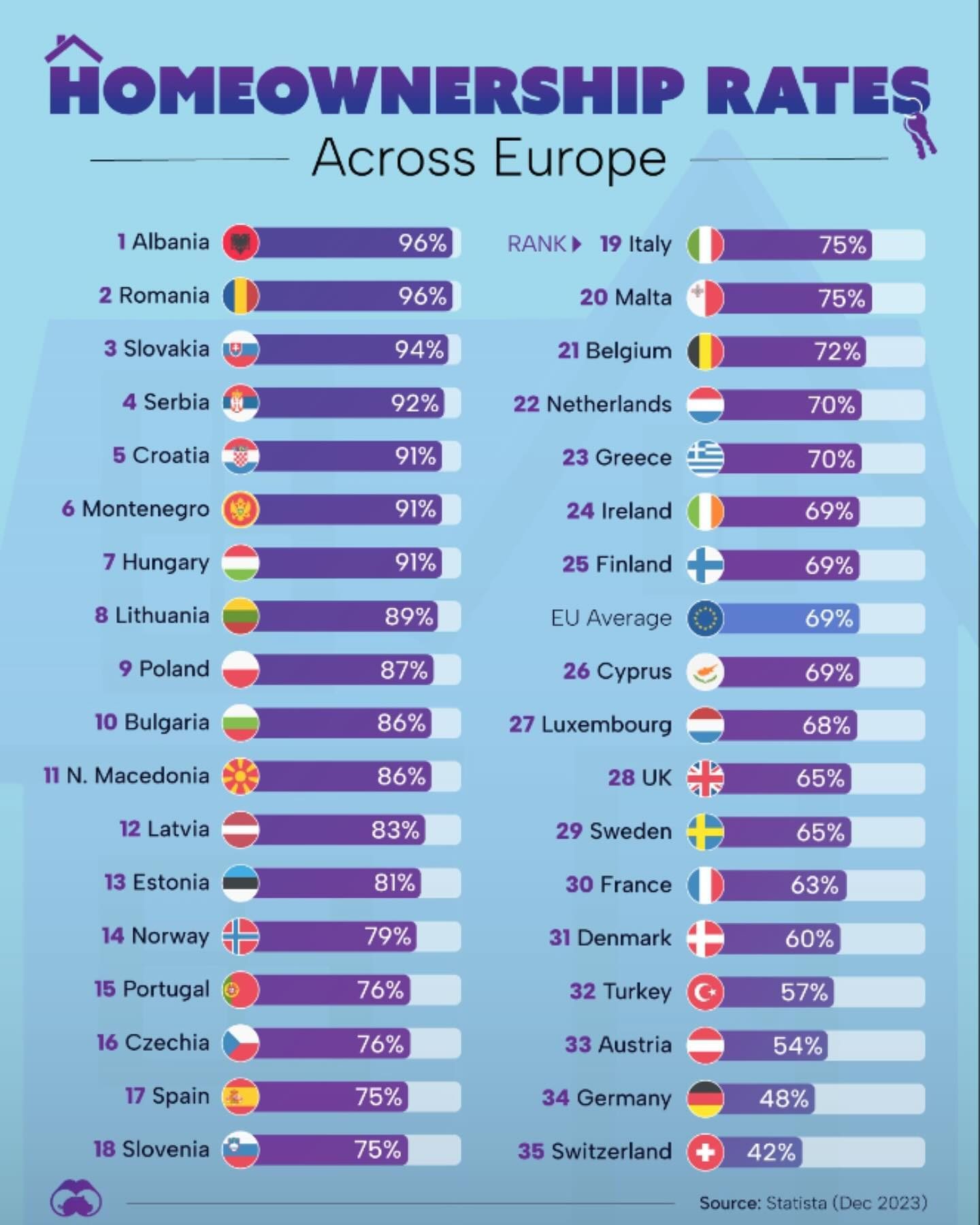
Albania and Romania stand out with some of the highest homeownership rates in Europe. Albania leads the continent with a remarkable 96% homeownership rate. This high rate is driven by factors such as affordable housing prices and a cultural preference for owning property. For example, a two-bedroom apartment in Albania can be purchased for around €287,000 ($315,000), making homeownership accessible to a broader segment of the population.
Romania closely follows with an 89% homeownership rate. Similar to Albania, Romania benefits from relatively lower housing costs and a cultural inclination towards owning a home.
Slovakia and Other Eastern European Countries
Slovakia, Croatia, Montenegro, and Hungary are among the countries with very high homeownership rates, all exceeding 90%. These countries share a common historical and cultural background, which may contribute to their high rates of homeownership. Economic factors, including stable economic growth and moderate housing prices, also play a significant role.
Sweden, Norway, and Finland
Sweden, Norway, and Finland have homeownership rates around 65-76%, which are comparatively moderate. These countries are known for their strong social welfare systems and high quality of life, which may influence homeownership patterns. Housing in these countries can be expensive, particularly in major cities, which might deter some residents from owning a home.
Switzerland
Switzerland has the lowest homeownership rate in Europe, at just 42%. This can be attributed to high housing prices and a strong rental market. In Zurich, for instance, similar-sized apartments cost around CHF 1,095,000 ($1.28 million), making homeownership a significant investment for residents. The high cost of living and the stability of the rental market are likely factors in the low homeownership rate.
EU Average and Regional Trends
The EU average homeownership rate is 69%. This average masks significant regional variations. For example, countries in Eastern Europe tend to have higher homeownership rates, while those in Western Europe often have lower rates. This disparity can be attributed to historical, economic, and cultural factors.
Eastern European countries, such as Albania, Romania, and Slovakia, have higher homeownership rates, largely due to more affordable housing and cultural preferences. In contrast, Western European countries, like Switzerland, Germany, and Austria, have lower rates, influenced by higher housing costs and a stronger rental market.
Other Notable Countries
Portugal and Czechia both have a 76% homeownership rate. These countries offer a balance between affordable housing and a strong rental market, making homeownership accessible to a wide range of residents. Italy and Spain both have a 75% homeownership rate, which can be attributed to cultural preferences and relatively stable housing markets. These countries, along with others, reflect the diverse factors influencing homeownership rates across Europe.
Practical Tips for Prospective Homeowners
For those considering homeownership in Europe, it is essential to research local housing markets and understand the cultural and economic factors at play. Here are some practical tips:
- Understand Local Market Conditions: Research housing prices, rental costs, and market trends in the region of interest.
- Consider Cultural and Social Factors: Some countries place a higher value on homeownership, which can influence housing policies and availability.
- Explore Financing Options: Look into local mortgage options, down payment requirements, and interest rates.
- Seek Professional Advice: Engage with local real estate agents and financial advisors for tailored guidance.
Important Takeaways
Homeownership rates in Europe vary widely, with Albania leading the way and Switzerland having the lowest rate. The factors influencing these rates include economic conditions, cultural preferences, and housing policies. For prospective homeowners, understanding these factors can help in making informed decisions about where and how to buy a home. Practical tips, including researching the local market and exploring financing options, can also be beneficial.
Conclusion
Homeownership rates in Europe offer a window into the region's economic, cultural, and social landscape. Whether driven by affordability, cultural preferences, or housing policies, these rates reflect the diverse factors influencing property ownership. As potential homeowners navigate the European real estate market, understanding these rates and their underlying factors can provide valuable insights and guide informed decisions.
Watch the Reel
Questions readers ask
What factors contribute to the high homeownership rates in Albania and Romania?
The high homeownership rates in Albania and Romania can be attributed to several factors, including the affordability of housing. Cultural preferences that prioritize property ownership also play a significant role. Additionally, historical and economic contexts in these countries have shaped a strong inclination towards homeownership.
How do European housing policies influence homeownership rates?
European housing policies significantly impact homeownership rates by affecting affordability and accessibility. For instance, policies that provide subsidies or tax incentives for homebuyers can boost ownership rates. Conversely, stringent regulations or lack of affordable housing options can lead to lower rates.
Why do homeownership rates differ so widely across European countries?
The wide variation in homeownership rates across Europe is due to a mix of economic conditions, cultural attitudes towards property ownership, and specific housing policies. For example, countries with strong cultural preferences for homeownership and affordable housing markets, like Albania and Romania, have higher rates. In contrast, nations with high living costs and different cultural norms, such as Sweden, see lower rates.
What are the homeownership rates like in Slovakia compared to other European countries?
Slovakia's homeownership rate falls within the broader spectrum of European rates. While it is not as high as Albania or Romania, it is influenced by a mix of affordable housing options and cultural preferences. Slovakia's rate is shaped by its housing policies and economic conditions, making it a mid-range European country in terms of homeownership.
How does Sweden's homeownership rate compare to other European nations?
Sweden has one of the lower homeownership rates in Europe. The Swedish housing market is characterized by high living costs and a strong rental market. This is influenced by cultural attitudes and housing policies that make renting a viable and popular long-term option for many residents.
What insights can be gained from understanding European homeownership rates?
Understanding European homeownership rates provides valuable insights into the real estate market and living standards. High rates may indicate a stable economy and a cultural emphasis on property ownership, while lower rates can suggest different housing market dynamics and cultural preferences. This information is crucial for policymakers, investors, and individuals considering relocation.
How does the affordability of housing in Europe impact homeownership rates?
Affordability is a key factor in homeownership rates across Europe. In countries where housing is more affordable, such as Albania and Romania, homeownership rates tend to be higher. Conversely, in countries with high living costs and limited affordable housing options, like Sweden, homeownership rates are generally lower. This dynamic is influenced by both economic conditions and housing policies.
Related deep dives
Similar reads based on topic and creator.

Recent articles
Fresh deep dives from the latest Reels we unpacked.




Comments
Be the first to comment.