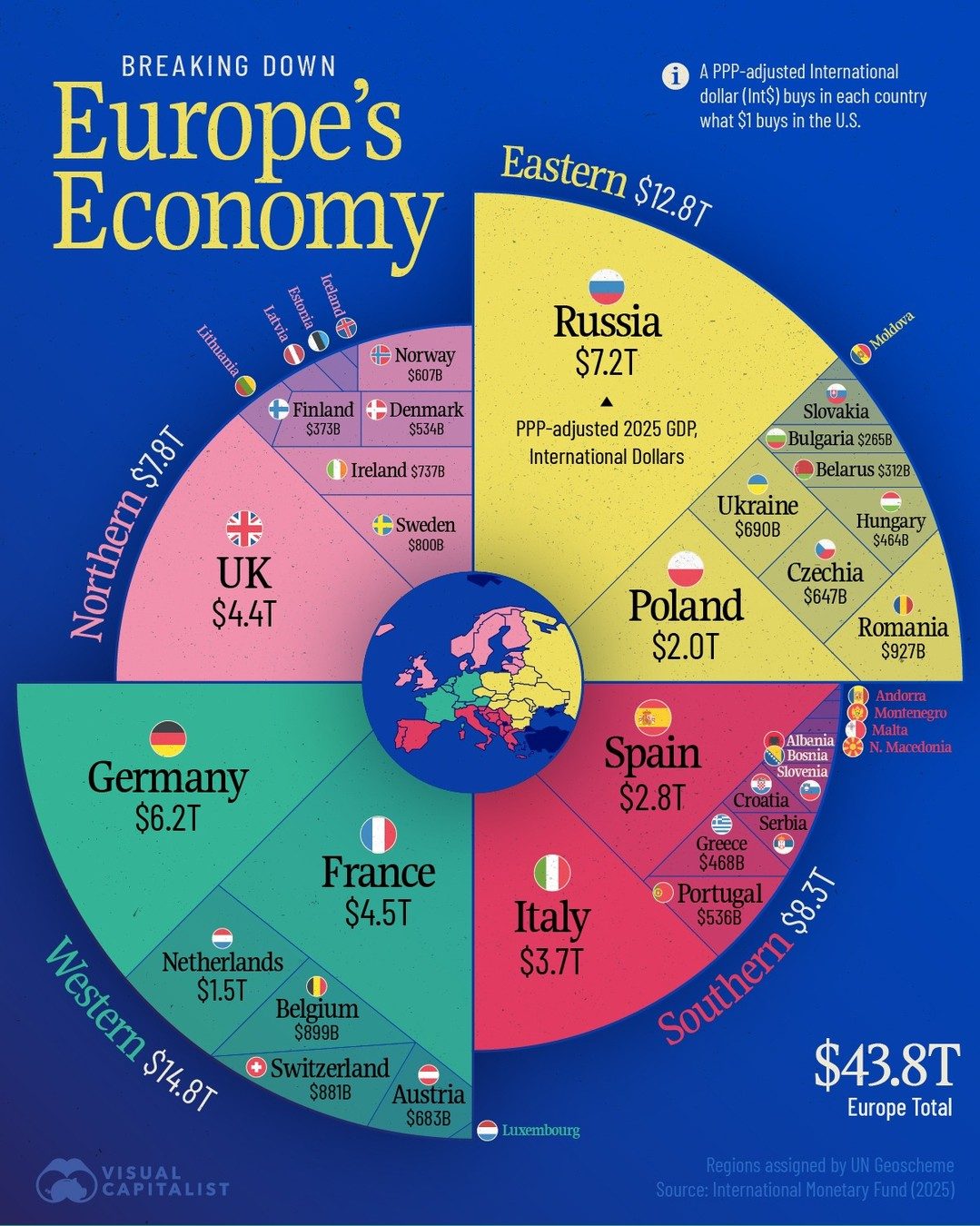
European Economy Breakdown by Region
When considering the European economy, the focus often lands on the prominent nations of Western Europe. However, a closer inspection of Europe's GDP by region reveals a more nuanced picture. This breakdown offers a detailed look at the purchasing-power-parity (PPP)-adjusted output in 2025, highlighting how various parts of Europe contribute to the continent's collective wealth.
Context: Why This Matters
Understanding the distribution of economic power across Europe is crucial for businesses, investors, and policymakers. It provides insights into market opportunities, investment potential, and economic stability across different regions. By examining the GDP contributions of various countries, one can better comprehend the dynamics at play within Europe's economy and how different regions interrelate.
Main Discussion
Western Europe: The Economic Powerhouse
Western Europe, encompassing countries like Germany, the UK, and France, is the backbone of the European economy. This region alone contributes $14.8 trillion to the continent's total GDP of $43.8 trillion.
Germany's Lead in Western Europe
Germany stands out as the economic powerhouse of Europe, with a GDP of $6.2 trillion. This substantial economic influence is driven by its robust industrial sector, advanced technology, and strong export market. Germany's economy is not only a significant contributor to Western Europe but also plays a pivotal role in the broader European market.
The UK and France: Significant Contributors
The UK and France follow closely behind Germany, with GDP contributions of $4.4 trillion and $4.5 trillion, respectively. Both countries have diverse economies with strong financial sectors, significant manufacturing capabilities, and thriving service industries. Their economic strengths bolster the overall stability and growth of the Western European region.
The Role of Smaller Western Nations
Other significant contributors in Western Europe include the Netherlands, Belgium, Switzerland, and Austria. These nations, while smaller in GDP compared to Germany, the UK, and France, still make notable contributions. For instance, the Netherlands contributes $1.5 trillion, while Switzerland adds $881 billion. These countries benefit from high standards of living, advanced technological infrastructure, and strategic economic policies that drive their economic growth.
Eastern Europe: Emerging Economic Power
The Eastern European region, which includes countries like Poland, Russia, and Romania, contributes $12.8 trillion to the European economy. This region is characterized by a mix of developing economies and more established markets, offering diverse opportunities for growth and investment. Russia, with a GDP of $7.2 trillion, is the largest economy in this region, driven by its energy sector and natural resources.
Poland and Its Economic Progress
Poland, with a GDP of $2.0 trillion, is a notable player in the Eastern European market. Its economy has seen substantial growth driven by industrialization, modernization, and integration into the European market. Poland's strategic position and economic policies have made it an attractive destination for foreign investment and a hub for manufacturing and service industries.
Southern Europe: Economic Challenges and Opportunities
Southern Europe, encompassing countries like Italy, Spain, and Greece, contributes $8.3 trillion to Europe's total GDP. This region faces unique economic challenges, including high unemployment rates and significant public debt. However, it also offers opportunities for economic growth through tourism, agriculture, and cultural exports.
Italy’s Economic Landscape
Italy, with a GDP of $3.7 trillion, is a significant contributor to the Southern European economy. Despite economic challenges, Italy's rich industrial base, robust agricultural sector, and cultural heritage provide a strong foundation for economic growth. The country's diverse economy includes sectors like automotive manufacturing, fashion, and tourism, which are key drivers of its GDP.
Northern Europe: Stability and Growth
Northern Europe, which includes countries like Sweden, Denmark, and Norway, contributes $7.8 trillion to the European economy. Known for their high standards of living, advanced social welfare systems, and strong economic policies, these countries are models of sustainable economic growth. Sweden, with a GDP of $800 billion, and Norway, with a GDP of $373 billion, are key players in this region.
Sweden and Its Economic Strength
Sweden's economy, valued at $800 billion, is characterized by a mix of industrial, technological, and service sectors. The country's strong focus on innovation, environmental sustainability, and social welfare makes it a leader in various industries, including technology and renewable energy. Sweden's economic policies and strategic investments ensure stable growth and a high standard of living for its citizens.
Practical Tips for Engaging with Europe’s Economy
Investing in Europe
For investors, understanding the regional dynamics is essential. Western Europe, with its stable economies, offers reliable opportunities for investment, while Eastern Europe presents growth potentials with higher risks. Southern Europe, though challenging, can be a rewarding investment destination if approached with a long-term perspective.
Doing Business in Europe
Businesses looking to expand into Europe should consider the strengths and challenges of each region. Countries like Germany, Sweden, and the Netherlands offer robust markets with established infrastructure and a thriving business environment. Conversely, emerging markets in Eastern Europe provide opportunities for growth and innovation, albeit with greater risks.
Tourism and Cultural Exchanges
Tourism is a significant economic driver in many European countries, particularly in Southern Europe. Countries like Italy, Spain, and Greece attract millions of tourists annually, contributing to their economic growth. Understanding the regional tourism landscapes can provide valuable insights for businesses in the travel and hospitality sectors.
Important Takeaways
- Western Europe is the largest contributor to the European economy, with Germany, the UK, and France leading the way.
- Eastern Europe, with significant players like Russia and Poland, offers diverse economic opportunities and growth potential.
- Southern Europe, while facing economic challenges, has robust sectors like tourism and cultural exports.
- Northern Europe, known for its stability and high standards of living, is a model of sustainable economic growth.
- Understanding the regional dynamics is crucial for investors, businesses, and policymakers looking to engage with the European economy.
Conclusion
The European economy is a complex tapestry of diverse regions, each contributing uniquely to the continent's collective wealth. By examining the GDP contributions and economic landscapes of Western, Eastern, Southern, and Northern Europe, one gains a comprehensive understanding of the economic dynamics at play. This knowledge is invaluable for navigating the European market, whether for investment, business expansion, or cultural exchange.
Watch the Reel
Questions readers ask
Which countries contribute the most to Western Europe's economic power?
Germany, the UK, and France are the primary contributors to Western Europe's economic power, each making significant additions to the region's GDP. These countries are known for their robust industries, technological advancements, and strong financial sectors, which collectively drive the economic landscape of Western Europe.
How does GDP per capita vary across different European regions?
GDP per capita in Europe varies significantly by region, with Western Europe generally having higher values compared to Eastern Europe. This disparity is often attributed to differences in economic development, industrialization, and infrastructure. For instance, Luxembourg, Switzerland, and Norway often top the list for the highest GDP per capita, while countries in Eastern Europe tend to have lower figures.
What is purchasing-power-parity (PPP) and why is it important in the context of European GDP?
Purchasing-power-parity (PPP) is a metric used to compare the real value of goods and services in different countries, adjusted for cost of living differences. In the context of European GDP, PPP is important because it provides a more accurate comparison of economic output by accounting for variations in prices and living costs across regions, offering a clearer picture of the actual economic power and standard of living in each area.
How do economic interdependencies affect the European economy?
Economic interdependencies in Europe are complex and multifaceted, with regions and countries relying on each other for trade, investment, and labor. For example, Germany's manufacturing sector benefits from access to skilled labor from Eastern Europe, while Southern European countries often rely on financial services from Western Europe. These interdependencies can lead to shared economic growth but also expose regions to systemic risks, such as financial crises and supply chain disruptions.
Why is understanding the European economic dynamics important for businesses and policymakers?
Understanding the economic dynamics of Europe is crucial for businesses and policymakers as it informs strategic decision-making. For businesses, it highlights potential market opportunities and investment prospects, while for policymakers, it provides insights into economic stability and areas needing policy interventions. By analyzing GDP contributions and economic trends, stakeholders can better navigate the European economic landscape and make informed decisions.
Related deep dives
Similar reads based on topic and creator.

Recent articles
Fresh deep dives from the latest Reels we unpacked.




Comments
Be the first to comment.