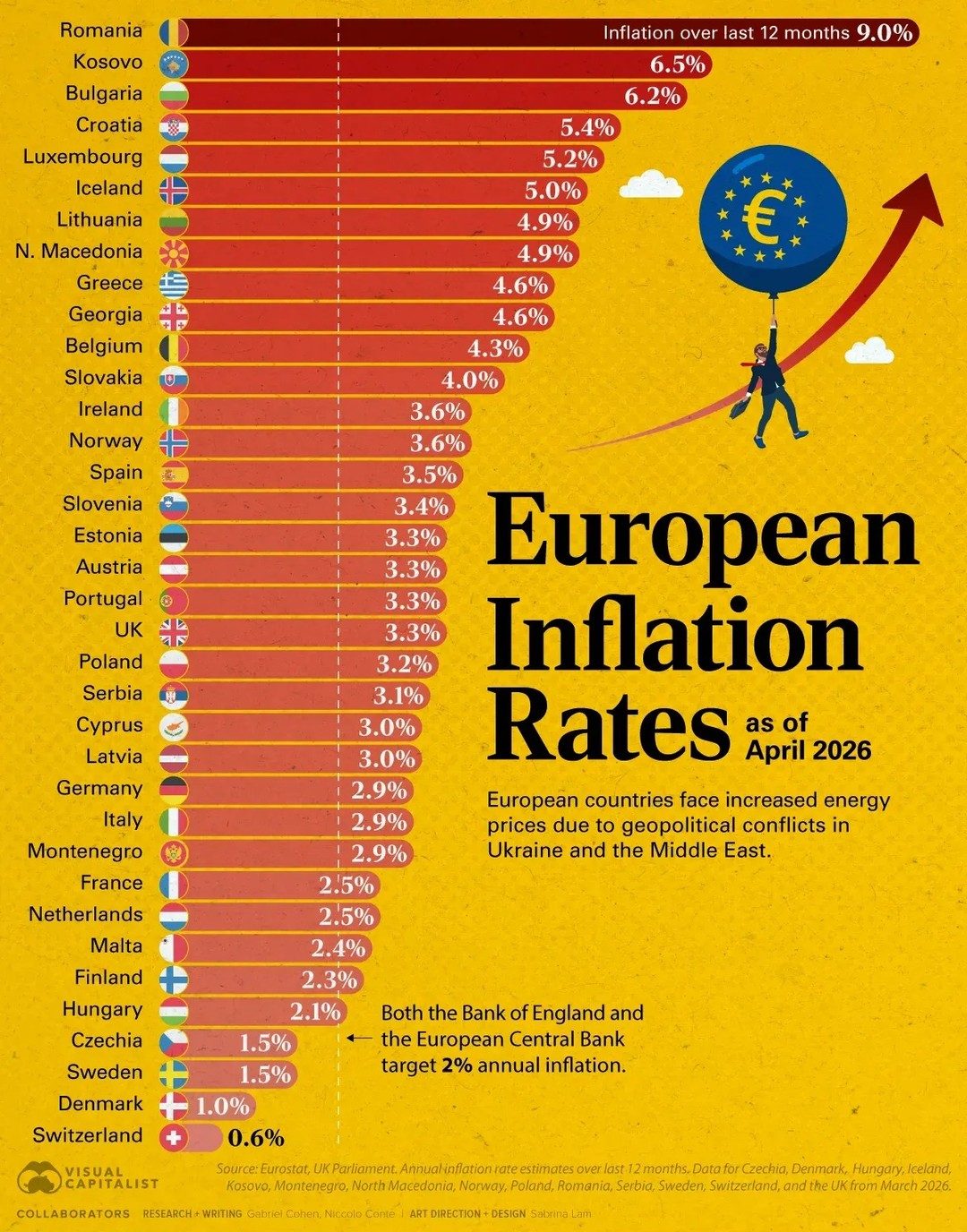
European Inflation Rates
The economic landscape of Europe is marked by a significant disparity in inflation rates. Recent data from April 2026 reported by Eurostat and the UK Parliament highlight that Romania, Kosovo, and Bulgaria are at the top of the list with the highest inflation rates, while a few countries are managing to maintain or stay below the EU's 2% target. This infographic reveals key insights into the economic challenges faced by European nations.
Why This Matters
Inflation rates are a crucial economic indicator, reflecting the overall health and stability of a nation's economy. High inflation can erode purchasing power, increase living costs, and upset economic balance. Understanding the inflation trends across Europe is essential for policymakers, investors, and individuals to make informed decisions.
Inflation Trends Across Europe
Countries with the Highest Inflation Rates
Several countries in Europe are grappling with elevated inflation rates, which can be attributed to various factors, including geopolitical conflicts and economic policies.
Romania
Romania tops the list with an inflation rate of 6.5%. This high rate reflects the country's economic challenges, which are exacerbated by external factors such as geopolitical instability in neighboring regions.
Kosovo and Bulgaria
Following Romania, Kosovo and Bulgaria report high inflation rates of 9.0% and 6.2%, respectively. These countries face similar challenges, including economic vulnerability and reliance on imports, which are affected by global price fluctuations and supply chain disruptions.
Countries with Moderate Inflation Rates
Several European countries are experiencing moderate inflation rates, which, while challenging, are more manageable compared to those at the top of the list.
Croatia, Luxembourg, and Iceland
Croatia, Luxembourg, and Iceland report inflation rates of 5.4%, 5.2%, and 5.0%, respectively. These rates indicate that while these countries are facing economic pressures, they are doing better in managing inflation compared to the leaders.
Countries Approaching the 2% Target
A few European countries have managed to keep their inflation rates close to the 2% target, which is the benchmark set by the European Central Bank (ECB).
Lithuania, N. Macedonia, and Belgium
Countries like Lithuania, North Macedonia, and Belgium have managed to keep their inflation rates at 4.9%, 4.9%, and 4.3%, respectively. This indicates that their economic policies are effectively controlling inflation, providing a stable economic environment for their citizens.
Countries Below the 2% Target
Only a select few European countries have managed to achieve or stay below the 2% inflation target. These countries are often seen as economic role models within Europe.
Switzerland, Denmark, Czechia, and Sweden
Switzerland, Denmark, Czechia, and Sweden are the standout performers, with inflation rates of 0.6%, 1.5%, 1.5%, and 2.3%, respectively. These countries have robust economies and effective monetary policies that help stabilize prices and ensure economic stability.
Geopolitical Factors
The high inflation rates in many European countries can be traced back to geopolitical factors, primarily the conflicts in Ukraine and the Middle East. These conflicts have disrupted supply chains, increased energy prices, and led to economic volatility, contributing to higher inflation rates.
Impact of Ukraine Conflict
The ongoing conflict in Ukraine has had a significant impact on European economies. Ukraine is a major supplier of agricultural products and strategic resources. The conflict has disrupted these supply chains, causing shortages and price hikes. Additionally, the conflict has led to an influx of refugees, putting additional strain on host countries' economies.
Impact of Middle East Conflicts
Geopolitical instability in the Middle East has resulted in higher energy prices, impacting fuel and transportation costs. Many European countries rely on oil and gas imports from the Middle East, making them vulnerable to fluctuations in global energy prices.
Practical Tips
For Citizens
Stay informed about economic policies and how they impact your finances. Keep an eye on interest rates, employment trends, and government measures aimed at controlling inflation.
For Investors
Diversify your investment portfolio to include assets that are less affected by inflation, such as real estate, commodities, and inflation-protected securities. Consider investing in countries with stable economies and effective monetary policies.
For Policymakers
To control inflation, policymakers should focus on implementing robust economic policies, fostering stable economic environments, and maintaining strong international trade relations.
Important Takeaways
Inflation Rates
Inflation rates across Europe vary significantly, with countries like Romania, Kosovo, and Bulgaria facing the highest rates. Geopolitical instability, especially in Ukraine and the Middle East, plays a crucial role in driving these elevated rates.
Economic Stability
Countries with lower inflation rates, such as Switzerland, Denmark, Czechia, and Sweden, demonstrate the effectiveness of sound economic policies and stable monetary systems. These countries serve as benchmarks for managing inflation.
Impact on Daily Life
High inflation rates can significantly impact daily life, affecting everything from groceries to housing costs. Understanding these economic trends is essential for making informed decisions about personal finance and investing.
Conclusion
The economic landscape of Europe, as illustrated by recent inflation data, presents a mixed picture. While some countries are effectively managing inflation, others face significant challenges. Geopolitical factors, particularly conflicts in Ukraine and the Middle East, play a pivotal role in driving inflation. Understanding these trends is crucial for policymakers, investors, and individuals to navigate the economic uncertainties of the future.
Watch the Reel
Related deep dives
Similar reads based on topic and creator.

Recent articles
Fresh deep dives from the latest Reels we unpacked.




Comments
Be the first to comment.