Engineering Brainteaser: Solving the Unknown Rectangle
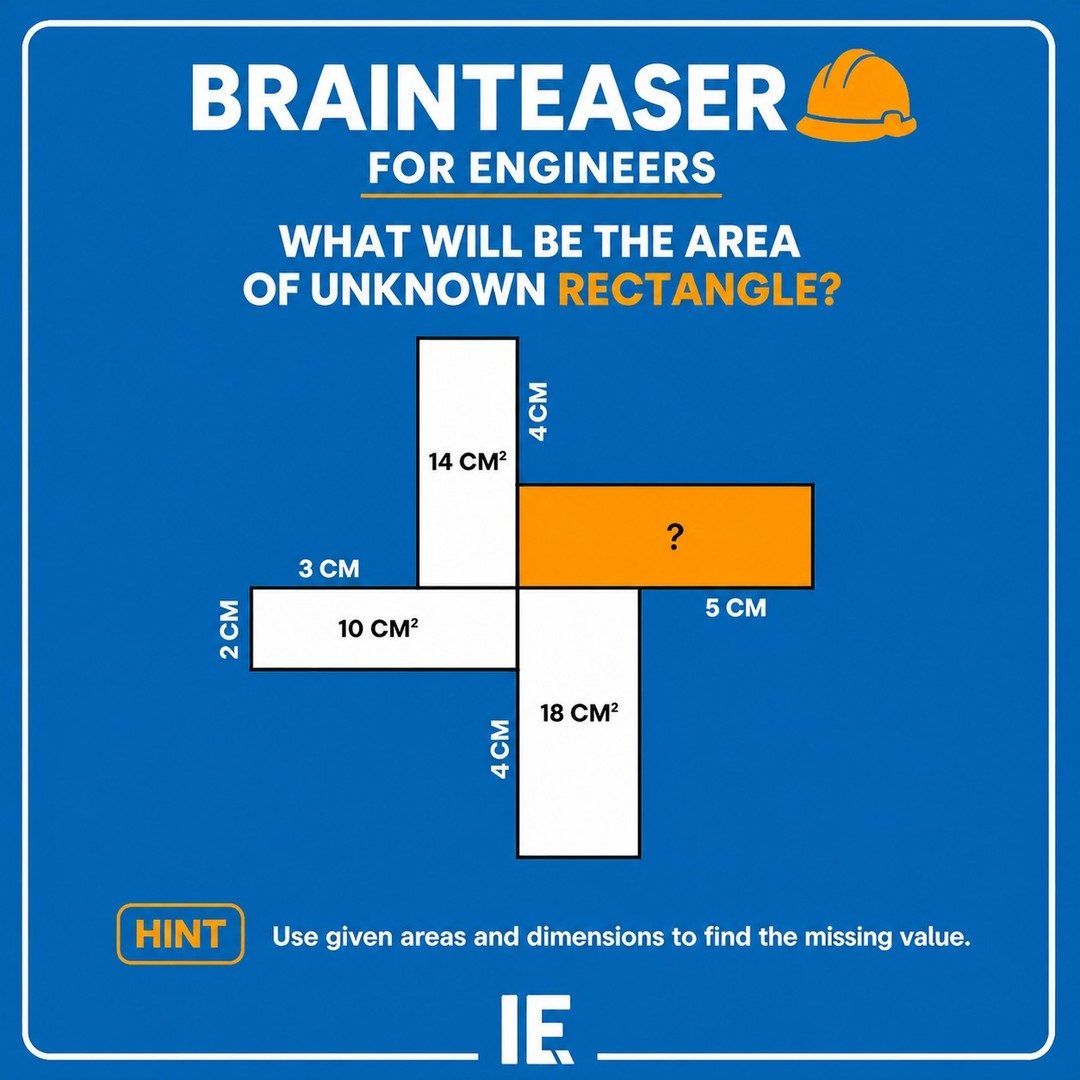
In front of you is a classic brainteaser designed specifically for engineers. The challenge is to determine the area of an unknown rectangle using the given areas and dimensions of other rectangles. This puzzle is perfect for honing your problem-solving skills and applying geometric principles.
Why This Matters
Engineers are often tasked with solving complex problems using mathematical principles and logical deductions. This brainteaser, while seemingly simple, provides valuable practice in understanding and applying geometric concepts. It's not just about finding the answer; it's about the process of logical deduction and the application of known values to solve for the unknown. Mastering these skills is crucial for success in various engineering disciplines.
The Brainteaser Explained
The Setup
You are presented with a diagram featuring several rectangles, each with either its area or dimensions specified. One rectangle's area is missing. Your goal is to determine the area of this unknown rectangle.
The given information includes:
- A rectangle with an area of 14 cm²
- A rectangle with a length of 3 cm and a width of 2 cm
- A rectangle with an area of 10 cm² and a length of 5 cm
- A rectangle with an area of 18 cm² and a length of 4 cm
The Hint
The hint provided is straightforward but powerful: "Use given areas and dimensions to find the missing value." This suggests that the solution lies in applying the known values to deduce the unknown area.
Solving the Brainteaser
To solve this puzzle, you need to apply a few foundational principles of geometry and algebra. Let's break down the steps.
Step 1: Organize the Information
List the given dimensions and areas clearly:
- Rectangle 1: Area = 14 cm²
- Rectangle 2: Length = 3 cm, Width = 2 cm
- Rectangle 3: Area = 10 cm², Length = 5 cm
- Rectangle 4: Area = 18 cm², Length = 4 cm
Step 2: Identify the Relationships
Determine how these rectangles are related. For instance, if Rectangles 2 and 3 share a side, their dimensions can be compared to find the unknown dimension of the rectangle in question.
Step 3: Apply Geometric Formulas
Use the formula for the area of a rectangle: Area = Length × Width. For rectangles where only the area or one dimension is known, you can deduce the unknown dimension.
Step 4: Calculate the Unknown Dimensions
For example, for Rectangle 2, you can calculate the area: [ \text{Area} = 3 \text{ cm} \times 2 \text{ cm} = 6 \text{ cm}^2 ]
For Rectangle 3, you can calculate the width: [ \text{Width} = \frac{\text{Area}}{\text{Length}} = \frac{10 \text{ cm}^2}{5 \text{ cm}} = 2 \text{ cm} ]
Step 5: Use Known Values to Find the Unknown
Apply the known dimensions and areas to find the missing value. For instance, if one rectangle's length is known and its area is missing, you can use the formula for the area.
Step 6: Verify Your Answer
Ensure your calculations are accurate. Double-check the dimensions and areas to confirm your solution is correct.
Example Calculation
Let's assume the unknown rectangle shares a side with Rectangle 3 (5 cm width). If the length of the unknown rectangle is 2 cm, then its area is: [ \text{Area} = 5 \text{ cm} \times 2 \text{ cm} = 10 \text{ cm}^2 ]
Practical Tips
Double-Check Your Calculations
Always verify your results by recalculating. Mistakes in arithmetic can lead to incorrect solutions.
Draw Diagrams
Use diagrams to visualize the relationships between the rectangles. Drawing can help clarify the spatial relationships and make the solution process clearer.
Use Logical Deduction
Apply logical reasoning. If one rectangle's dimensions depend on another, deduce the missing information step-by-step.
Important Takeaways
Area and Dimensions Interplay
Understanding how the area and dimensions of rectangles are related is key to solving this brainteaser. The ability to convert between these values is fundamental in geometry and engineering applications.
Logical Thinking
This puzzle requires logical thinking and problem-solving skills. Practicing such brainteasers can enhance your ability to tackle complex engineering problems.
Application of Mathematical Principles
This brainteaser reinforces the application of basic mathematical principles, such as the formula for the area of a rectangle. These principles are universally applicable in various engineering fields.
Conclusion
The brainteaser for engineers is a valuable exercise in logical thinking, geometric principles, and problem-solving. By applying the given dimensions and areas, you can deduce the unknown value. This puzzle not only challenges your mind but also prepares you for more complex engineering problems.
Whether you are an aspiring engineer or a seasoned professional, engaging with such brainteasers can sharpen your skills and deepen your understanding of foundational concepts. So, take up the challenge and enjoy the process of solving this intriguing puzzle.
Watch the Reel
Questions readers ask
How do you start solving a brainteaser involving the area of a mystery rectangle?
Begin by examining the given areas and dimensions of the other rectangles. Look for relationships or patterns that might help you deduce the missing dimensions of the unknown rectangle.
What geometric principles are typically involved in solving a rectangle area brainteaser?
The primary geometric principles involved are the basic area formula for a rectangle (length × width) and understanding how to manipulate and apply these formulas to find missing values.
Can you provide a step-by-step approach to solving for the unknown rectangle's area?
First, identify the known areas and dimensions. Next, use these known values to set up equations that relate to the unknown rectangle. Finally, solve these equations to find the missing dimensions and calculate the area.
What if the brainteaser provides hints or additional information about the rectangles?
If hints or additional information are provided, use them to narrow down possible solutions. These hints might offer clues about the relationships between the rectangles, such as congruence or proportionality.
Are there any common pitfalls to avoid when solving a brainteaser like this?
A common pitfall is overlooking the relationship between dimensions and area. Always double-check your calculations and ensure that your equations are set up correctly. Another mistake is not considering all possible configurations of the rectangles.
How can solving this brainteaser help improve engineering skills?
This brainteaser helps improve problem-solving skills, logical reasoning, and the ability to apply geometric principles. It also enhances your confidence in tackling complex problems with limited information.
Related deep dives
Similar reads based on topic and creator.

Recent articles
Fresh deep dives from the latest Reels we unpacked.




Comments
Be the first to comment.