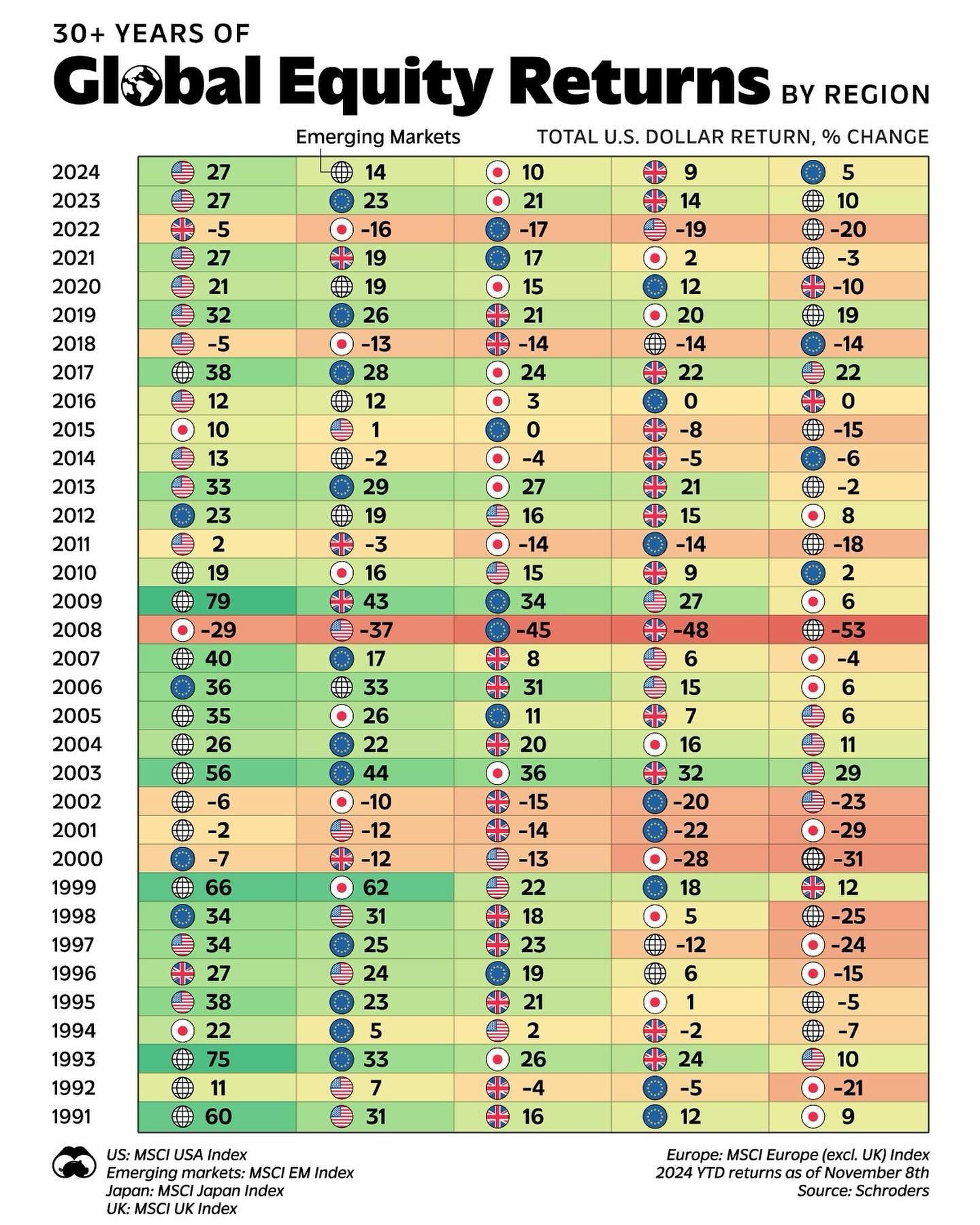
Emerging Markets Performance
Equity markets have seen significant shifts in performance over the past three decades, with emerging markets and established regions like the U.S. taking turns in the spotlight. Since 1991, the global equity landscape has been dynamic, with different regions experiencing periods of dominance.
Why This Matters
Understanding the historical performance of equity markets across different regions is crucial for investors. It provides context for current market conditions, helps in making informed investment decisions, and offers insights into the potential future performance of various regions. By examining the performance trends, investors can better allocate their portfolios and manage risks.
Main Discussion
The Rise and Fall of Emerging Markets
From 1991 to 2010, emerging markets were the top-performing region, delivering strong returns for 12 out of those 20 years. This period was marked by rapid economic growth in countries like China, India, and Brazil, which fueled significant stock market gains. The MSCI Emerging Markets Index, which tracks the performance of large and mid-cap stocks in emerging markets, saw substantial growth during this time.
The U.S. Dominance
In the more recent past, from 2009 to 2023, the U.S. has emerged as the dominant player in global equity markets. The MSCI U.S. Index, which represents the performance of large and mid-cap U.S. stocks, has been the top returning region for 10 out of the past 15 years. This period has been characterized by strong economic growth, technological innovation, and robust corporate earnings in the U.S.
Comparing Regional Performance
While the U.S. and emerging markets have had their periods of dominance, other regions like Europe and Japan have also shown varying levels of performance. The MSCI Europe Index, which includes stocks from countries like Germany, France, and the Netherlands, and the MSCI Japan Index, which includes stocks from Japan, have also experienced periods of significant growth and volatility.
Visualizing the Data
The visualization of total U.S. dollar return percentage changes from 1994 to 2024 provides a clear picture of how different regions have performed over the years. Emerging markets, for instance, showed significant volatility, with years of high returns followed by years of lower or even negative returns. In contrast, the U.S. market has shown more consistent performance, with fewer extreme fluctuations.
Practical Tips
Diversifying Your Portfolio
Given the cyclical nature of regional equity market performance, diversification is key. Investors should consider allocating a portion of their portfolio to emerging markets, even during periods when they are not the top performers. This can help capture potential high-growth periods and mitigate risk.
Staying Informed
Keeping up with economic trends and geopolitical events in different regions can provide valuable insights. For example, understanding the economic policies of emerging countries, such as China and India, can help in making informed investment decisions.
Using Indexes for Benchmarking
Indexes like the MSCI U.S., Europe, Japan, and Emerging Markets Indexes serve as useful benchmarks for evaluating the performance of individual stocks or portfolios. By comparing the performance of your investments to these indexes, you can gain a better understanding of their relative performance.
Important Takeaways
- Historical Context Matters: Understanding the historical performance of different regions can provide valuable context for current market conditions.
- Emerging Markets Have Potential: Despite recent volatility, emerging markets have shown tremendous growth potential over the long term.
- Diversification is Key: Allocating investments across different regions can help manage risks and capture opportunities during different market cycles.
- Stay Informed: Keeping up with global economic trends and geopolitical events is essential for making informed investment decisions.
- Use Indexes as Benchmarks: Comparing the performance of your investments to regional indexes can provide a clearer picture of their relative performance.
Conclusion
The performance of global equity markets has been dynamic and cyclical, with emerging markets and the U.S. taking turns as the top-performing regions. By understanding the historical context, staying informed, and diversifying your portfolio, you can navigate the complexities of global equity markets more effectively. Whether you are a seasoned investor or just starting, keeping an eye on regional performance trends can help you make more informed investment decisions.
Watch the Reel
Questions readers ask
What are emerging markets and why are they significant in global equity returns since 1991?
Emerging markets refer to economies that are transitioning from a low income, less developed, often rural economy, to a modern, industrialized economy. They are significant in global equity returns since 1991 because of their rapid economic growth and volatility, which can greatly impact overall portfolio performance. The emerging markets equity performance has seen shifts in dominance compared to U.S. equities, making them a key area of interest for investors.
How have U.S. equities performed in comparison to emerging markets since 1991?
Since 1991, U.S. equities have shown strong performance, particularly in recent years. While emerging markets led in the early decades, U.S. equities have taken the lead in more recent periods, demonstrating resilience and consistent growth. This performance is often attributed to the stability and maturity of the U.S. economy, as well as the dominance of U.S. companies in global markets.
What factors contribute to the alternating periods of dominance between emerging markets and U.S. equities?
The alternating periods of dominance between emerging markets and U.S. equities can be attributed to various factors, including economic growth rates, geopolitical stability, and market volatility. Emerging markets often experience rapid growth but also higher volatility, while the U.S. market tends to offer more stability. Additionally, global economic trends and regulatory environments play significant roles in shaping these performance patterns.
Why is it important for investors to understand the historical performance of global equity markets, including the U.S. and emerging markets?
Historical performance analysis helps investors understand the cyclical nature of global equity markets and anticipates future trends. By examining the equity performance comparison of the US equity market performance and emerging markets growth 1991-2024, investors can make informed decisions, allocate their portfolios effectively, and manage potential risks. This understanding allows investors to navigate market fluctuations and optimize their investment strategies.
What is the significance of the global equity index in analyzing equity returns since 1991?
The global equity index provides a comprehensive view of equity returns for a broad range of markets, including both U.S. and emerging markets. By analyzing the global equity index, investors can assess the overall performance of global equity markets, identify trends, and compare the performance of different regions. This index helps in understanding the broader context of equity returns since 1991, offering insights into the relative performance of various markets.
How do economic growth rates in emerging markets impact their equity performance compared to the U.S.?
Emerging markets often experience higher economic growth rates, which can drive significant returns for investors. However, this rapid growth is often accompanied by higher volatility and uncertainty. In contrast, the U.S. market typically offers more stable growth, although at a slower pace. Understanding these dynamics helps investors balance their portfolios and navigate the risks and opportunities associated with emerging markets and U.S. equities.
What can investors learn from the performance of emerging markets and U.S. equities over the 2010-2024 period?
The 2010-2024 period provides valuable insights into the resilience and growth potential of both emerging markets and U.S. equities. During this time, U.S. equities have shown strong performance, while emerging markets have experienced varying levels of success. This analysis helps investors understand the impact of global economic trends, geopolitical events, and market volatility on equity performance, guiding them in making well-informed investment decisions.
Related deep dives
Similar reads based on topic and creator.


Recent articles
Fresh deep dives from the latest Reels we unpacked.




Comments
Be the first to comment.