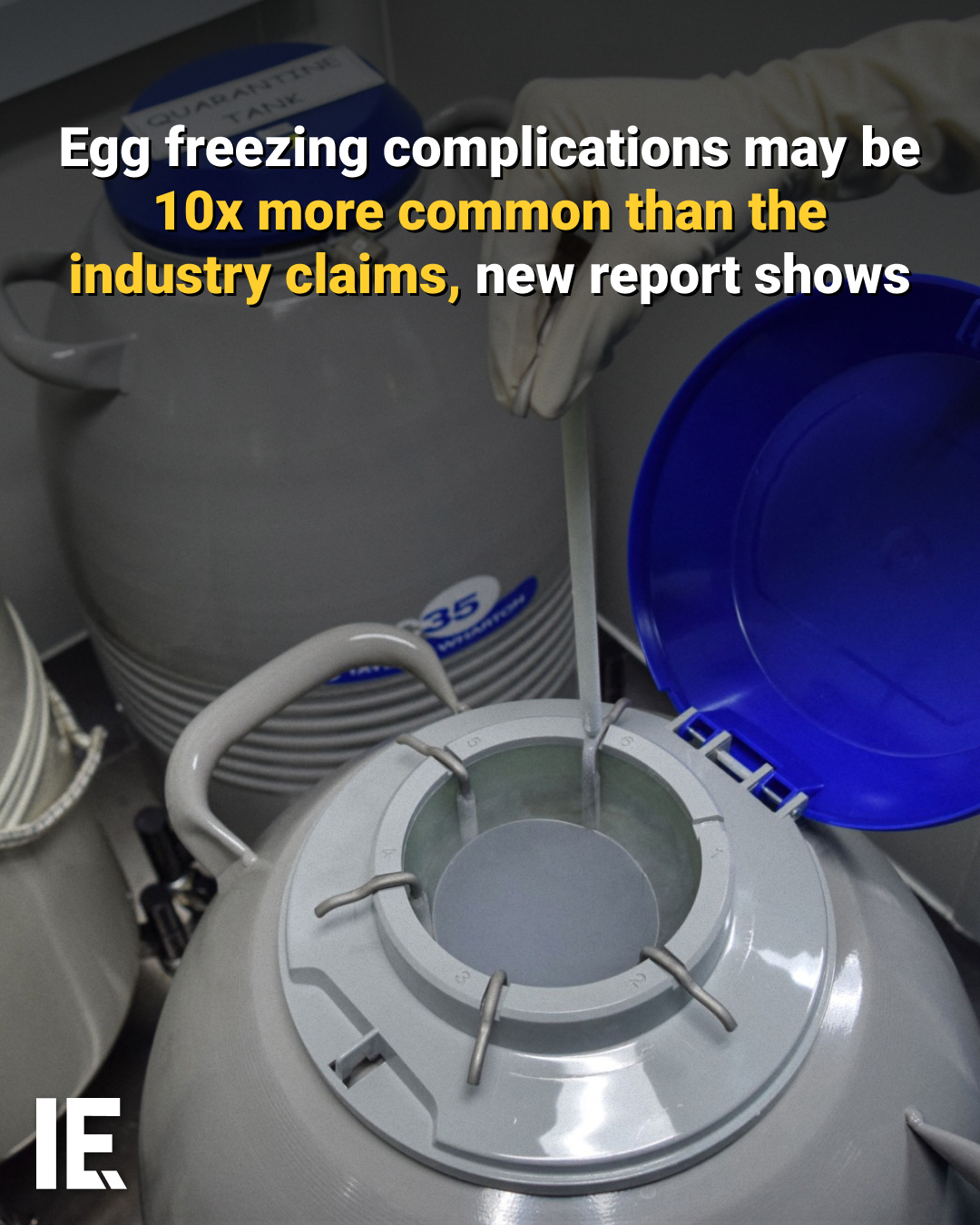
A close up of an industrial cryopreservation tank fills the frame. Oblivious to the viewer, the tank stores and protects a woman's fertility options. A text overlay reveals a disturbing truth. Egg freezing complications may be 10 times more common than the industry claims. This revelation disrupts the smooth narrative of fertility preservation, raising questions about medical claims, women’s health, and procedural transparency.
The Quiet Cryopreservation Tank
Egg freezing — a process of cryopreservation — offers women the ability to preserve their eggs at a given point in time, be it for elective or medical reasons. By stifling time in a cryopreservation tank, eggs can be preserved and thawed years later for use in assisted reproduction. The century-old process of cryopreservation involved a gradual reduction of temperature, but modern vitrification techniques flash-freeze eggs at -320.8 Fahrenheit, creating a glass-like solid that halts time for extended periods. Despite its complexity, this procedure is often marketed as a safe and reliable segue for fertility preservation. The tank is a humdrum witness to hope and fear. Fertility clinics and media outlets tend to report success rates for egg freezing, focusing on positive outcomes, the number of babies born per cycle, and statistical improvements. But success rates alone offer a limited view of the process. Other metrics are just as telling, particularly the rate of complications. The process of freezing eggs involves extracting them from the ovaries, freezing them, and then thawing the eggs once a woman decides to use them. Risks can arise at any point in this chain; complications often happen during the egg retrieval phase, which is technically an invasive surgery. These complications are side effects, not the intended outcomes of egg freezing.
The Quiet Revolution in Fertility
Medical advancements in fertility preservation have brought hope to women. Egg freezing has empowered women of all ages, but especially those with cancer, who face fertility loss from medical treatments. This technology could also benefit women who want to pursue parenthood at a more advanced age, offering a kind of insurance policy in case they struggle with infertility in future years. However, egg freezing is not a guaranteed solution for future parenthood. Age impacts the number and quality of eggs retrieved; younger patients tend to produce higher quantities and better quality eggs. Still, frozen embryos — or eggs that have not been fertilized — are the only option for women who wish to avoid the egg donor or sperm donor process. Despite these limitations, patients are not usually told to weigh the risk of complications at a later date. Even so, recent reports challenge the narrative of safety by revealing a higher incidence of complications than industry reports suggest. Women still lack a full understanding of the potential risks involved.
The Cryopreservation Process
A cryopreservation tank — visible in the video — stares at us. Its blue lid on the side hints at storage systems that monitor temperature and pressure. Inside, thousands of frozen eggs await potential futures as eggs in a warming bath and a fine syringe tip. Eggs are at their most vital inside the ovaries and they must survive the journey. The process begins with hormone stimulation, which encourages the ovaries to produce multiple eggs. After retrieval, the eggs are flash-frozen and stored in liquid nitrogen. These eggs are then kept in cryopreservation tanks at ultra-low temperatures. The tanks need meticulous monitoring, which makes this part of the process rather pricey.
The Egg Extraction
During egg retrieval, the exact problem lurks. The risk of complications, including infection, bleeding, and ovarian hyperstimulation syndrome, exists before the eggs are in the tank. The ovarian hyperstimulation syndrome is a life-threatening condition caused when the eggs are overstimulated and released in excess.
The Quarantine Tank
The OCR reads: "QUARANTINE TANK." This is a storage compartment for infected eggs, which have been safely isolated. The tank might seem alarming, but its purpose is clear. It provides space for eggs from infected or isolated patients. This step in the process illustrates the separation between frozen eggs and possible contaminants.
The Bureaucracy of Complications
The video's report that the complications of egg freezing may be 10 times more common than industry claims widens our understanding. This revelation shifts the complicated process from a medical conversation to a public health transparency question. One factor is the lack of standardized reporting protocols. While the industry may report success rates, there is no standardized protocol for tracking complications and adverse events. This makes it difficult to assess the true risk-benefit ratio of the procedure. Another issue is the marketing of egg freezing in media. Popular outlets often frame egg freezing as an empowering procedure. The public needs to understand that the balance between fertility and risk is not as straightforward as it seems.
The High Cost of Egg Freezing
Medical providers offer egg freezing as a solution for fertility struggles, but it comes at a high cost. The process requires several thousand dollars for the initial procedure, and there are annual costs to keep the eggs in storage. For women pursuing fertility options but unable to afford this procedure, it is a monumental financial decision. Because of the expensive nature, companies like Google and Apple have covered egg freezing in the past. In addition, fertility clinics are ethically obligated to weigh risks against benefits when presenting egg freezing options.
- Cost of first cycle: The initial retrieval cycle can cost between 10,000 to 15,000 dollars.
- Annual Storage Costs: Annual storage fees often range between 500 to 2,000 dollars.
- Medications: Prices for fertilizing drugs range between 10,000 to 20,000 dollars.
- Additional Cycles: Sometimes, more than one cycle is needed.
Decoding the Claims
Women eyeing fertility preservation need to fully decode the information available. The current data suggests a lack of transparency, so the research is the only route to peace of mind. Women must process these risks, costs, and outcomes in addition to the emotional toll of trying to preserve your fertility. Researchers and experts continue to work on refining egg freezing techniques. While the procedure is not new, its uses and applications for preserving fertility evolve. As technology progresses, the necessity of the quarantine tank could fade away, as would the risks of complications.
Watch the Reel
Related deep dives
Similar reads based on topic and creator.

Recent articles
Fresh deep dives from the latest Reels we unpacked.




Comments
Be the first to comment.