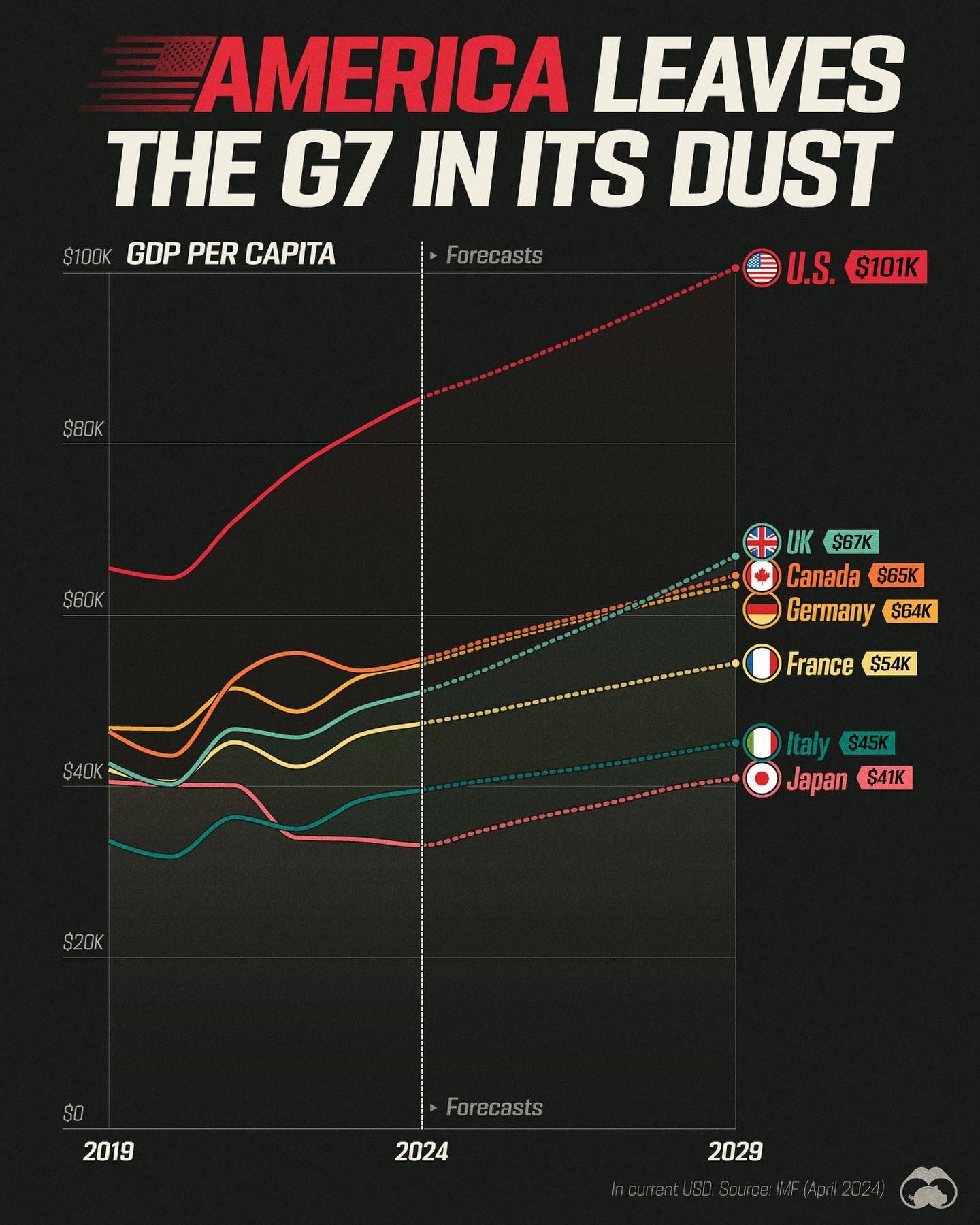
Economic Comparison of G7 Nations: GDP Per Capita Forecasts to 2029
The projected GDP per capita of the United States and other G7 nations through 2029 offers valuable insights into global economic trends. The International Monetary Fund (IMF) forecasts that the U.S. will lead the group, surpassing $100,000 in GDP per capita by 2029. This outlook is significant as it reflects the economic recovery and growth trajectories of these major economies.
Why This Matters
Understanding the GDP per capita forecasts of G7 nations is crucial for several reasons. It provides a snapshot of economic health, influencing investment decisions, trade policies, and global economic stability. The projections also highlight how countries are bouncing back from the pandemic, with the U.S. showing the strongest recovery among G7 nations.
Main Discussion
U.S. Economic Outlook
The U.S. is projected to achieve a GDP per capita of $101,000 by 2029, a significant milestone that underscores its economic resilience and robust growth. This forecast reflects several factors, including a strong labor market, technological advancements, and effective fiscal policies. The U.S. economy has shown remarkable adaptability, particularly in recovering from the pandemic, which has contributed to its positive outlook.
Comparative Analysis of G7 Nations
-
United Kingdom (UK): The UK is expected to have a GDP per capita of $67,000 by 2029, showing steady growth but lagging behind the U.S. The UK's economic performance is influenced by factors such as Brexit and its impact on trade, as well as domestic policy decisions.
-
Canada: With a projected GDP per capita of $64,000, Canada's economic outlook is stable but modest compared to the U.S. Canada's economy benefits from its diverse sectors, including natural resources, manufacturing, and services. However, it faces challenges such as housing affordability and climate change mitigation.
-
Germany: Germany is expected to have a GDP per capita of $64,000 by 2029. As Europe's largest economy, Germany's performance is crucial for the region. Known for its manufacturing prowess, particularly in automotive and industrial sectors, Germany's growth is driven by innovation and export-oriented policies.
-
France: France's GDP per capita is projected to reach $54,000 by 2029. France benefits from a strong service sector and significant contributions from tourism and agriculture. However, economic challenges include high unemployment rates and public debt.
-
Italy: Italy's GDP per capita is forecasted to be $45,000 by 2029. Italy faces significant economic challenges, including high public debt and a struggling economy. However, efforts to reform and modernize its industrial base and improve public finances are underway.
-
Japan: Japan is expected to have a GDP per capita of $41,000 by 2029. Japan's aging population and low birth rates are significant economic challenges. However, the country remains a global leader in technology and manufacturing, contributing to its economic resilience.
These forecasts highlight the diverse economic landscapes of G7 nations and the varying factors influencing their growth trajectories.
Practical Tips
When interpreting economic forecasts and making informed decisions, consider the following tips:
- Stay Informed: Keep up to date with the latest economic data and trends. Websites from organizations like the IMF and World Bank offer detailed, reliable information.
- Assess Multiple Factors: Consider a range of economic indicators, including GDP, inflation, unemployment, and trade balances, to get a comprehensive view.
- Consider Long-Term Trends: While short-term fluctuations are important, long-term economic trends provide a more stable basis for decision-making.
- Diversify Investments: Given the varying economic landscapes, diversifying investments across different G7 nations can help mitigate risks and maximize returns.
Important Takeaways
- The U.S. is projected to lead the G7 nations in GDP per capita by 2029, with a forecast of $101,000.
- While other G7 nations show steady growth, they lag behind the U.S. in terms of GDP per capita.
- Understanding the economic trends and forecasts of G7 nations is essential for making informed investment and policy decisions.
Conclusion
The economic forecast for the G7 nations provides a clear picture of their respective trajectories in the coming years. The U.S. stands out with a projected GDP per capita of $101,000 by 2029, reflecting its strong economic recovery and growth potential. Other G7 nations, while showing steady progress, face unique challenges and opportunities that shape their economic landscapes. By staying informed and considering multiple factors, individuals and organizations can navigate these trends and make strategic decisions.
Watch the Reel
Questions readers ask
What is GDP per capita and why is the U.S. projection for 2029 notable?
GDP per capita is a measure of a country's economic output per person. The U.S. projection to surpass $100,000 in GDP per capita by 2029 is notable because it signifies robust economic growth and recovery, positioning the U.S. as a leader among G7 nations.
How does the U.S. GDP per capita projection compare to other G7 countries?
The International Monetary Fund (IMF) forecasts that the U.S. will have the highest GDP per capita among G7 countries by 2029. This places the U.S. above nations like Canada, France, and Germany, which are also expected to see growth but at a slower pace.
What factors contribute to the U.S. economic recovery and GDP per capita growth?
Several factors contribute to the U.S. economic recovery and GDP per capita growth, including strong fiscal and monetary policies, a resilient private sector, and innovations in technology and industries like healthcare. The U.S.'s diverse economy also plays a significant role in its ability to rebound from economic setbacks.
What does the U.S. GDP per capita projection mean for global trade and investment?
The projection of the U.S. surpassing $100,000 in GDP per capita by 2029 can influence global trade and investment decisions. Investors may see the U.S. as a more attractive market due to its strong economic outlook, potentially leading to increased foreign direct investment and influencing trade agreements.
How has the pandemic affected the GDP per capita of G7 nations and their recovery paths?
The pandemic initially caused a significant slowdown in GDP per capita growth for most G7 nations. However, countries have shown varying recovery paths, with the U.S. demonstrating strong resilience. By 2029, the U.S. is expected to not only recover from the pandemic-induced downturn but also to surpass pre-pandemic levels significantly.
Related deep dives
Similar reads based on topic and creator.


Recent articles
Fresh deep dives from the latest Reels we unpacked.




Comments
Be the first to comment.