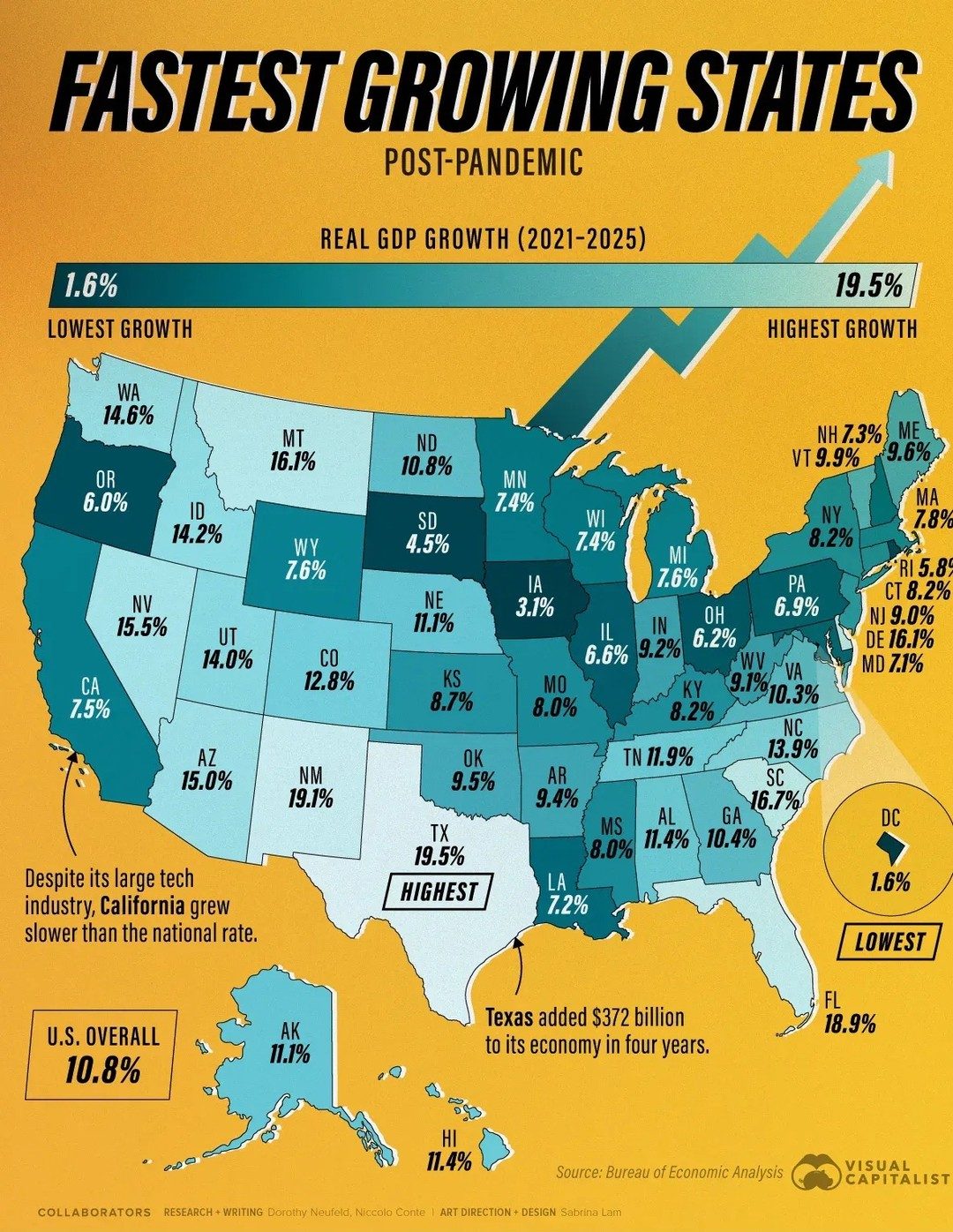
US Economic Growth by State
Economic growth has varied dramatically across the United States since 2021, with some states showing remarkable expansion while others lag behind. The data from the Bureau of Economic Analysis reveals that Texas led the pack with a 19.5% increase in real GDP, outpacing all other states. Meanwhile, California, often at the forefront of technological advancements like the AI boom, saw a modest growth of just 7.5%. This disparity highlights the diverse economic landscapes across the country.
Context
Understanding the economic growth of individual states is crucial for investors, policymakers, and businesses. It provides insights into which regions are thriving, where opportunities for investment lie, and which areas may need economic support. The period from 2021 to 2025 is particularly noteworthy as it includes the post-pandemic recovery phase, making it a critical timeframe to analyze.
Main Discussion
Texas: The Economic Powerhouse
Texas stands out with a staggering 19.5% growth, adding $372 billion to its economy in just four years. This growth is a testament to the state's robust economy, driven by sectors such as energy, technology, and manufacturing. The state's favorable business environment, including low taxes and a skilled workforce, has attracted numerous companies, fueling its economic expansion.
The AI Boom and California's Growth
Despite leading the AI boom, California's economic growth of 7.5% trails the national average. This discrepancy suggests that while the AI sector is thriving, it has not been enough to significantly boost the overall state economy. California's high cost of living and regulatory environment may also be factors contributing to its relatively lower growth compared to other states.
Regional Performances
The economic growth across the country is not uniform. States in the Northeast and Midwest generally show lower growth rates. For instance, states like Michigan, Illinois, and Minnesota have growth rates below 10%. In contrast, states in the South and Southwest, such as Florida, Georgia, and Nevada, are experiencing significant growth, often exceeding 15%.
High-Growth States
- Texas (19.5%): As mentioned, Texas leads the way with significant contributions from energy, tech, and manufacturing.
- New Mexico (19.1%): Driven by government spending and defense industries.
- Florida (18.9%): Benefits from tourism, real estate, and a growing tech sector.
- Nevada (15.5%): Tourism and entertainment are the primary drivers.
- Colorado (12.8%): Known for its aerospace and tech industries.
Low-Growth States
- District of Columbia (1.6%): Lagging behind all other states, largely due to its unique economic structure heavily reliant on federal government activities.
- Washington (14.6%): Despite being home to major tech companies, its growth is modest.
- Montana (10.8%): The state's remote location and reliance on agriculture and tourism contribute to its lower growth.
Economic Contributions
The significant economic contributions of high-growth states are crucial for the national economy. Texas's addition of $372 billion alone is a substantial boost to the overall GDP. These states often serve as economic engines, driving innovation, job creation, and investment opportunities.
Practical Tips
For businesses and investors, understanding state-level economic growth can be a strategic advantage. Here are some practical tips:
- Investment Opportunities: Look for states with high growth rates, particularly in sectors driving that growth. Texas's energy and tech sectors, for example, present lucrative investment opportunities.
- Business Expansion: Consider expanding operations in states with robust economic growth. These states often have favorable business environments and a skilled workforce.
- Risk Management: Diversify investments across multiple states to mitigate risks associated with economic downturns in any single region.
Important Takeaways
- Texas is the fastest-growing state, with a 19.5% increase in real GDP.
- California's growth of 7.5% is modest despite leading the AI boom.
- The economic growth varies significantly across the country, with the South and Southwest generally performing better than the Northeast and Midwest.
- High-growth states contribute substantially to the national economy, providing investment opportunities and driving innovation.
Conclusion
The economic landscape of the United States is diverse and dynamic. Texas's remarkable growth and California's modest performance highlight the varied factors influencing state economies. Investors and businesses should closely monitor these trends to capitalize on opportunities and manage risks effectively. By understanding the economic performance of individual states, stakeholders can make more informed decisions, fostering growth and development across the nation.
Watch the Reel
Questions readers ask
Why has Texas shown significant economic growth compared to other states?
Texas's economic growth can be attributed to its business-friendly environment, which includes lower taxes and less regulatory burden. Additionally, the state's diverse economy, spanning sectors like energy, technology, and healthcare, has contributed to its remarkable 19.5% increase in real GDP.
How does California's economic growth compare to Texas?
California's economic growth has lagged behind Texas, with a modest 7.5% increase in real GDP. Despite being a hub for technological advancements like the AI boom, California's growth has been outpaced by Texas, highlighting the varied economic landscapes across the country.
Which sectors are driving Texas's economic growth?
Texas's economic growth is driven by a diverse range of sectors. Key contributors include energy, particularly oil and gas, as well as technology, healthcare, and manufacturing. This diversification has helped the state maintain robust economic performance.
What insights can be gained from comparing state GDP growth?
Comparing state GDP growth provides valuable insights into regional economic trends. It helps investors identify promising markets, aids policymakers in allocating resources, and assists businesses in making informed decisions about expansion and investment opportunities.
What is the economic outlook for Texas in the coming years?
The economic outlook for Texas is largely positive, with projections indicating continued growth. Factors such as ongoing infrastructure investments, a strong job market, and a favorable business environment are expected to support this trajectory, making Texas a key player in the US economic recovery.
Recent articles
Fresh deep dives from the latest Reels we unpacked.




Comments
Be the first to comment.