Economic Development Indicator: Measuring Evenness Within Countries
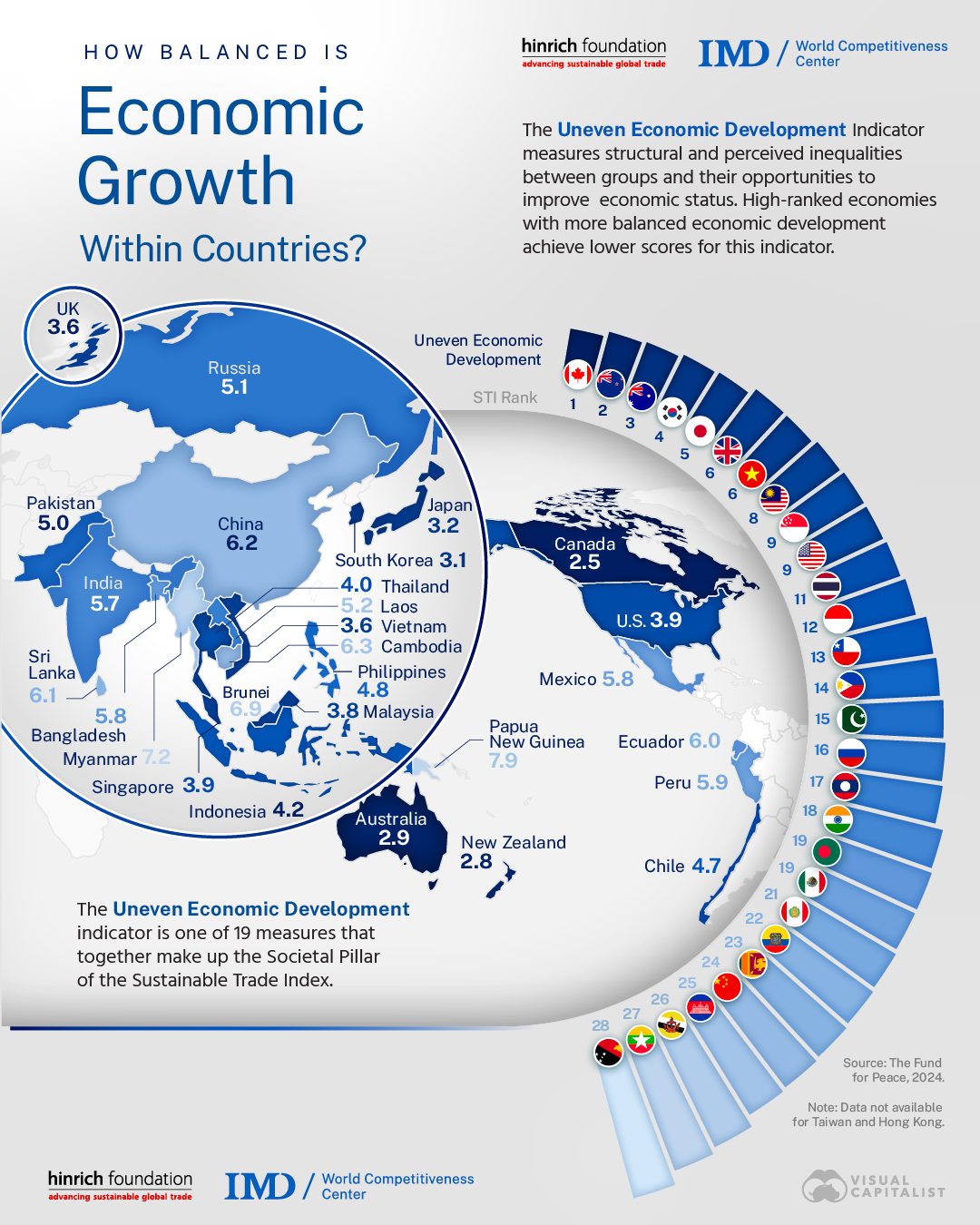
Economic development within countries can vary dramatically, with some regions thriving while others lag behind. This unevenness is a critical factor in global economic dynamics. The 'Uneven Economic Development' indicator, developed in partnership with the Hinrich Foundation and using data from the Fund for Peace, provides a fascinating lens through which to examine these disparities.
Context / Why this matters
Understanding the evenness of economic development within countries is crucial for several reasons. It sheds light on regional inequalities, highlights areas that may require targeted development efforts, and provides insights into the overall stability and sustainability of a country's economy. By identifying which countries excel in even distribution of economic growth and which struggle, policymakers and economists can make more informed decisions to address these imbalances.
Main discussion
The Uneven Economic Development Indicator
The 'Uneven Economic Development' indicator is one of 19 measures that comprise the Societal Pillar of the Sustainable Trade Index (STI). This indicator specifically focuses on the distribution of economic development within a country's borders. The data reveals significant variations, with some countries showing remarkable evenness while others exhibit stark disparities.
High Performers
Countries that rank high on this indicator typically demonstrate a more balanced distribution of economic growth. For instance, Singapore and Brunei lead the pack with scores of 4.2 and 4.0, respectively. These countries have managed to distribute economic benefits more evenly across their regions, contributing to overall stability and prosperity.
Middle Ground
In the middle ground, countries like Thailand, UK, and the Philippines score between 3.2 and 4.8. These nations show a moderate level of evenness in economic development. While there are still regional disparities, efforts to balance growth are more evident. For example, the Philippines' score of 4.8 indicates a somewhat balanced approach to economic development, despite challenges in certain regions.
Laggards
At the lower end of the spectrum, countries like Papua New Guinea, Peru, and Ecuador score 7.9, 5.9, and 6.0, respectively. These scores suggest significant inequalities in economic development. Regions in these countries may be severely underdeveloped compared to others, highlighting the need for targeted interventions to bridge these gaps.
Key Findings
The infographic highlights several noteworthy findings:
- Leading Economies: Countries like Singapore and Brunei exemplify even economic development. Their high scores indicate a more equitable distribution of economic benefits across different regions.
- Moderate Performance: Thailand, UK, and the Philippines showcase a moderate level of evenness. While they face regional disparities, their overall economic strategies are more balanced.
- Room for Improvement: Countries like Papua New Guinea, Peru, and Ecuador have significant room for improvement. Their lower scores reflect substantial inequalities that need to be addressed.
Regional Inequalities
Regional inequalities within countries can manifest in various ways, including disparities in income levels, access to services, and infrastructure development. These inequalities can have far-reaching consequences, affecting social stability, political cohesion, and economic growth.
Income Disparities
Income disparities are a common indicator of uneven economic development. Regions with higher income levels often have better access to education, healthcare, and job opportunities. Conversely, regions with lower income levels may struggle with poverty, limited services, and fewer economic prospects.
Access to Services
Access to essential services such as healthcare, education, and public utilities is another critical factor. Regions with well-developed infrastructure and services tend to attract more investment and economic activity. In contrast, regions lacking these services may face higher levels of poverty and stagnant economic growth.
Infrastructure Development
Infrastructure development plays a pivotal role in economic growth. Regions with robust infrastructure, including transportation networks, communication systems, and energy supplies, are more likely to attract investment and foster economic activity. Conversely, regions with inadequate infrastructure may struggle to keep pace with more developed areas.
Practical tips
For policymakers and economists, addressing uneven economic development requires a multipronged approach. Here are some practical tips to consider:
- Targeted Investments: Allocate resources to underdeveloped regions to improve infrastructure, education, and healthcare. This can help bridge economic disparities and foster more balanced growth.
- Policy Reforms: Implement policies that promote economic activities in lagging regions. This could include tax incentives, subsidies, and regulatory reforms.
- Public-Private Partnerships: Encourage collaboration between the public and private sectors to drive economic development in underdeveloped regions. Public-private partnerships can leverage resources and expertise to achieve better outcomes.
- Data-Driven Decisions: Use data and analytics to identify regions that require attention and to track the effectiveness of development initiatives. This data-driven approach can help in making informed decisions and measuring progress.
- Community Engagement: Involve local communities in the planning and implementation of development projects. This ensures that initiatives are tailored to local needs and have community support.
Important takeaways
Understanding the evenness of economic development within countries is essential for fostering sustainable growth and addressing regional inequalities. The 'Uneven Economic Development' indicator provides valuable insights into these disparities, highlighting which countries are leading the way and which face significant challenges.
Conclusion
The 'Uneven Economic Development' indicator offers a comprehensive view of how economic benefits are distributed within countries. While some nations excel in balancing growth, others face substantial inequalities that require urgent attention. By leveraging data and implementing targeted strategies, policymakers can work towards a more even distribution of economic development, fostering stability and prosperity for all regions.
Watch the Reel
Questions readers ask
What is the 'Uneven Economic Development' indicator and how is it calculated?
The 'Uneven Economic Development' indicator is a tool developed in partnership with the Hinrich Foundation. It uses data from the Fund for Peace to measure the distribution of economic growth within countries, revealing regional disparities and highlighting areas that may require targeted development efforts.
Why is understanding economic evenness important for a country's economic stability?
Understanding economic evenness is crucial for identifying regional inequalities and ensuring overall economic stability. This allows policymakers to address disparities, target resources effectively, and promote balanced economic growth, which can mitigate risks of instability and foster sustainable development policies.
Which countries are highlighted in the article for their economic development disparities?
The article mentions several countries, including Thailand, Russia, Pakistan, China, Japan, and South Korea, which have been analyzed using the 'Uneven Economic Development' indicator to assess the distribution of economic growth within their borders.
How can policymakers use the 'Uneven Economic Development' indicator to shape economic development policies?
Policymakers can utilize this indicator to identify regions that are lagging behind in economic growth, then allocate resources and implement targeted policies to address these disparities. By doing so, they can promote more balanced economic development, enhance regional cohesion, and contribute to the overall stability of the country's economy.
What role does the Fund for Peace play in the analysis of economic evenness within countries?
The Fund for Peace provides the data that is essential for analyzing the 'Uneven Economic Development' indicator. This data helps in identifying regional economic inequalities and assessing the distribution of economic growth, enabling a comprehensive understanding of the economic landscape within countries.
How does the 'Uneven Economic Development' indicator contribute to addressing regional inequalities?
The indicator highlights areas with significant economic disparities, allowing policymakers to direct resources and interventions where they are most needed. This targeted approach helps in reducing regional economic inequalities, fostering more balanced growth, and promoting social and economic cohesion within countries.
Can the 'Uneven Economic Development' indicator be applied to all countries, or are there specific criteria for its use?
The indicator can be applied to most countries, as it relies on widely available economic data. However, the usefulness of the data is dependent on the availability of reliable economic statistics and the context of each country, making it an adaptable tool for various economic analyses.
Recent articles
Fresh deep dives from the latest Reels we unpacked.




Comments
Be the first to comment.