East vs. West Coast Economics
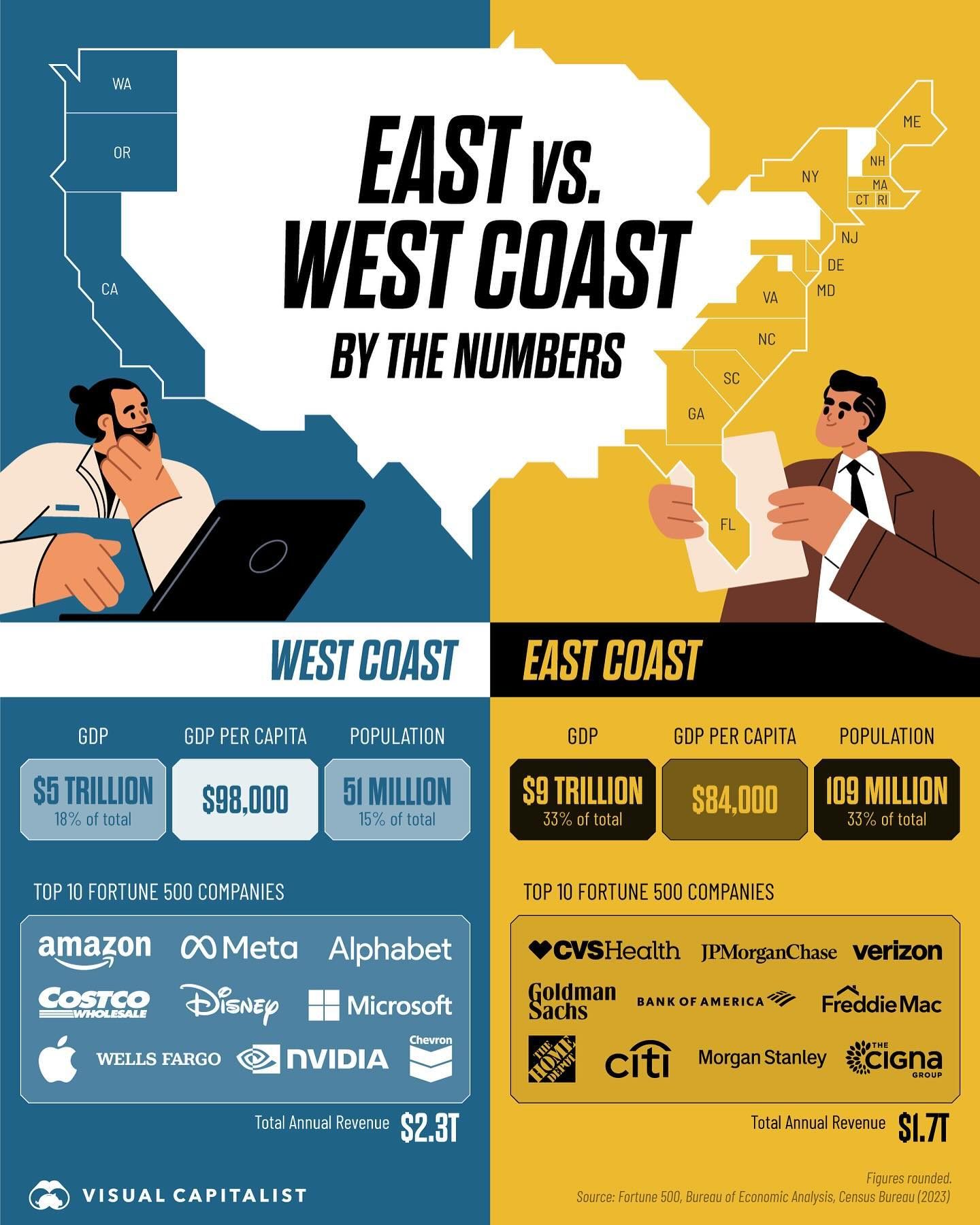
The United States' East and West Coasts are economic powerhouses, each contributing significantly to the nation's total GDP. The Eastern Coast boasts a combined GDP of $9 trillion, approximately a third of the entire U.S. economy. In contrast, the West Coast, with a smaller population, punches above its weight with a higher GDP per capita.
Why This Matters
Understanding the economic dynamics of the East and West Coasts provides valuable insights into the broader economic landscape of the United States. These two regions are home to some of the most influential and profitable companies in the world, driving innovation, employment, and economic growth. By examining the economic productivity of these coasts, we gain a clearer picture of the economic engine that powers the U.S.
Main discussion
East Coast Economic Powerhouse
The East Coast, stretching from Maine to Florida, is a robust economic engine. With a combined GDP of $9 trillion, it generates a significant portion of the U.S. economy. This region is home to several major financial hubs, including New York City, which is the epicenter of global finance. The top 10 Fortune 500 companies on the East Coast include financial giants like Goldman Sachs, Bank of America, and JPMorgan Chase, as well as healthcare powerhouse CVS Health and telecommunications leader Verizon. These companies contribute to the East Coast’s total annual revenue of $1.7 trillion, showcasing the region's economic might.
West Coast Innovation and Wealth
The West Coast, encompassing California, Oregon, and Washington, has a smaller population but a remarkable GDP per capita of $98,000, compared to $84,000 on the East Coast. This higher GDP per capita indicates a more affluent population and a highly productive economy. The West Coast is home to some of the world's most innovative and valuable companies, including Amazon, Meta, Alphabet, Microsoft, and Costco. These tech giants, along with others like Disney and Chevron, contribute to the West Coast’s total annual revenue of $2.3 trillion, highlighting the region's significant economic contributions.
Comparing the Top 10 Fortune 500 Companies
The top 10 Fortune 500 companies on each coast reflect the economic strengths of their respective regions.
East Coast:
- Goldman Sachs
- Bank of America
- Citi
- Morgan Stanley
- Freddie Mac
- CVS Health
- JPMorgan Chase
- Verizon
West Coast:
- Amazon
- Meta
- Alphabet
- Costco
- Wells Fargo
- Disney
- Microsoft
- Chevron
These companies represent a mix of financial services, technology, healthcare, and retail, showcasing the diverse economic landscape of both coasts.
Population and Economic Productivity
The East Coast has a significantly larger population, with 109 million people, compared to the West Coast's 51 million. Despite the smaller population, the West Coast’s higher GDP per capita indicates greater economic productivity per person. This disparity highlights the West Coast's role as a hub for high-value industries, particularly in technology and innovation, which drive higher economic output per capita.
Key Economic Indicators
Several key economic indicators further illustrate the economic differences between the East and West Coasts:
- GDP: The East Coast’s $9 trillion GDP is more than three times the West Coast’s GDP of $2.3 trillion.
- GDP per Capita: The West Coast’s $98,000 GDP per capita is significantly higher than the East Coast’s $84,000.
- Population: The East Coast has a larger population, with 109 million people compared to the West Coast's 51 million.
These indicators underscore the unique economic strengths and contributions of each region.
Practical Tips
For individuals and businesses looking to leverage the economic opportunities on either coast, consider the following practical tips:
- Research Economic Trends: Stay informed about the latest economic trends and industry developments in your region of interest. This will help you identify potential growth opportunities and areas of investment.
- Network with Industry Leaders: Connect with key players in your industry to gain insights and build valuable relationships. Attend industry conferences, join professional organizations, and engage with local business communities.
- Leverage Regional Strengths: Understand the unique strengths of each coast and tailor your strategies accordingly. For example, the East Coast’s strong financial sector can offer valuable opportunities for financial services and investments, while the West Coast’s tech industry can provide innovative solutions and partnerships.
- Explore Collaboration Opportunities: Explore partnerships and collaborations with businesses on the other coast to gain a broader perspective and access new markets.
Important Takeaways
- The East Coast’s economic strength lies in its large population and diverse economic sectors, including finance, healthcare, and telecommunications.
- The West Coast’s higher GDP per capita reflects its focus on high-value industries, particularly technology and innovation.
- Understanding the economic dynamics of both coasts can provide valuable insights and opportunities for businesses and individuals.
Conclusion
The economic comparison between the East and West Coasts of the United States reveals a fascinating landscape of economic strength and productivity. The East Coast’s robust economy, driven by its large population and diverse industries, stands in contrast to the West Coast’s high-value, innovation-focused economy. By examining the key economic indicators and top companies on each coast, we gain a deeper understanding of the economic engine that powers the U.S.
Watch the Reel
Questions readers ask
What are the main economic drivers of the East Coast?
The East Coast's economic strength lies in its major financial hubs, such as New York City, and a high concentration of Fortune 500 companies. These entities contribute significantly to the region's GDP, making it a powerhouse in the national economy.
Why does the West Coast have a higher GDP per capita?
The West Coast's higher GDP per capita is primarily due to the presence of tech giants and innovative enterprises. These companies drive economic growth and productivity, leading to a higher output per person despite a smaller population compared to the East Coast.
How do the East and West Coasts contribute to the U.S. economy?
The East Coast contributes nearly a third of the U.S. economy with a combined GDP of $9 trillion. The West Coast, while having a smaller population, has a significant economic impact due to its high GDP per capita, driven by tech and innovative industries.
What are the top companies on the East Coast compared to the West Coast?
The East Coast is home to many Fortune 500 companies, including financial institutions and major corporations in various sectors. In contrast, the West Coast is dominated by tech giants like Apple, Google, and Amazon, which are key players in the global tech industry.
How does the economic performance of the East Coast compare to the West Coast?
The East Coast has a larger total GDP, driven by its major financial hubs and numerous Fortune 500 companies. The West Coast, however, has a higher GDP per capita due to its tech-driven economy and innovative enterprises, making it a strong competitor in terms of economic productivity.
What insights can be gained from comparing the economic performance of these two regions?
By examining the economic performance of the East and West Coasts, we can understand the unique strengths and contributions of each region to the national economy. This comparison highlights the importance of both financial and tech industries in driving economic growth and innovation in the U.S.
Recent articles
Fresh deep dives from the latest Reels we unpacked.




Comments
Be the first to comment.