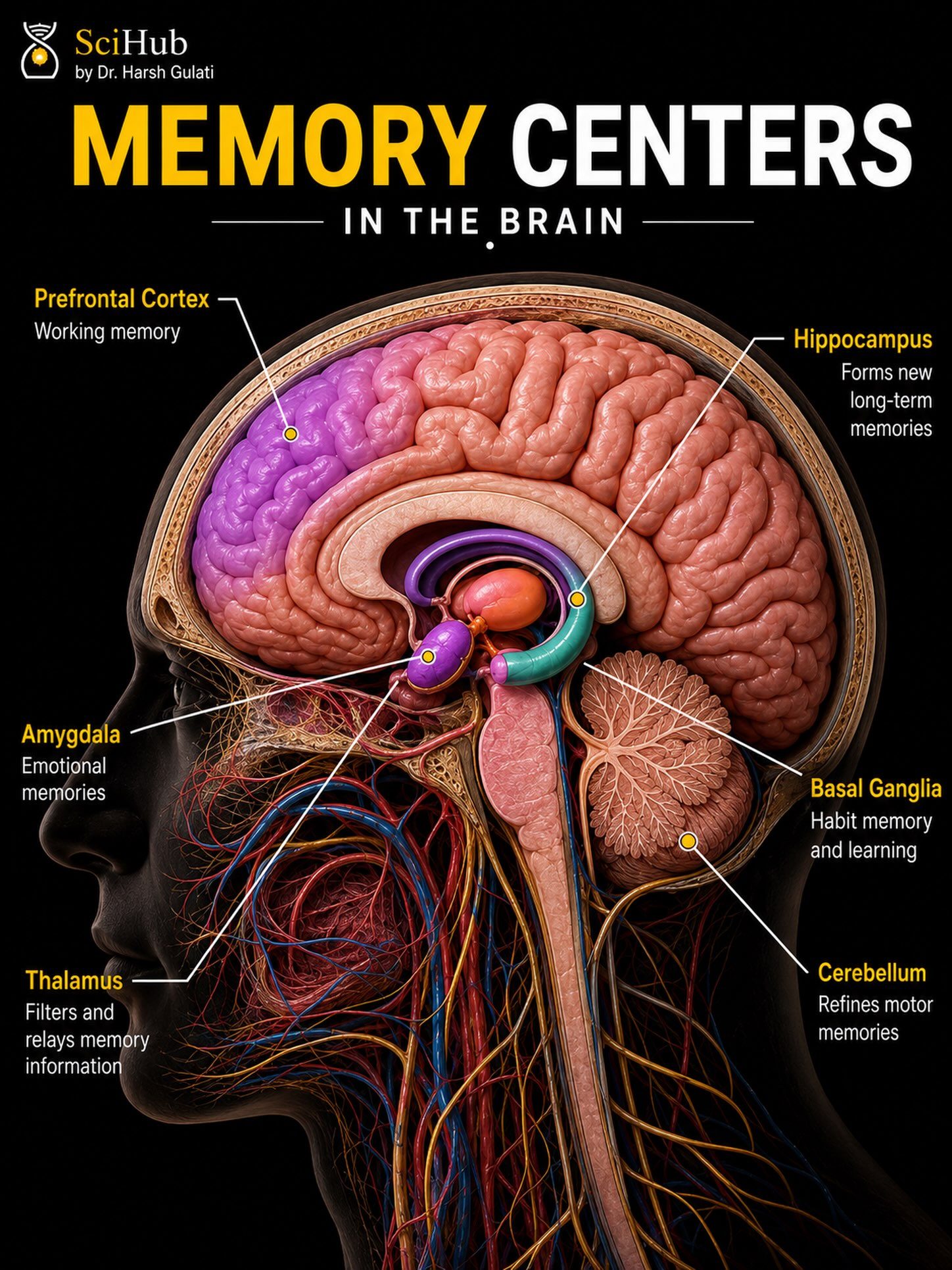
Memory Centers in the Brain
Humans create and retain memories through a complex network of regions within the brain. A better understanding of these memory centers can provide insights into how the brain processes, stores, and retrieves information. Here, we delve into the key regions that make up this remarkable neural network and their specific roles in memory formation and recall.
Context / Why This Matters
Recognition of faces, acquisition of new skills, recollection of events, and decision-making all depend on the intricate workings of different brain regions. Each of these areas plays a pivotal part in the process of creating, organizing, and accessing memories. By understanding these regions, we can better appreciate the complexity and efficiency of the human brain.
Main Discussion
Prefrontal Cortex
The prefrontal cortex is crucial for working memory. This region acts as a temporary storage space for information needed for short-term thinking and decision-making. It allows you to hold and process information for tasks such as problem-solving, planning, and mental calculations. For example, when you are following a recipe, the prefrontal cortex helps you remember the steps and the sequence in which to perform them. This region is also involved in executive functions, such as attention, inhibition, and cognitive flexibility.
Hippocampus
The hippocampus is often referred to as the brain’s memory builder. It plays a central role in converting new experiences into long-term memories. This process, known as memory consolidation, is essential for storing information that we want to retain over extended periods. The hippocampus is particularly active during sleep, helping to reinforce memories and integrate them into our long-term storage system. It is also essential for spatial navigation, allowing us to remember our surroundings and find our way through familiar places.
Amygdala
The amygdala is responsible for processing emotional memories. This region gives emotional significance to memories, which is why emotionally charged events are often remembered more vividly. For instance, the amygdala helps us recall moments of joy, fear, or sadness with greater detail and intensity. Its role in emotional memory helps us learn from our experiences and respond appropriately to future situations.
Basal Ganglia
The basal ganglia are involved in habit memory and learning. This region is responsible for procedural memories, which are memories for how to perform tasks that have become automatic with practice, such as riding a bicycle or typing. The basal ganglia work in tandem with the motor cortex to refine and automate movements, making them smooth and efficient. It also plays a role in reward-based learning, helping us associate actions with positive outcomes.
Thalamus
The thalamus serves as a relay station for sensory information, acting as a central hub that filters and relays memory information to and from different brain regions. It helps in the integration of sensory input, enabling us to perceive and respond to our environment effectively. Its role in memory involves integrating different types of information, allowing for a cohesive memory experience.
Cerebellum
The cerebellum is primarily known for its role in motor coordination, but it also plays a part in refining motor memories. This region helps store and refine motor memories, allowing us to perform complex movements with precision and smoothness. For example, when learning a new skill like dancing or playing a musical instrument, the cerebellum helps in the practice-to-performance transition, making the movements more fluid and less conscious.
Practical Tips
To improve memory and brain health, consider incorporating the following tips into your daily routine:
- Exercise Regularly: Physical activity boosts blood flow to the brain, improving memory and cognitive function.
- Maintain a Healthy Diet: Consuming a balanced diet rich in antioxidants, omega-3 fatty acids, and other essential nutrients supports brain health.
- Get Adequate Sleep: Quality sleep is crucial for memory consolidation and overall cognitive function.
- Engage in Mental Stimulation: Activities like puzzles, reading, and learning new skills help keep the brain active and enhance memory.
- Practice Mindfulness: Mindfulness and meditation can improve focus and reduce stress, both of which are beneficial for memory.
Important Takeaways
- The brain's memory centers work together to store, organize, and recall information. The prefrontal cortex, hippocampus, amygdala, basal ganglia, thalamus, and cerebellum each play a unique and vital role in this process.
- The prefrontal cortex is essential for working memory and short-term decision-making.
- The hippocampus converts new experiences into long-term memories.
- The amygdala gives emotional significance to memories, making them more vivid.
- The basal ganglia are responsible for habit and procedural memory, such as riding a bicycle or typing.
- The thalamus acts as a relay station, filtering and organizing sensory information.
- The cerebellum helps refine motor memories, allowing for smooth and coordinated movements.
Conclusion
The brain's memory centers are a complex and interconnected network that enable us to remember, learn, and navigate our world. By understanding the roles of the prefrontal cortex, hippocampus, amygdala, basal ganglia, thalamus, and cerebellum, we gain a deeper appreciation for the brain's remarkable ability to process and store information.
Watch the Reel
Questions readers ask
What is the role of the prefrontal cortex in memory?
The prefrontal cortex plays a significant role in working memory, which involves temporarily storing and manipulating information. It is also crucial for decision-making and recalling memories, especially those related to complex thoughts and future planning.
How does the hippocampus contribute to memory?
The hippocampus is vital for converting short-term memories into long-term memories, a process known as consolidation. It is particularly important for spatial memory and the recall of personal experiences, or episodic memory. Damage to the hippocampus can lead to difficulties in forming new memories.
What is the function of the amygdala in emotional memory?
The amygdala is key to emotional memory, helping to store and retrieve memories that have strong emotional content. It works closely with the hippocampus to enhance the encoding and recall of emotionally charged events, making memories more vivid and long-lasting.
How do the basal ganglia and thalamus contribute to memory?
The basal ganglia are involved in procedural memory, which includes motor skills and habits. The thalamus acts as a relay center, filtering and sending information to the cerebral cortex, which is crucial for various types of memory, including sensory and motor memories.
What are the different memory systems in the brain?
The brain has several memory systems, including declarative (explicit) memory for facts and events, non-declarative (implicit) memory for skills and habits, and working memory for short-term information. Each system relies on different brain regions and processes.
How does the brain store long-term memories?
Long-term memories are stored through complex processes involving various brain regions, including the prefrontal cortex, hippocampus, and amygdala. These regions work together to encode, consolidate, and retrieve memories, often involving multiple neural pathways and chemical signals.
Related deep dives
Similar reads based on topic and creator.



Recent articles
Fresh deep dives from the latest Reels we unpacked.




Comments
Be the first to comment.