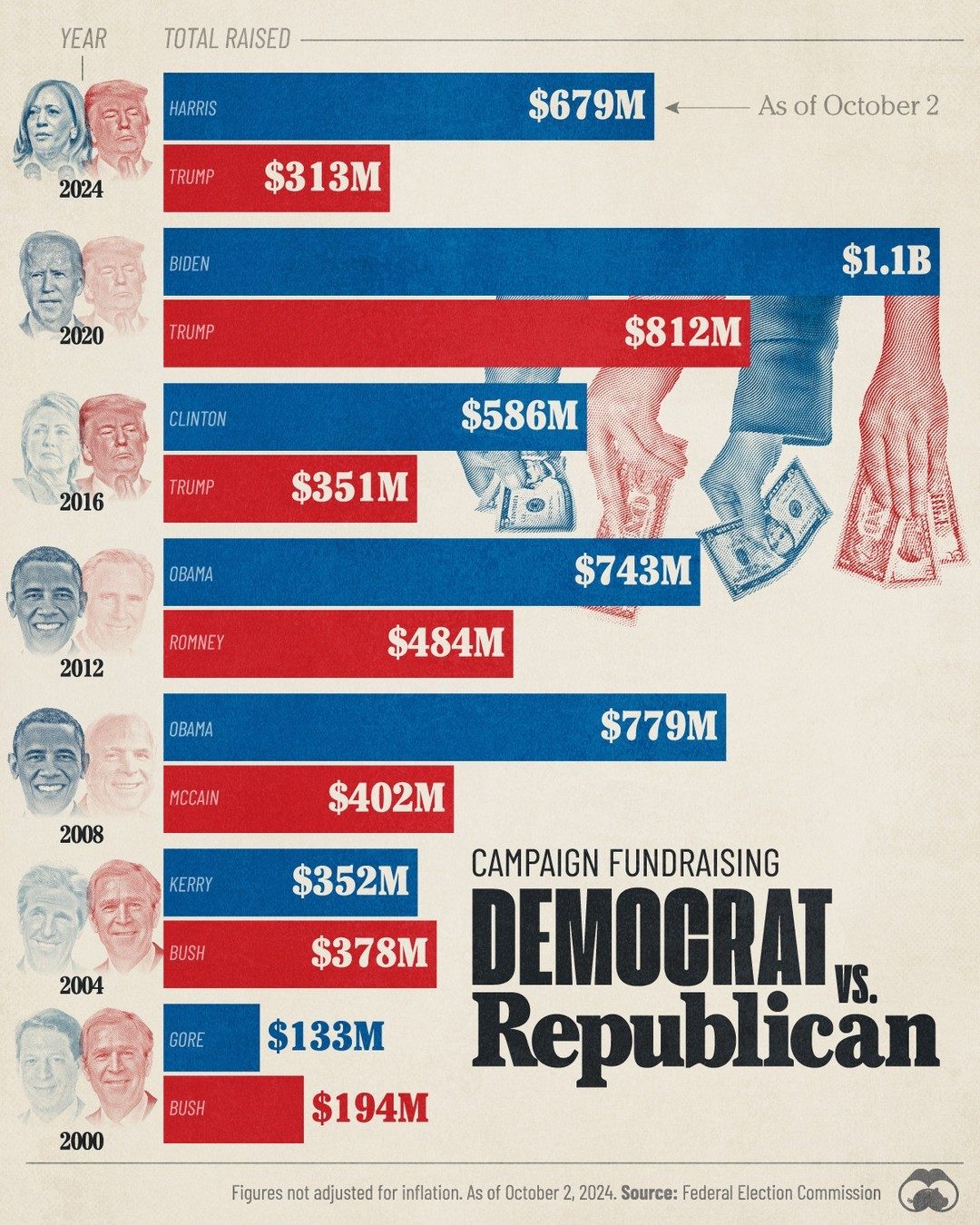
Campaign fundraising is a critical component of U.S. presidential elections, and the financial resources of each party play a significant role in shaping political outcomes. The fundraising disparities between the Democratic and Republican candidates from 2000 to 2024 offer valuable insights into the political landscape and the strategies employed by each party.
Context / Why This Matters
Campaign fundraising is essential for running successful political campaigns. Funds are used for various purposes, including advertising, campaign rallies, staff salaries, and other logistical expenses. The amount of money raised by a candidate can significantly influence public perception, media presence, and ultimately, voter turnout. Understanding the fundraising trends of the Democratic and Republican parties can provide a clearer picture of the political strategies and public support behind each candidate.
Main Discussion
Fundraising Trends from 2000 to 2024
The data from the Federal Election Commission shows a consistent pattern where Democratic candidates have out-raised their Republican counterparts in every presidential election since 2004. This trend is particularly evident in the key election years from 2000 to 2024.
2000 and 2004: The Early Years
In the 2000 election, George W. Bush raised $194 million, while Al Gore raised $133 million. By 2004, the fundraising gap had widened significantly, with John Kerry raising $352 million compared to George W. Bush's total of $378 million. These early years set the stage for a pattern that would continue in subsequent elections, with Democratic candidates often raising more funds than their Republican opponents.
2008 to 2016: The Obama and Clinton Years
In 2008, Barack Obama raised $402 million, while John McCain raised $313 million. The fundraising totals continued to rise in 2012, with Mitt Romney raising $484 million and Barack Obama raising $586 million. The 2016 election saw Hillary Clinton raise $586 million, while Donald Trump raised $812 million.
2020 and 2024: The Modern Era
The 2020 election saw Donald Trump raise $812 million, while Joe Biden's fundraising total was not explicitly mentioned in the data. However, Kamala Harris, who took over after Biden's announcement to step down, raised over $100 million within 36 hours. This rapid fundraising effort highlights the significant financial support and public interest in Kamala Harris' candidacy. The 2024 election data, as of October 2, 2024, shows Kamala Harris raising $679 million, while Donald Trump raised $313 million.
The Impact of Fundraising on Campaign Success
The fundraising totals alone do not determine the outcome of an election, but they are a crucial indicator of a candidate's support base and campaign effectiveness. Higher fundraising totals often translate into better campaign infrastructure, more media coverage, and increased public engagement. However, it is essential to consider other factors such as candidate charisma, public policies, and external events that can influence voter decisions.
Practical Tips for Understanding Campaign Fundraising
Follow the Money Trail
Understanding campaign financing involves following the money trail. This means looking at who contributes to each candidate, how much they contribute, and where the contributions come from. This information is publicly available through the Federal Election Commission and can provide valuable insights into the financial backing of each candidate.
Analyze Spending Patterns
In addition to total fundraising amounts, analyzing how candidates spend their funds can offer a deeper understanding of their campaign strategies. For example, a candidate might spend more on digital advertising, campaign rallies, or ground operations. This information can be found in the Federal Election Commission reports and can help predict a candidate's focus areas and campaign priorities.
Consider External Influencers
External influencers, such as media coverage, public policies, and major events, can significantly impact campaign fundraising and success. For example, a candidate might receive a surge in donations following a strong debate performance or after a major policy announcement. Understanding these external factors can provide a more holistic view of a candidate's campaign trajectory.
Important Takeaways
The fundraising trends from 2000 to 2024 highlight the consistent dominance of Democratic candidates in fundraising efforts. This trend is evident in the data provided by the Federal Election Commission, which shows Democratic candidates out-raising their Republican counterparts in every election since 2004. However, it is essential to consider the broader context, including external influencers and spending patterns, to gain a comprehensive understanding of campaign success.
Conclusion
Campaign fundraising trends from 2000 to 2024 offer valuable insights into the financial support and public engagement surrounding each party's presidential candidates. The data shows a consistent pattern of Democratic candidates out-raising their Republican opponents, with significant fundraising efforts by Democratic candidates in each election year. Understanding these trends and the broader context of campaign financing can provide a clearer picture of the political landscape and the strategic decisions made by each party.
Watch the Reel
Questions readers ask
Why have Democrats typically out-raised Republicans in U.S. presidential elections from 2000 to 2024?
Democrats have typically out-raised Republicans due to a combination of factors, including stronger support from small-dollar donors, larger fundraising events, and robust online fundraising campaigns. Additionally, Democratic candidates have often benefited from endorsements and contributions from high-profile donors and political action committees.
What are some key areas where campaign funds are allocated?
Campaign funds are crucial for various expenses, including advertising, campaign rallies, staff salaries, and other logistical costs. These funds help shape public perception, increase media presence, and ultimately influence voter turnout, making them indispensable for running successful political campaigns.
Who does the article say has typically out-raised their counterparts in presidential elections from 2000 to 2024?
The article states that from 2000 to 2024, Democratic candidates have typically out-raised their Republican counterparts.
How might fundraising trends influence the 2024 presidential election?
Fundraising trends can significantly influence the 2024 presidential election by affecting the resources available for advertising, campaign events, and organizational efforts. Stronger fundraising efforts can help candidates gain a competitive edge in reaching out to voters and shaping public opinion.
What role does the Federal Election Commission (FEC) play in campaign fundraising?
The Federal Election Commission (FEC) plays a crucial role in regulating and overseeing campaign fundraising. The FEC ensures compliance with campaign finance laws, tracks contributions and expenditures, and provides transparency in political campaign finance, making it a vital institution in the democratic process.
Why is it important to compare fundraising strategies between Democrats and Republicans?
Comparing fundraising strategies between Democrats and Republicans provides valuable insights into the political landscape and the strategies employed by each party. By analyzing their tactics, such as the use of small-dollar donations, fundraising events, and online campaigns, one can better understand the dynamics of campaign finance and its impact on election outcomes.
How does public perception influence campaign fundraising?
Public perception can significantly influence campaign fundraising. Positive public perception can attract more donors and contributions, while negative perception can deter potential supporters. Campaigns often invest in advertising and outreach efforts to shape public perception and enhance their fundraising capabilities.
Recent articles
Fresh deep dives from the latest Reels we unpacked.




Comments
Be the first to comment.