Student Debt: A Major Component of U.S. Household Debt
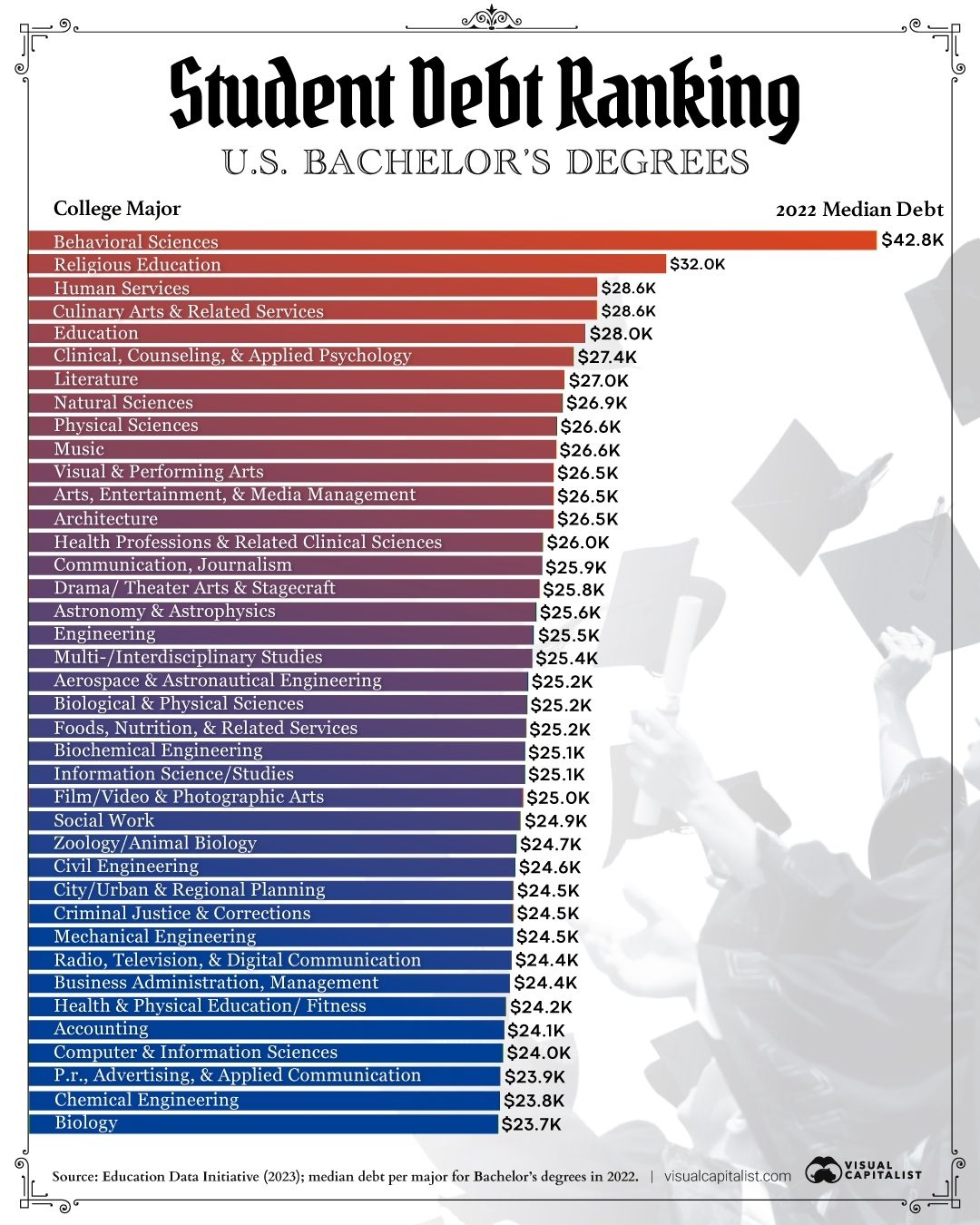
Student debt has reached a staggering $1.6 trillion in the second quarter of 2023, making it the third largest category of U.S. household debt. This significant financial burden has become a broader social issue, impacting millions of Americans. To provide a clearer picture, data from the Education Data Initiative has been visualized to show the median debt per major for bachelor's degrees across the country. This information is crucial for understanding the financial implications of pursuing higher education in various fields.
Why This Matters
Student debt is more than just a personal financial issue; it has wide-ranging economic and social implications. High levels of student debt can affect homeownership rates, career choices, and even mental health. Understanding the median debt per major can help prospective students make more informed decisions about their educational and career paths.
Median Debt by Major
The data reveals significant variations in median debt levels across different majors. Here are some key insights:
Highest Debt Levels
Majors with the highest median debt levels often involve specialized or professional training. For example:
- Religious Education: $32.0K
- Human Services: $28.6K
- Culinary Arts & Related Services: $28.0K
- Education: $27.4K
These fields typically require specialized training, which can be expensive. Students pursuing these degrees may face higher costs for tuition, books, and other related expenses.
Mid-Range Debt Levels
Many majors fall into a mid-range of debt levels, reflecting a balance between the cost of education and potential earning power. Some examples include:
- Clinical, Counseling, & Applied Psychology: $27.0K
- Literature: $26.9K
- Natural Sciences: $26.9K
- Physical Sciences: $26.6K
These fields generally offer a mix of theoretical and practical training, making them versatile but still requiring significant financial investment.
Lower Debt Levels
Certain majors have lower median debt levels, which can be beneficial for students seeking to minimize financial burden. Some examples include:
- Civil Engineering: $24.6K
- Criminal Justice & Corrections: $24.5K
- Mechanical Engineering: $24.5K
- Accounting: $23.8K
These fields often have more direct pathways to employment, which can help students start repaying their loans sooner.
Trends and Patterns
Public vs. Private Institutions
The type of institution a student attends can also impact their debt levels. Public institutions typically have lower tuition rates compared to private nonprofit institutions. This trend can be seen in the median debt levels, where students at public 4-year colleges generally have lower debt compared to their counterparts at private nonprofit 4-year colleges.
Yearly Trends
Year-over-year data shows a consistent increase in student debt levels. Between 2005 and 2021, the median debt per major has steadily risen. This trend reflects the increasing cost of higher education and the need for more financial aid.
Practical Tips for Managing Student Debt
Given the significant debt levels, it's essential for students to have a solid plan for managing their loans. Here are some practical tips:
Choose Your Major Wisely
When selecting a major, consider the potential earning power and job market demand. Majors with higher median debt levels should be matched with fields that offer strong job prospects and competitive salaries.
Research Financial Aid Options
Explore scholarships, grants, and work-study programs to reduce the need for loans. Financial aid can significantly lower the overall debt burden.
Create a Budget
Develop a budget to manage your expenses during college and after graduation. This can help you stay on track with loan repayments and avoid additional debt.
Consider Loan Forgiveness Programs
Some professions, such as teaching and public service, offer loan forgiveness programs. Research these options if your career path qualifies.
Start Repaying Early
If possible, start making payments on your loans while still in school. This can help reduce the overall interest paid over the life of the loan.
Important Takeaways
Financial Planning
Understanding the median debt levels for different majors can help students plan their financial future more effectively. By choosing a major with a lower debt level or pursuing financial aid options, students can mitigate the burden of student debt.
Economic Impact
The rising student debt levels have broader economic implications. High debt levels can affect consumer spending, homeownership rates, and overall economic growth. Policymakers and educators need to address these issues to ensure a more equitable and sustainable future for students and the broader economy.
Informed Decision-Making
This data empowers prospective students to make more informed decisions about their educational and career paths. By choosing majors with lower debt levels or pursuing financial aid options, students can minimize their financial burden and focus on achieving their career goals.
Conclusion
Student debt is a significant financial burden for many Americans, with the total debt reaching $1.6 trillion in Q2 2023. Understanding the median debt per major can provide valuable insights for prospective students and policymakers alike. By choosing majors with lower debt levels, pursuing financial aid, and planning for loan repayment, students can better manage their financial future. This information is crucial for making informed decisions and addressing the broader social and economic implications of student debt.
Watch the Reel
Questions readers ask
What are the median debt levels for students pursuing bachelor's degrees in specialized training fields like engineering or health sciences?
Bachelor's degree graduates in fields requiring specialized training, such as engineering and health sciences, often face higher debt levels. For instance, the median debt for engineering majors can reach around $29,000, while health sciences majors may have median debts close to $25,000. These figures highlight the significant financial investment required for these career paths.
Which majors typically have lower median debt levels for bachelor's degree graduates?
Majors in fields like public administration and social sciences tend to have lower median debt levels. For example, public administration majors may have a median debt of around $20,000, and social sciences majors might have median debts close to $18,000. These figures suggest that students in these fields may face less financial burden compared to those in specialized training programs.
How does the debt level for communication majors compare to other fields?
Communication majors typically have median debt levels that are more manageable compared to fields requiring specialized training. The median debt for communication majors is approximately $21,000. This figure is lower than majors in fields like engineering and health sciences, providing a clearer picture of the financial implications for students pursuing degrees in communication.
What is the significance of understanding median debt per major for prospective students?
Understanding the median debt per major is crucial for prospective students to evaluate the financial implications of their career choices. By knowing the typical debt levels for their intended major, students can make more informed decisions about their financial future and plan accordingly. This information helps in assessing the potential return on investment in higher education.
How does the overall student debt in the U.S. compare to other types of household debt?
As of the second quarter of 2023, student debt in the U.S. has reached $1.6 trillion, making it the third largest category of U.S. household debt. This significant figure underscores the broad social and economic impact of student debt, affecting millions of Americans and influencing various aspects of their financial lives, such as homeownership and career choices.
What are the implications of high student debt levels on broader economic and social issues?
High levels of student debt can have wide-ranging economic and social implications. For instance, it can affect homeownership rates, as graduates may struggle to save for a down payment while managing their debt repayments. Additionally, it can influence career choices, potentially steering graduates away from lower-paying but fulfilling careers in fields like public administration or social sciences.
How can students mitigate the financial burden of pursuing a bachelor's degree in high-debt fields?
Students pursuing majors with higher debt levels, such as engineering or health sciences, can explore several strategies to mitigate financial burden. These include applying for scholarships, seeking part-time work, choosing affordable institutions, and opting for financial aid programs. Additionally, understanding the earning potential in their desired field can help students evaluate if the investment is financially worthwhile.
Related deep dives
Similar reads based on topic and creator.

Recent articles
Fresh deep dives from the latest Reels we unpacked.




Comments
Be the first to comment.