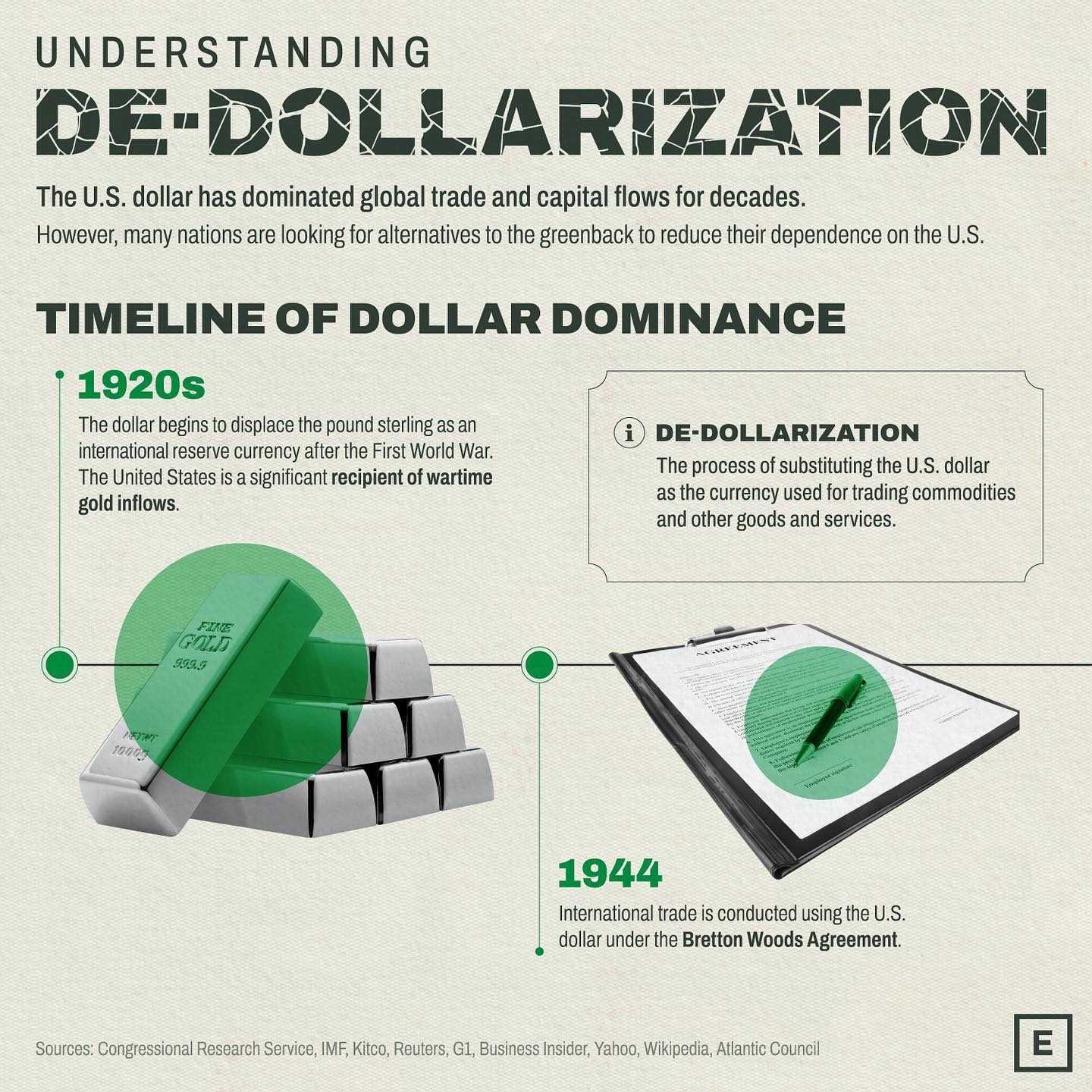
De-Dollarization: A Timeline of Global Financial Shifts
The U.S. dollar's dominance in global trade and capital flows has been a defining feature of the international financial system for decades. However, recent geopolitical and economic events have spurred numerous nations to explore alternatives, seeking to reduce their reliance on the greenback and the U.S. financial system.
Why This Matters
The de-dollarization trend is significant for several reasons. It reflects a growing desire among countries to diversify their reserves and reduce the influence of the U.S. on their economies. This shift is driven by geopolitical tensions, economic considerations, and a quest for financial independence.
The Rise of the U.S. Dollar
The U.S. dollar's ascent to dominance began in the 1920s, following the First World War. With the United States becoming a significant recipient of wartime gold inflows, the dollar began to displace the pound sterling as the international reserve currency.
Key Milestones
- 1944: Bretton Woods Agreement
Under the Bretton Woods Agreement, the U.S. dollar became the primary currency for international trade. This system established the dollar as the global standard, backed by gold.
- 1960s: Economic Competition
The 1960s saw European and Japanese exports becoming more competitive with U.S. exports. The large supply of dollars around the world made it difficult to back each dollar with gold, setting the stage for future changes.
- 1971: Nixon Shock
President Nixon's decision to cease the direct convertibility of U.S. dollars to gold marked a significant turning point. This move, known as the "Nixon Shock," ended the Bretton Woods system and allowed the dollar to float freely.
- 1981: Hyperinflation and Devaluation
Years of hyperinflation led to a dramatic loss in the U.S. dollar's purchasing power, decreasing by two-thirds. This period highlighted the risks of relying heavily on a single currency.
Recent Efforts at De-Dollarization
In response to geopolitical tensions and economic pressures, several countries have actively pursued de-dollarization strategies.
Russia and China
Following the annexation of Crimea in 2014, Russia prioritized de-dollarization in response to Western sanctions. This effort has been reinforced by Russia and China deepening cooperation between their financial systems. The volume of Chinese-Russian trade in yuan has increased significantly, reflecting a shift away from the U.S. dollar.
Global Financial Crisis and Beyond
The 2007-2008 global financial crisis saw investors flocking to the U.S. dollar, expecting it to retain its value. However, the subsequent years have shown a diversification trend. Central banks, particularly those in countries facing U.S. sanctions, have started buying gold at unprecedented rates, diversifying their foreign exchange reserves.
2022 and Beyond
The war in Ukraine has accelerated de-dollarization efforts. In 2022, central banks bought gold at the fastest pace since 1967 as countries sought to diversify their reserves away from the dollar.
Practical Tips for Understanding De-Dollarization
- Stay Informed on Geopolitical Developments
Geopolitical tensions often drive de-dollarization efforts. Staying informed about global events can help you understand shifts in currency use.
- Monitor Central Bank Policies
Central banks play a crucial role in de-dollarization. Pay attention to their announcements and policies regarding gold purchases and reserve diversification.
- Follow Trade Agreements
Changes in trade agreements, such as the growing use of the yuan in Chinese-Russian trade, can indicate broader shifts in global financial dynamics.
Important Takeaways
- Diversification is Key
Countries are increasingly diversifying their foreign exchange reserves away from the U.S. dollar, primarily through gold purchases and increased use of other currencies like the yuan and ruble.
- Geopolitical Factors Drive Change
Geopolitical tensions, such as those between Russia and Western countries, have accelerated de-dollarization efforts.
- The U.S. Dollar Remains Significant
Despite these shifts, the U.S. dollar still holds a significant portion of global foreign exchange reserves, with about 60% of reserves still denominated in dollars.
Conclusion
The de-dollarization trend is a complex and evolving phenomenon driven by geopolitical tensions and economic considerations. As countries seek to reduce their dependence on the U.S. dollar, understanding the timeline and key events of de-dollarization provides valuable insights into the future of global finance.
Watch the Reel
Questions readers ask
What are the primary motivations behind the de-dollarization trend?
The primary motivations behind de-dollarization include geopolitical tensions, economic independence, and the desire to diversify international trade reserves. Many nations are seeking to reduce their reliance on the U.S. dollar to mitigate risks associated with U.S. financial policies and to gain more control over their economic policies.
What are some key historical events that have influenced the de-dollarization movement?
Several key events have influenced the de-dollarization movement, including the Bretton Woods Agreement in 1944, the collapse of the gold standard in 1971, and the emergence of regional trade agreements. Additionally, recent geopolitical tensions and economic sanctions have accelerated the trend as countries look for alternatives to the U.S. dollar.
How is China contributing to the de-dollarization trend?
China is significantly contributing to the de-dollarization trend by promoting the use of the yuan in international trade. Through initiatives like the Belt and Road Initiative and by increasing the yuan's inclusion in global foreign exchange reserves, China is encouraging other nations to adopt the yuan, thus reducing their dependence on the U.S. dollar.
What role do gold reserves play in the de-dollarization process?
World gold reserves serve as a stable and reliable alternative to the U.S. dollar for many countries. As nations seek to diversify their reserves, they often increase their gold holdings to hedge against potential dollar devaluation and to ensure financial stability. This shift towards gold is a key strategy in the de-dollarization process.
How do geopolitical tensions impact foreign exchange trends and de-dollarization?
Geopolitical tensions often lead to economic sanctions and trade restrictions, which in turn drive countries to seek alternatives to the U.S. dollar. This shift can alter foreign exchange trends, encouraging the use of other currencies and reducing the dollar's dominance in international trade and capital flows.
What impact does de-dollarization have on the U.S. economy?
De-dollarization can have several impacts on the U.S. economy. It may reduce the demand for U.S. treasuries, potentially leading to higher interest rates. Additionally, a decline in the U.S. dollar's dominance could affect the U.S. trade balance, as imports and exports might be influenced by changes in international currency preferences.
What are some benefits and risks of a country adopting a new currency for international trade?
Benefits include increased financial autonomy and reduced vulnerability to U.S. economic policies. Risks include potential volatility in the new currency's value and operational challenges in transitioning to a new system. Additionally, there may be resistance from trading partners who prefer the stability of the U.S. dollar.
Recent articles
Fresh deep dives from the latest Reels we unpacked.




Comments
Be the first to comment.