Currency Performance Shifts in 2025: A Regional Analysis
In 2025, the global currency landscape is transforming, with significant shifts in the performance of major currencies against the U.S. dollar. Understanding these changes is crucial for traders, investors, and anyone involved in international finance. This analysis breaks down the performance of the most-traded currencies in the world's seven major regions and their implications for the financial markets.
Context / Why This Matters
The U.S. dollar has long been the cornerstone of global trade and finance. However, recent developments suggest a weakening trend, which presents both challenges and opportunities. A thorough examination of currency performance by region reveals emerging patterns and potential shifts in market dynamics. By analyzing the data, traders and investors can better understand the forces at play and make more informed decisions.
Main Discussion
Overview of the Currency Market in 2025
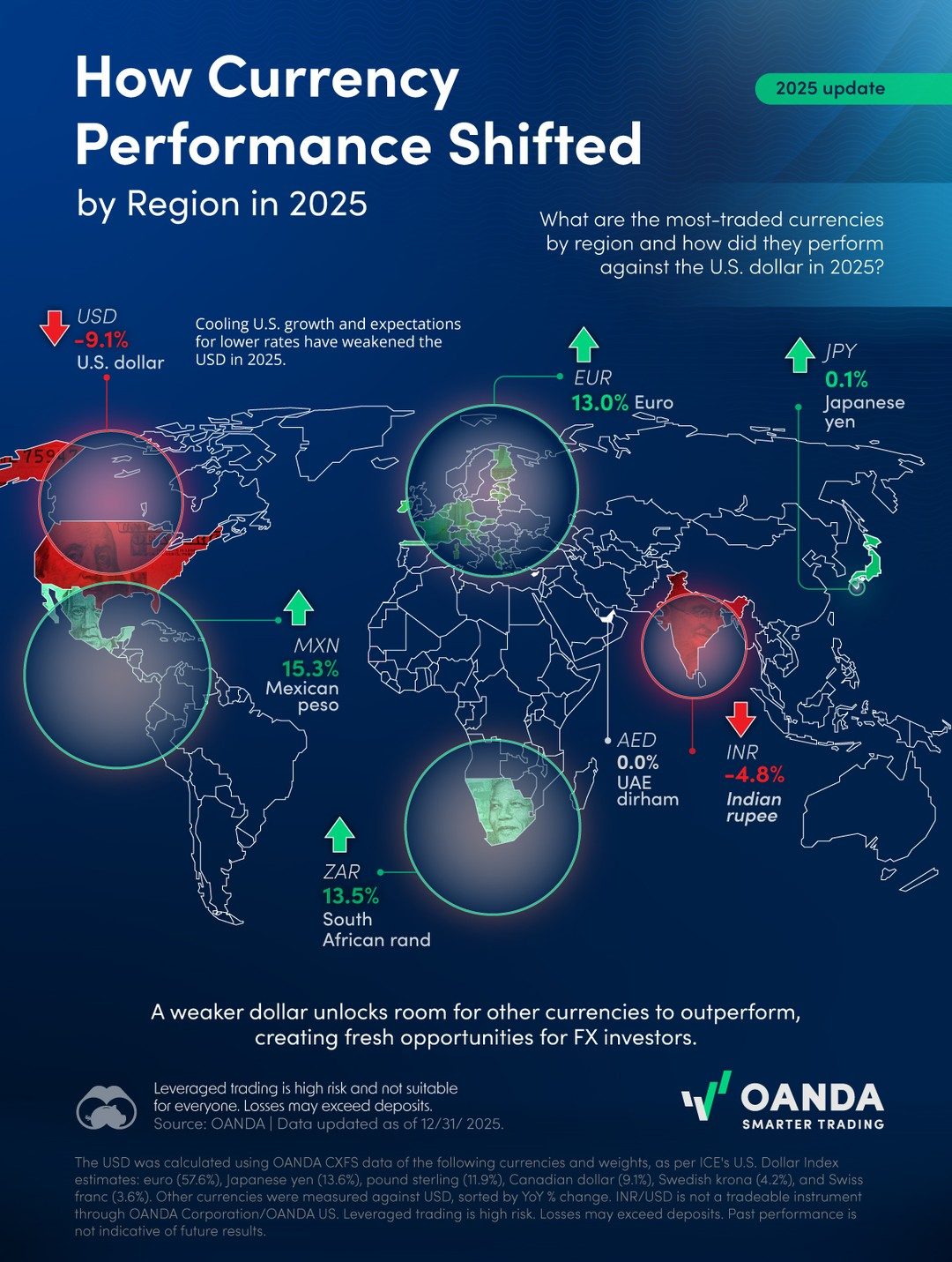
The global currency market is a complex web of interdependent economies, each with its own set of challenges and opportunities. In 2025, the U.S. dollar is projected to weaken by -9.1% due to cooling U.S. growth and expectations of lower interest rates. This weakening trend creates room for other currencies to outperform, offering fresh opportunities for forex traders.
Regional Currency Performance
European Union: The Euro
The Euro, often seen as a barometer of European economic health, is projected to strengthen by 13.0% against the U.S. dollar in 2025. This positive outlook is driven by robust economic growth and stabilized political environments across key Eurozone countries. The Euro's performance suggests that the region is maintaining its financial stability, making it an attractive option for investors.
Asia: The Japanese Yen and Indian Rupee
In Japan, the yen is expected to decline by -4.8% against the U.S. dollar. This slight weakening could be attributed to ongoing economic challenges, including an aging population and persistent deflationary pressures. In contrast, the Indian Rupee is projected to drop by -8.8%, reflecting a more volatile economic landscape in India.
Latin America: The Mexican Peso
The Mexican peso shows a strong upward trend, with a projected increase of 15.3% against the U.S. dollar. This performance can be attributed to improved economic policies, stable trade relations, and robust economic indicators. The peso's strength indicates a more positive economic outlook for Mexico.
Middle East: The UAE Dirham
The UAE Dirham remains stable, with a projected 0.0% change against the U.S. dollar. This stability reflects the Middle East’s sustained economic growth and the UAE's strategic economic policies. The Dirham’s stability offers a safe haven for investors seeking a stable currency.
South Africa: The South African Rand
The South African Rand is projected to increase by 13.5% against the U.S. dollar. This strong performance can be attributed to improved economic policies, increased investment, and a more stable political environment. The Rand's strength indicates a positive economic outlook for South Africa.
Currency Opportunities
A weaker U.S. dollar signals a potential shift in global currency dynamics. For traders and investors, this presents new opportunities to capitalize on the performance of other currencies. Currencies like the Euro and the Mexican peso, which are expected to outperform the U.S. dollar, offer attractive investment prospects.
The Impact on Global Markets
The weakening U.S. dollar has broader implications for the global financial markets. It affects commodity prices, trade relations, and international investment flows. For example, a weaker dollar often leads to higher prices for commodities like gold and oil, which are priced in U.S. dollars. This dynamic can have ripple effects on global trade and economic policies.
Practical Tips
For traders and investors navigating these currency shifts, here are some practical tips:
Stay Informed
Keep a close eye on economic indicators and policy changes. Understanding the underlying economic trends can help you predict currency movements more accurately.
Diversify Your Portfolio
Diversifying your portfolio across different regions and currencies can help mitigate risks and take advantage of the performance of multiple currencies.
Leverage Technology
Utilize advanced trading tools and platforms like OANDA to monitor currency trends and execute trades more efficiently. These tools can provide real-time data and analysis, helping you make more informed decisions.
Important Takeaways
- The U.S. dollar is projected to weaken in 2025, creating opportunities for other currencies to outperform.
- Key currencies like the Euro and the Mexican peso are expected to strengthen against the U.S. dollar.
- Staying informed about economic trends and diversifying your portfolio can help you navigate these currency shifts effectively.
- Leveraging advanced trading tools can enhance your ability to monitor and capitalize on currency movements.
Conclusion
The currency landscape in 2025 is dynamic and presents both challenges and opportunities. Understanding the performance of major currencies against the U.S. dollar is essential for traders and investors. By staying informed, diversifying portfolios, and utilizing advanced trading tools, you can navigate these shifts more effectively and capitalize on emerging opportunities. As the global financial markets continue to evolve, keeping a pulse on these trends will be crucial for success.
Watch the Reel
Questions readers ask
Why is the U.S. dollar expected to weaken in 2025?
The U.S. dollar's expected weakening in 2025 is attributed to several factors, including shifts in global trade patterns, changes in monetary policy, and the strengthening of other major currencies. This trend is significant as it opens up new opportunities for traders and investors in the forex market.
Which regions are expected to see the best performing currencies in 2025?
Regions with strong economic growth, stable political environments, and favorable trade agreements are likely to have the best performing currencies in 2025. According to the analysis, these regions include Southeast Asia, Eastern Europe, and parts of South America.
How can traders capitalize on the weakening U.S. dollar in 2025?
Traders can capitalize on the weakening U.S. dollar by diversifying their portfolios to include currencies from regions expected to outperform. This includes understanding the regional trends and using tools such as currency analysis and market forecasts to make informed trading decisions.
Which currencies are the most traded in 2025?
In 2025, the most traded currencies are expected to include the U.S. dollar, Euro, Japanese Yen, British Pound, Swiss Franc, Canadian Dollar, and Australian Dollar, along with emerging currencies from regions with strong economic growth and favorable trade agreements.
How does currency performance by region impact global financial markets?
Currency performance by region significantly impacts global financial markets by influencing trade flows, investment decisions, and monetary policies. By understanding these regional dynamics, traders and investors can better navigate the complexities of the forex market and identify profitable opportunities.
Recent articles
Fresh deep dives from the latest Reels we unpacked.




Comments
Be the first to comment.