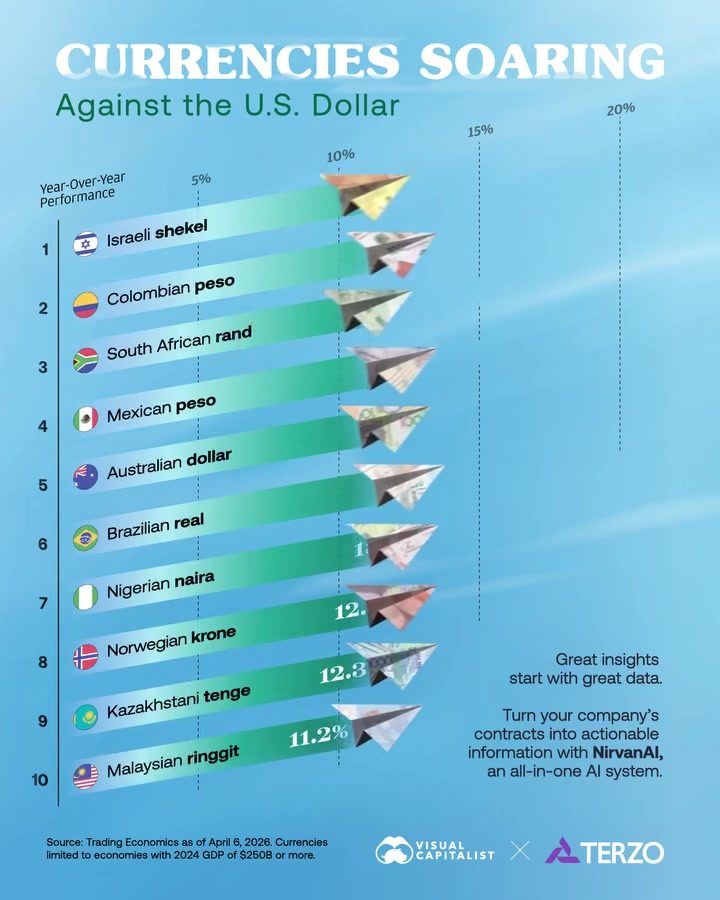
Currency Performance Against USD
This year, several currencies have shown significant gains against the U.S. dollar, with the Israeli shekel leading the charge at a remarkable +20.2% increase. This surge highlights a broader trend in global markets, where various currencies have seen double-digit growth. To understand this phenomenon, it's crucial to examine the factors driving these gains and the currencies that have benefited the most.
Context: Why This Matters
The performance of currencies against the U.S. dollar is a critical indicator of economic health and investor sentiment. A strong currency can signal robust economic growth, stable inflation, and attractive investment opportunities. Conversely, a weakening dollar can reflect economic uncertainty or shifts in global trade dynamics. For investors, traders, and businesses, tracking these fluctuations is essential for making informed decisions and mitigating risks.
Main Discussion
Leading Currencies
The Israeli shekel's impressive +20.2% gain against the U.S. dollar stands out among the top performers. This surge can be attributed to several factors, including strong economic performance, stable inflation rates, and favorable policy decisions. The shekel's strength reflects Israel's resilient economy, which has proven capable of navigating global challenges.
Other notable performers include the Kazakhstani tenge, which has seen a substantial increase of 19.7%, and the Malaysian ringgit, with a 16.4% gain. These currencies have benefited from strategic economic policies, favorable trade agreements, and improving economic conditions. The Colombian peso and South African rand also made significant strides, with gains of 14.8% and 14.5%, respectively. These increases highlight the diverse economic strengths across different regions.
Factors Driving Currency Strength
Several factors contribute to the strength of a currency against the U.S. dollar:
- Economic Growth: Countries with robust economic growth tend to see their currencies appreciate. Strong GDP growth, increased consumer spending, and a thriving business environment can all drive currency strength.
- Inflation Rates: Lower inflation rates relative to the U.S. can make a currency more attractive to investors. Stable or declining inflation often leads to currency appreciation.
- Interest Rates: Higher interest rates can attract foreign capital, as investors seek better returns. Central banks that maintain or increase interest rates can see their currencies strengthen as a result.
- Trade Balances: A positive trade balance, where a country exports more than it imports, can lead to currency appreciation. Export-driven economies often see their currencies gain value as demand for their goods increases.
- Geopolitical Stability: Political and social stability can enhance investor confidence, leading to increased investment and currency appreciation. Countries with stable governments and low levels of political risk tend to have stronger currencies.
Regional Trends
South and Central America
The Colombian peso and Mexican peso are among the top performers in South and Central America, reflecting the region's diverse economic landscape. Colombia's economic reforms and strong export sectors have driven the peso's appreciation, while Mexico's ties to the U.S. economy and strategic trade agreements have bolstered its currency. However, the region's performance varies, with some countries still grappling with economic challenges and currency volatility.
Africa
The South African rand and Nigerian naira have seen notable gains, driven by improvements in economic conditions and strategic policy decisions. South Africa's efforts to stabilize its economy and attract foreign investment have contributed to the rand's strength, making it a standout performer in the African market. Meanwhile, the Nigerian naira's performance reflects the country's efforts to diversify its economy and reduce its reliance on oil exports.
Economic Indicators and Policy Decisions
Economic indicators such as GDP growth, inflation rates, and trade balances play a pivotal role in currency performance. Countries that maintain strong economic indicators tend to see their currencies appreciate. Additionally, policy decisions by central banks, such as interest rate adjustments and monetary policies, can significantly impact currency values.
Practical Tips
For investors and traders looking to capitalize on these trends, several practical tips can help navigate the complex world of forex:
- Stay Informed: Keep up-to-date with economic news, policy changes, and global economic trends. Understanding the factors driving currency movements can help you make informed investment decisions.
- Diversify Your Portfolio: Spread your investments across various currencies to mitigate risks. Diversification can help protect against sudden currency fluctuations and market volatility.
- Monitor Economic Indicators: Pay close attention to key economic indicators, such as GDP growth, inflation rates, and trade balances. These indicators can provide valuable insights into a currency's potential performance.
- Use Technical Analysis: Technical analysis tools and charts can help you identify trends and patterns in currency movements. Utilizing these tools can enhance your ability to make timely and profitable trades.
- Risk Management: Implement robust risk management strategies to protect your investments. Set stop-loss orders, diversify your holdings, and stay informed about market conditions to minimize potential losses.
Important Takeaways
The performance of various currencies against the U.S. dollar underscores the dynamic and interconnected nature of global markets. Key takeaways include:
- The Israeli shekel's +20.2% gain highlights the potential for significant currency appreciation in strong economies.
- Economic growth, inflation rates, interest rates, trade balances, and geopolitical stability are critical factors driving currency strength.
- Regional trends and specific economic policies play a significant role in currency performance.
- Investors and traders can benefit from staying informed, diversifying their portfolios, monitoring key indicators, using technical analysis, and implementing robust risk management strategies.
The diverse economic landscapes and strategic policies of different countries continue to shape global currency markets, offering both opportunities and challenges for investors.
Conclusion
The recent performance of various currencies against the U.S. dollar underscores the dynamic and complex nature of global financial markets. With the Israeli shekel leading the charge and other currencies like the Kazakhstani tenge and Malaysian ringgit showing significant gains, it's clear that strategic economic policies and favorable conditions can drive impressive results. By understanding the factors at play and implementing practical investment strategies, investors can navigate these markets with greater confidence and potentially reap the benefits of a strong currency.
Watch the Reel
Questions readers ask
Which currency has shown the most significant gain against the USD in 2026 so far?
The Israeli shekel has shown the most significant gain, with a +20.2% increase against the U.S. dollar.
What are some of the economic indicators that have contributed to the strong performance of certain currencies against the USD?
Strong economic growth, stable inflation, and strategic policies have contributed to the strong performance of various currencies against the USD.
Why is the performance of currencies against the USD important?
The performance of currencies against the USD is important because it serves as a critical indicator of economic health and investor sentiment. It can signal robust economic growth and attractive investment opportunities.
Which currencies are among the top performers against the USD in 2026?
While the Israeli shekel leads with a +20.2% increase, several other currencies have shown double-digit growth against the USD, reflecting broader trends in global markets.
What might a weakening dollar indicate?
A weakening dollar may indicate economic uncertainty or shifts in global trade. It can also reflect changes in investor sentiment and economic policies.
How can strong currencies impact global currency shifts?
Strong currencies could attract further investment, influence global trade dynamics, and impact currency exchange partnerships, potentially leading to broader shifts in global currency markets.
What is the significance of the Israeli shekel's performance against the USD?
The Israeli shekel's performance highlights broader economic trends and signals strong growth, stable inflation, and attractive investment opportunities in the region.
Recent articles
Fresh deep dives from the latest Reels we unpacked.




Comments
Be the first to comment.