Identifying the Next Number in a Sequence with Puzzles
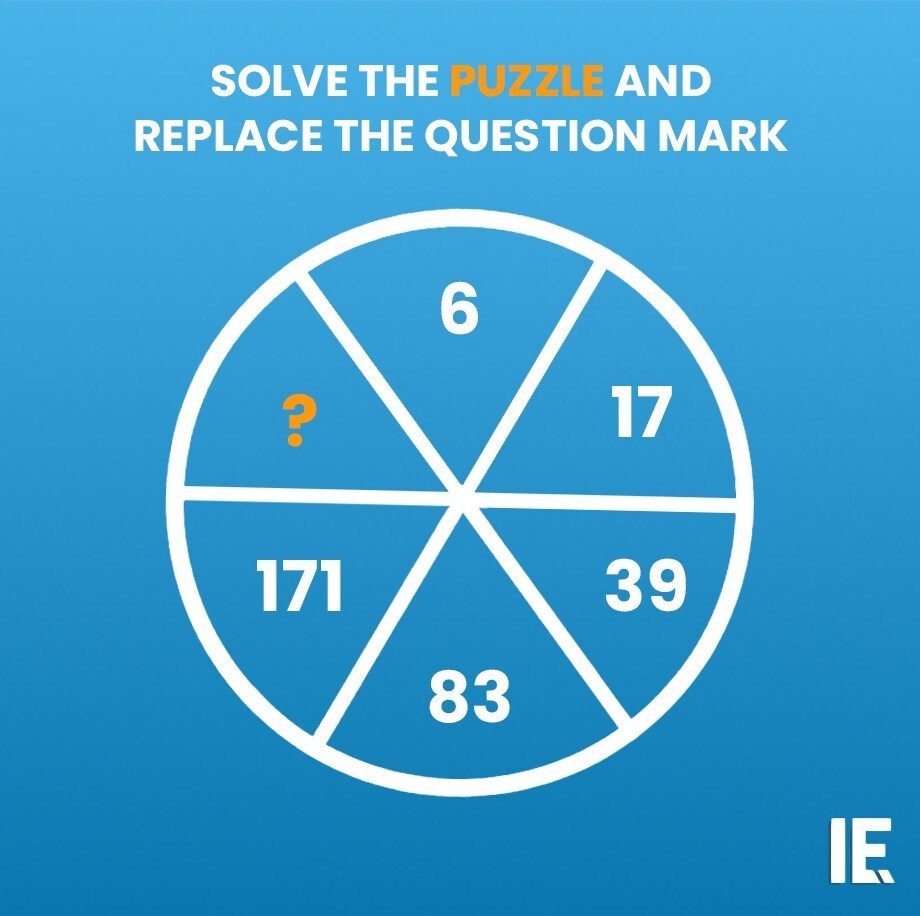
Engaging in a puzzle can be a fun way to sharpen the mind and challenge your problem-solving skills. One common type of puzzle is identifying a numerical pattern in a sequence, often represented in a circle. This type of puzzle involves recognizing the rule governing the sequence and applying it to find the missing number.
Why this matters
Puzzles like these can benefit your cognitive abilities, especially in logic and pattern recognition. They can also be a great way to engage in some mental exercise.
Understanding the sequence and pattern
In this puzzle, you are presented with a circle divided into several sections, each containing a number. The challenge is to determine the pattern that governs the sequence and then replace the question mark with the correct number.
Examining the given numbers
The provided numbers are 6, 17, 171, 39, and 83. There are two main approaches to solving this type of puzzle: looking for a mathematical operation or a simple numerical pattern.
Mathematical operations
One approach is to look for a mathematical operation that could transform one number into the next. For instance, you might consider addition, subtraction, multiplication, or division.
Consider the first two numbers, 6 and 17. If you subtract 6 from 17, you get 11. This doesn't immediately seem helpful, but let's explore further. If you subtract 11 from 171, you get 160. This doesn't seem to fit a simple pattern, so it's possible that a different operation or a combination of operations is at play.
Numerical patterns
Another approach is to look for a numerical pattern. One common pattern is to look at the digits of the numbers and see if there is a relationship between them.
Consider the numbers 6, 17, 171, 39, and 83. Let's break them down by their digits:
- 6 is a single digit.
- 17 has two digits: 1 and 7.
- 171 has three digits: 1, 7, and 1.
- 39 has two digits: 3 and 9.
- 83 has two digits: 8 and 3.
One possible pattern is that the digits are simply increasing in a certain way, but this doesn't seem to fit the numbers provided.
Identifying the correct pattern
A more plausible pattern involves a mathematical operation that combines addition and multiplication.
For instance, consider the following steps:
- Take the first number, 6, and multiply it by 3: 6 * 3 = 18.
- Add 1 to 18 to get 19, then subtract 2 to get 17.
This pattern doesn't seem to fit, but let's try another approach.
Practical tips
Break down the numbers
One practical tip is to break down the numbers into their individual digits and look for patterns in those digits. For example, in the number 17, you have the digits 1 and 7. In the number 171, you have the digits 1, 7, and 1.
Look for patterns in the digits
Another tip is to look for patterns in the digits themselves. For instance, you might notice that the number 17 has a 1 and a 7, while the number 171 has a 1, a 7, and another 1. This could indicate a pattern where the digits are repeating or increasing in a certain way.
Consider mathematical operations
Finally, consider mathematical operations that could transform one number into the next. This could involve addition, subtraction, multiplication, or division. For example, you might notice that 6 + 11 = 17, and 17 + 154 = 171. This could indicate a pattern where the difference between numbers is increasing in a certain way.
Important takeaways
- Break down the numbers into their individual digits and look for patterns in those digits.
- Consider mathematical operations that could transform one number into the next.
- Look for a combination of addition and multiplication that could fit the pattern.
- Practice with different types of puzzles to improve your pattern recognition skills.
Conclusion
Identifying the next number in a sequence can be a challenging but rewarding puzzle. By breaking down the numbers, looking for patterns in the digits, and considering mathematical operations, you can crack the pattern and solve the puzzle. Whether you're a puzzle enthusiast or just looking for a mental challenge, this type of puzzle can help sharpen your mind and improve your problem-solving skills.
Watch the Reel
Questions readers ask
What is the primary goal of a circle puzzle challenge?
The main objective is to identify the numerical pattern in a sequence arranged in a circle and determine the next missing number, testing your logic and pattern recognition skills.
How can solving circle pattern puzzles benefit me?
Engaging with these puzzles can enhance your cognitive abilities, particularly in logic and pattern recognition. They serve as a fun mental exercise, making them a great way to challenge your mind.
What skills does a number sequence puzzle help improve?
Number sequence puzzles primarily improve your problem-solving skills, logical reasoning, and pattern recognition. They encourage you to think critically and follow the pattern to find the missing number.
How do I approach solving a circle brainteaser?
To solve a circle brainteaser, carefully observe the sequence of numbers and try to identify the underlying pattern or rule. Once you've determined the pattern, apply it to find the missing number in the sequence.
Are there different types of circle puzzles?
Circle puzzles can vary in complexity and pattern types. Some may involve simple arithmetic sequences, while others might require more complex mathematical operations or visual pattern recognition.
Can circle puzzles be considered a form of math puzzles for adults?
Yes, circle puzzles are a form of math puzzles for adults as they require you to apply logical thinking and mathematical reasoning to solve them. They are designed to be engaging and thought-provoking.
Recent articles
Fresh deep dives from the latest Reels we unpacked.




Comments
Be the first to comment.