Monarchies Around the World
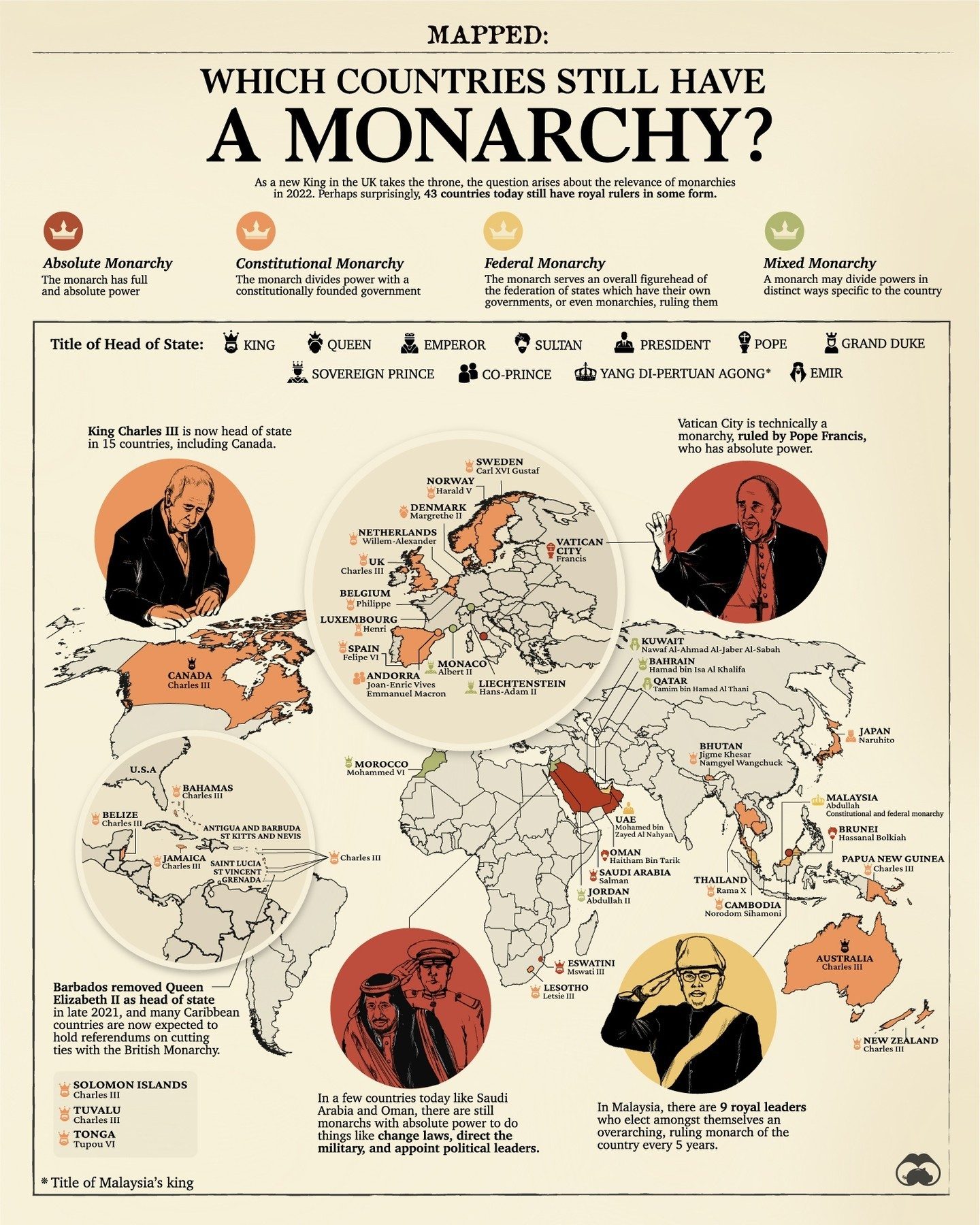
With the passing of Queen Elizabeth II, attention has turned to the state of monarchies globally. Surprisingly, 43 countries still recognize a royal ruler in some form. These monarchies vary significantly in their structure and influence, categorized into Absolute, Constitutional, Federal, and Mixed types. Understanding these distinctions provides insight into the diverse roles monarchs play in contemporary governance.
Why This Matters
Monarchies, despite their often ceremonial roles, remain integral to the political and cultural landscapes of many nations. The type of monarchy a country has can influence its political stability, cultural identity, and international relations. This is particularly relevant as nations grapple with the evolving roles of traditional institutions in modern societies.
Types of Monarchies
Absolute Monarchies
Absolute monarchies grant the monarch supreme autocratic power, with no legal or constitutional restraints on their authority. These monarchs wield significant influence over the legislative, executive, and judicial branches of government. Notable examples include:
- Saudi Arabia: The King holds extensive powers, including the ability to appoint the government and pass laws.
- Brunai: The Sultan of Brunei holds absolute power, with the ability to enact laws and govern without a constitution.
- Oman: The Sultan of Oman is the absolute ruler, with comprehensive powers over the state.
Constitutional Monarchies
Constitutional monarchies are governed by a constitution that outlines the monarch's role and limits their power. The monarch typically serves as a figurehead, with executive authority vested in a parliament or other elected body. Many European countries fall into this category:
- Norway, Sweden, and Denmark: These Scandinavian countries are constitutional monarchies, with the monarch's role largely ceremonial. The King or Queen serves as a unifying figure, symbolizing national unity and continuity, but day-to-day governance is in the hands of elected officials.
Federal Monarchies
Federal monarchies combine elements of federalism and monarchy, with a federal structure that allows for regional autonomy. The monarch typically serves as the head of state for the entire federation, while regional leaders may hold significant power within their jurisdictions. Examples include:
- Malaysia: The country is a federal constitutional monarchy, with a unique system where the Yang di-Pertuan Agong (King) is elected from among the rulers of the nine Malay states for a five-year term.
Mixed Monarchies
Mixed monarchies combine features of different types, creating a unique governance structure. These monarchies may have elements of both absolute and constitutional rule, or other distinctive features. Examples include:
- Andorra: A co-principality, Andorra is ruled jointly by two co-princes—the President of France and the Bishop of Urgell. This unique system balances the influence of both the French state and the Catholic Church.
Monarchs and Their Titles
The title of the monarch can vary widely, reflecting the country's cultural, historical, and political context. Some of the titles include:
- King/Queen: The most common title, held by rulers in countries like Spain, Canada, and the Netherlands.
- Sovereign Prince/Princess: Used in smaller, often principality-style monarchies, such as Monaco.
- Emperor/Empress: Typically reserved for larger, more historically significant monarchies, such as Japan and Brunei.
- Emir: Used in some Middle Eastern monarchies, such as Kuwait and Qatar.
- Pope: The head of the Vatican City, which is technically a monarchy ruled by the Pope, who holds absolute power within the Vatican's borders.
King Charles III and the Commonwealth Realm
King Charles III is now head of state in 15 countries, a testament to the enduring influence of the British monarchy. Known as the Commonwealth Realm, these countries share a historical, cultural, and political bond with the United Kingdom, with the British monarch serving as their head of state. This arrangement allows for a degree of continuity and shared heritage while still maintaining their autonomy.
Commonwealth Realm Countries
- Canada: Canada’s monarch is represented by a Governor General, who carries out ceremonial and constitutional duties on the monarch's behalf.
- Australia, Jamaica, and New Zealand: While each has its own Governor General, the monarch remains the constitutional head of state.
The Vatican City
The Vatican City, an independent city-state enclaved within Rome, is technically a monarchy ruled by the Pope. As the head of the Catholic Church, the Pope holds absolute power within the Vatican, making it a unique absolute monarchy. This arrangement allows the Vatican to maintain a degree of independence and influence in global affairs, particularly in matters related to the Catholic Church.
Conclusion
Monarchies continue to play a significant role in the governance and cultural identity of many countries. From absolute monarchies to complex federal and mixed systems, each type offers a unique perspective on how traditional leadership can coexist with modern democratic principles. Whether serving as a ceremonial figurehead or wielding significant political power, monarchs remain a fascinating and enduring part of global governance.
As the world evolves, so too do these institutions, adapting to new challenges and opportunities while maintaining their historical significance. Understanding the diverse forms of monarchy and their roles in contemporary society provides a richer appreciation of the global political landscape.
Watch the Reel
Questions readers ask
Which countries have absolute monarchies in 2023?
In 2023, several countries are classified as absolute monarchies, where the monarch holds supreme power. These include Brunei, Oman, Saudi Arabia, Eswatini, and Vatican City. In these nations, the monarch's decisions are not subject to parliamentary approval.
What is a constitutional monarchy, and which countries have this system?
A constitutional monarchy is a form of government where the monarch acts as a ceremonial figurehead, while the real political power resides with an elected parliament. Examples include the United Kingdom, Sweden, Japan, Spain, and Canada. These countries have a clear separation of powers between the monarch and the government.
Can you explain the concept of a federal monarchy?
A federal monarchy is a system in which a federal structure of government is combined with a monarchy. The monarch acts as the head of state for the entire federation, while individual states or regions may have their own governments. Examples include Malaysia and the United Arab Emirates.
What are mixed monarchy nations, and how do they function?
Mixed monarchies, also known as semi-constitutional monarchies, combine elements of both absolute and constitutional monarchies. In these nations, the monarch holds significant political power but must also work within a parliamentary system. Examples include Jordan and Morocco, where the monarch has substantial influence but shares power with elected bodies.
How many countries have a king or queen in 2023?
In 2023, 43 countries recognize a royal ruler. Many of these countries have kings or queens as their monarchs, while others have different titles such as emperor, sultan, or emir. This includes nations with various types of monarchies, from absolute to constitutional.
Are there any countries with emperors as monarchs?
Yes, there are a few countries where the monarch holds the title of emperor. Japan is the most notable example, where the Emperor serves as a ceremonial figurehead. Additionally, the Emperor of Japan, Naruhito, is part of the world's oldest continuous hereditary imperial line.
How does the type of monarchy affect a country's governance?
The type of monarchy can significantly influence a country's governance. In absolute monarchies, the monarch holds supreme power, which can lead to swift decision-making but may lack public input. In contrast, constitutional monarchies balance traditional leadership with democratic governance, promoting political stability and public engagement.
Recent articles
Fresh deep dives from the latest Reels we unpacked.




Comments
Be the first to comment.