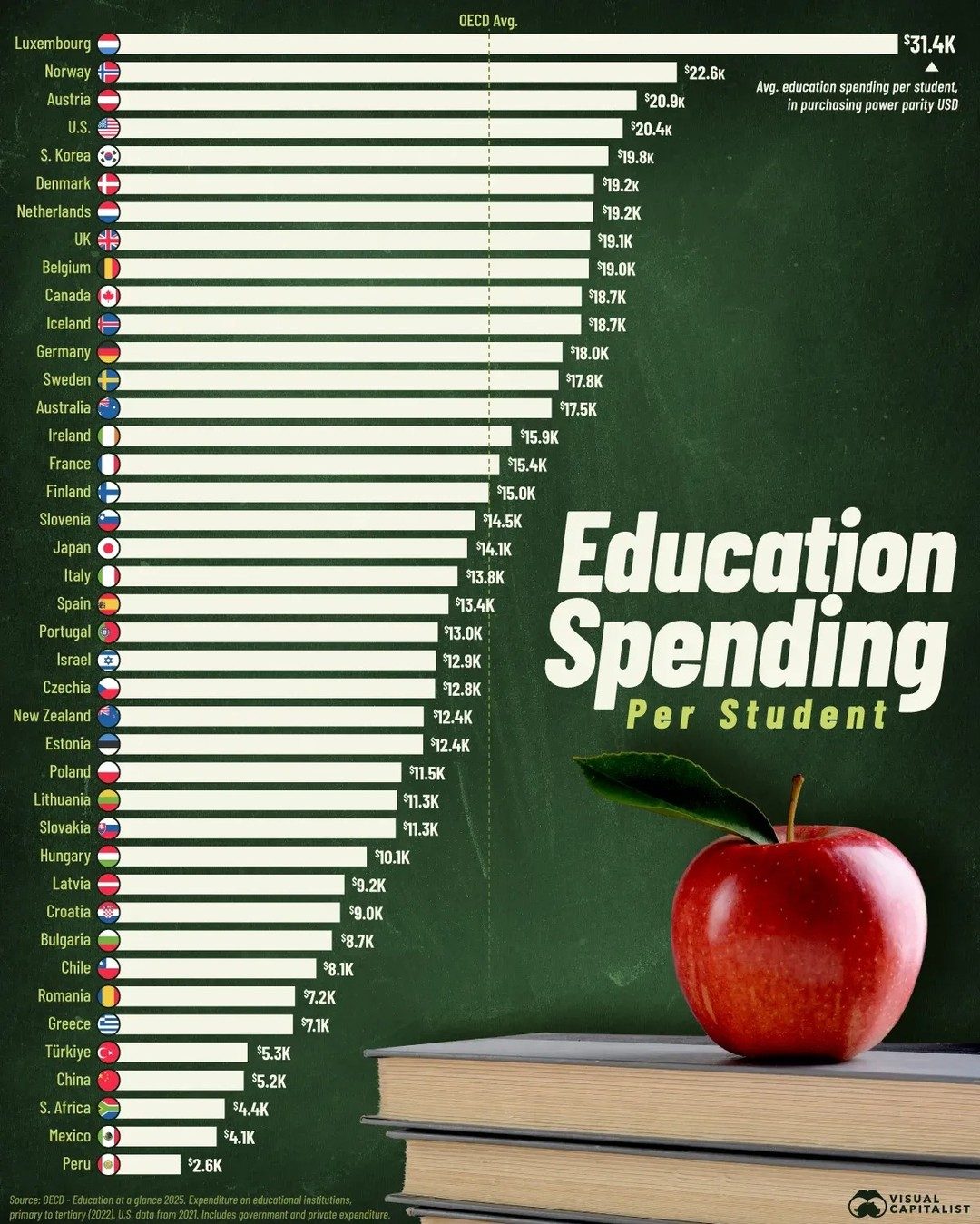
Education Spending Per Student Across Countries
Luxembourg leads the world in annual education spending per student, far outpacing other nations. At the other end of the spectrum, countries like Peru, China, and Mexico allocate significantly less. This spending varies widely across the globe, reflecting different economic priorities and educational philosophies. Here, we delve into the data to understand the disparities and what they might imply for educational systems worldwide.
Context / Why this matters
Education spending is a crucial indicator of a country's commitment to its future workforce and societal development. It reflects not just the financial investment but also the priority given to education in national policy. Comparing these expenditures can provide insights into how different regions approach education, the potential quality of educational outcomes, and the challenges faced by varying levels of investment.
Main discussion
High-Spending Countries
Luxembourg and Norway
Luxembourg tops the list with an astonishing $31,000 spent per student annually. This figure is nearly double that of the OECD average, underscoring Luxembourg's substantial investment in education. Norway follows closely, also committing over $30,000 per student. These high levels of expenditure often correlate with advanced educational infrastructures, comprehensive curricula, and well-compensated educators.
Advanced Economies
Most advanced economies cluster between $18,000 and $21,000 in annual spending per student. Countries like the United States, Denmark, the Netherlands, and the United Kingdom fall within this range. The U.S., for instance, spends around $20,400 per student, showcasing its significant investment in educational systems. These nations often benefit from robust educational frameworks, extensive research initiatives, and substantial private sector contributions.
Mid-Range Spenders
European Countries
Several European nations, including Germany, France, and Spain, spend between $13,000 and $18,000 per student. While these amounts are lower than the high-spending countries, they still indicate a strong commitment to education. For example, Germany's $18,000 investment per student supports a well-regarded educational system known for its dual education approach, which integrates school learning with workplace training.
Asia-Pacific Region
In the Asia-Pacific region, countries like South Korea, Japan, and Australia spend between $13,000 and $19,000 per student. South Korea, with its renowned educational rigor, spends around $20,400, while Australia invests approximately $17,500. These countries often prioritize educational outcomes, with high-stakes testing and competitive academic environments.
Low-Spending Countries
Emerging Economies
Countries like Mexico, China, and Türkiye spend significantly less, with annual expenditures dropping below $6,000 per student. Mexico's spending of around $2,600 per student stands out as remarkably low. This disparity highlights the challenges these countries face in balancing educational quality with economic constraints. Despite the lower spending, many of these nations are making strides in improving educational access and outcomes, albeit with limited resources.
Developing Nations
Nations such as Peru and South Africa spend the least, with Peru at the bottom of the list at $2,600 per student. These countries often grapple with substantial economic and social challenges, making it difficult to allocate significant funds to education. Nonetheless, international aid and policy reforms are playing a critical role in enhancing educational infrastructure and opportunities in these regions.
Practical tips
For policy-makers and educators looking to understand and improve education spending, here are some practical tips:
- Analyze Current Spending: Start by examining the current allocation of educational funds. Identify areas where resources are most effectively utilized and where improvements can be made.
- Benchmark Against Peers: Compare your country's spending with similar economies. This can provide insights into potential areas for investment and help set realistic goals.
- Leverage Data: Use data-driven approaches to track the impact of educational spending. Metrics such as student performance, dropout rates, and graduate employment can guide policy decisions.
- Engage Stakeholders: Involve parents, teachers, and students in the decision-making process. Their insights can provide valuable perspectives on educational needs and challenges.
- Innovate and Adapt: Explore innovative educational models and technologies that can enhance learning outcomes without necessarily increasing costs. This includes online learning platforms, blended learning models, and community-based educational initiatives.
Important takeaways
Understanding the global landscape of education spending reveals several key points:
- High Spending Doesn't Always Equal Better Outcomes: While high spending often correlates with better educational outcomes, it is not the only factor. Effective policy implementation, teacher quality, and educational infrastructure also play crucial roles.
- Economic Constraints Impact Spending: Lower-income countries face significant challenges in allocating substantial funds to education. However, they can leverage international aid and policy reforms to enhance educational opportunities.
- Regional Differences: Spending patterns vary widely by region, reflecting different economic priorities, cultural values, and educational philosophies.
- Data-Driven Decisions: Using data to track and analyze educational outcomes can help guide policy decisions and improve the effectiveness of educational spending.
Conclusion
Education spending is a complex and multifaceted issue that varies widely across countries. Luxembourg's substantial investment in education sets a high benchmark, while countries like Peru highlight the challenges faced by lower-income nations. Understanding these disparities can inform policy decisions, educational strategies, and resource allocation. By leveraging data, engaging stakeholders, and innovating educational models, nations can strive to enhance educational outcomes, regardless of their economic status.
Watch the Reel
Questions readers ask
Why does Luxembourg spend the most on education per student?
Luxembourg's high education spending per student is due to its commitment to providing high-quality educational resources and opportunities for its residents. This includes investing in infrastructure, teacher salaries, and specialized programs to enhance the learning experience, with a large influx of foreign workers being a contributing factor.
How does education spending in Luxembourg compare to other high-spending countries?
Luxembourg outpaces other high-spending countries like Norway, which also invests heavily in education. Norway is known for its generous social welfare programs, including education, but even in this context, Luxembourg's spending on education per student is notably higher.
What factors contribute to the low education spending in countries like Peru and Mexico?
Countries like Peru and Mexico have lower education spending per student due to economic constraints, high levels of poverty, and other pressing national needs. These countries often need to allocate significant resources to immediate survival needs, such as healthcare and infrastructure, which can limit their ability to invest heavily in education.
How does the OECD measure and compare global education expenditure?
The OECD compares global education expenditure by analyzing data on annual education spending per student, which accounts for various costs including teacher salaries and resources. This data allows for a clearer understanding of how countries prioritize and allocate funds to their education systems, providing a basis for international comparison.
What are the implications of high education spending on a country's future workforce and societal development?
High education spending can lead to better-educated citizens who are more equipped to contribute to a country's economy and society. This often results in higher productivity, innovation, and overall economic growth. Additionally, a well-funded education system can foster a more skilled and adaptable workforce, better prepared to navigate global markets and challenges.
What are some of the challenges faced by countries with low education budgets?
Countries with low education budgets often struggle with inadequate resources, outdated infrastructure, and limited access to quality educational materials. These challenges can lead to lower graduation rates, skill gaps in the workforce, and difficulties in attracting and retaining qualified teachers, all of which can hinder economic and social development.
How might countries with low education spending aim to improve their systems?
Countries with low education spending can seek to improve their systems by focusing on targeted investments, international partnerships for resource sharing, and innovative funding strategies. Additionally, leveraging technology to enhance learning and reduce costs can help maximize the impact of limited budgets.
Related deep dives
Similar reads based on topic and creator.

Recent articles
Fresh deep dives from the latest Reels we unpacked.




Comments
Be the first to comment.