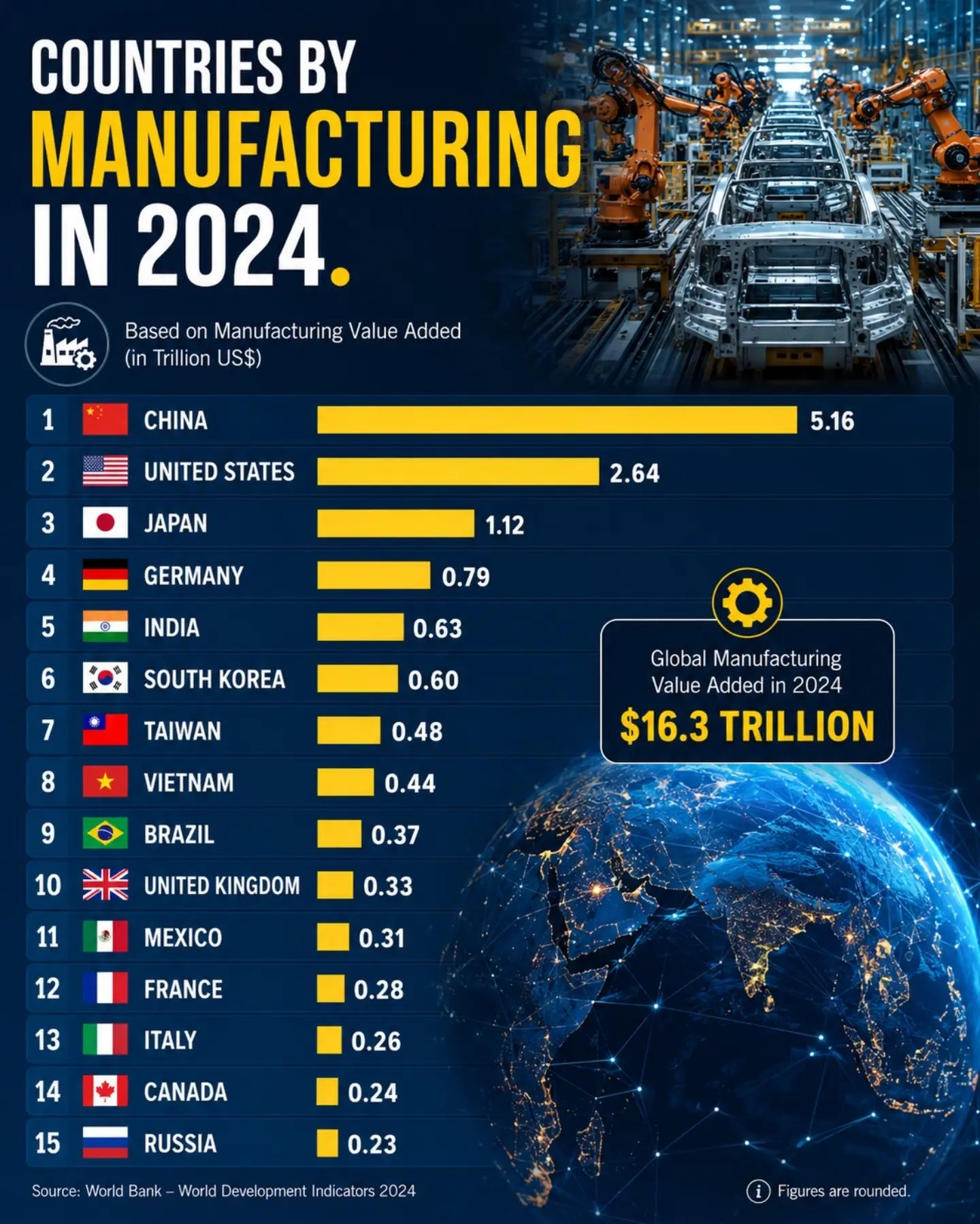
Manufacturing Output by Country in 2024
In 2024, the global manufacturing landscape is dominated by a handful of countries, each contributing significantly to the world's total manufacturing value added. This value is a crucial indicator of a country's industrial output and economic strength. The top countries by manufacturing output in 2024 are ranked based on their Manufacturing Value Added (MVA), which measures the total value of goods and commodities produced within a country.
Why This Matters
Understanding the distribution of manufacturing output across countries provides valuable insights into global economic trends, trade dynamics, and industrial competitiveness. It helps businesses and policymakers make informed decisions about investment, trade agreements, and economic policies.
Global Manufacturing Overview
In 2024, the total global manufacturing value added is projected to be $16.3 trillion. This figure represents the cumulative output of all manufacturing activities worldwide, highlighting the immense scale and importance of the manufacturing sector.
Leading Countries in Manufacturing
China
China tops the list with an impressive $5.16 trillion in manufacturing value added. This places China far ahead of other countries, reflecting its status as the world's largest manufacturing hub. China's dominance in manufacturing is driven by its vast industrial base, extensive infrastructure, and a large, skilled workforce.
United States
The United States ranks second with $2.64 trillion in manufacturing value added. The U.S. benefits from advanced technology, a robust innovation ecosystem, and a highly skilled workforce. Key sectors contributing to the U.S. manufacturing output include aerospace, automotive, and technology.
Japan
Japan follows closely with $1.12 trillion in manufacturing value added. Known for its precision manufacturing and technological advancements, Japan is a global leader in automotive, electronics, and machinery sectors. The country's emphasis on quality and innovation drives its manufacturing competitiveness.
Germany
Germany contributes $0.79 trillion to the global manufacturing value added. Renowned for its engineering excellence, Germany is a powerhouse in the automotive, machinery, and chemical industries. The country's strong industrial base and commitment to research and development are key factors in its manufacturing success.
South Korea
South Korea rounds out the top five with $0.60 trillion in manufacturing value added. The country's manufacturing sector is highly advanced, particularly in electronics, semiconductors, and automobiles. South Korea's focus on innovation and exports has made it a significant player in the global manufacturing landscape.
Emerging Manufacturing Powers
Beyond the top five, several other countries are making significant strides in manufacturing output.
Taiwan
Taiwan contributes $0.48 trillion to the global manufacturing value added, fueled by its strengths in electronics and semiconductor manufacturing. The country's high-tech industries and advanced manufacturing capabilities position it as a key player in the global supply chain.
Vietnam
Vietnam has emerged as a notable manufacturing hub, adding $0.37 trillion to the global manufacturing value added. The country's competitive labor costs, strategic location, and favorable trade policies have attracted significant foreign direct investment, particularly from China and the U.S.
Brazil
With $0.33 trillion in manufacturing value added, Brazil is a leading manufacturer in Latin America. The country's diverse industrial base includes automotive, aerospace, and agricultural machinery. Brazil's abundant natural resources and large domestic market support its manufacturing growth.
Other Key Countries
Mexico ($0.28 trillion), France ($0.26 trillion), Italy ($0.24 trillion), Canada ($0.23 trillion), and Russia ($0.23 trillion) are also significant contributors to global manufacturing. Each of these countries has unique strengths and industrial sectors that drive their manufacturing output.
Key Drivers of Manufacturing Success
Several factors contribute to a country's success in manufacturing. Understanding these drivers can provide insights into why certain countries excel in this sector.
Technological Advancements
Countries that invest heavily in research and development, and adopt advanced manufacturing technologies, tend to lead in manufacturing output. Automation, robotics, and artificial intelligence are transforming traditional manufacturing processes, enhancing efficiency and productivity.
Skilled Workforce
A highly skilled and educated workforce is essential for maintaining a competitive edge in manufacturing. Countries with strong educational systems and vocational training programs can develop the talent needed to drive innovation and productivity.
Strategic Policies
Government policies play a crucial role in shaping a country's manufacturing landscape. Incentives for innovation, trade agreements, and investment in infrastructure can foster a favorable environment for manufacturing growth.
Global Trade Dynamics
International trade agreements and global supply chains influence a country's manufacturing output. Open trade policies and strategic trade partnerships can enhance a country's manufacturing competitiveness by providing access to global markets and resources.
Practical Tips for Businesses
For businesses looking to engage with global manufacturing trends, here are some practical tips:
Diversify Supply Chains
Given the global nature of manufacturing, diversifying supply chains can mitigate risks and ensure continuity. Businesses should consider multiple suppliers and geographies to enhance resilience.
Invest in Technology
Adopting advanced manufacturing technologies can improve efficiency, reduce costs, and drive innovation. Investing in automation, robotics, and digital transformation can provide a competitive edge.
Focus on Skills and Training
Ensuring a skilled workforce is essential for success in manufacturing. Businesses should prioritize training and development programs to enhance the skills of their employees.
Leverage Trade Agreements
Understanding and leveraging trade agreements can open new markets and opportunities. Businesses should stay informed about global trade policies and explore potential benefits from trade agreements.
Important Takeaways
The global manufacturing landscape in 2024 is characterized by the dominance of a few leading countries, with China, the United States, and Japan at the forefront. Emerging manufacturing powers like Vietnam and Taiwan are also making significant contributions. Technological advancements, skilled workforce, strategic policies, and global trade dynamics are key drivers of manufacturing success.
Conclusion
Understanding the global manufacturing output by country in 2024 provides valuable insights into the economic landscape and industrial competitiveness. By examining the leading countries and the factors driving their success, businesses and policymakers can make informed decisions to navigate the dynamic global manufacturing environment.
Watch the Reel
Questions readers ask
Which countries are the top 3 in manufacturing output for 2024?
In 2024, China leads the global manufacturing output, followed by the United States and Japan. These countries are known for their vast industrial capabilities and significant contributions to the world's manufacturing total. The exact rankings of these countries are based on their Manufacturing Value Added (MVA).
Why is Manufacturing Value Added (MVA) important in this context?
MVA is a critical metric because it quantifies the total value of goods and commodities produced within a country, serving as a key indicator of a nation's industrial output and overall economic strength. It helps in understanding the economic importance of manufacturing in a country.
How does China maintain its leading position in global manufacturing?
China's dominance in manufacturing can be attributed to its extensive industrial infrastructure, abundant labor force, and supportive government policies. Additionally, China's strategic investments in technology and innovation have solidified its position as the world's top manufacturing powerhouse in 2024.
What insights can be gained from the 2024 global manufacturing rankings?
The 2024 global manufacturing rankings offer insights into the economic strength and industrial competitiveness of countries. These rankings help businesses identify potential markets for investment, and policymakers understand the global trade dynamics, enabling informed decision-making.
Why are the United States and Japan significant in the 2024 global manufacturing landscape?
Both the United States and Japan are significant contributors to global manufacturing output, with advanced technologies and innovative capabilities. Together, these countries help shape global trade dynamics and economic trends, making them crucial players in the 2024 manufacturing landscape.
What trends in world manufacturing growth can be expected in 2024?
In 2024, trends in world manufacturing growth include the increasing adoption of automation and artificial intelligence, a rise in sustainable manufacturing practices, and a shift towards regional supply chains. These trends are influenced by technological advancements, environmental concerns, and changing global trade policies.
What can a manufacturing infographic for 2024 reveal about the global manufacturing landscape?
A manufacturing infographic for 2024 can visually represent the distribution of manufacturing output across countries, highlighting the leaders in the sector and providing a snapshot of global manufacturing trends. It helps visualize the data and understand the economic strengths of various countries in a clear and informative manner.
Recent articles
Fresh deep dives from the latest Reels we unpacked.




Comments
Be the first to comment.