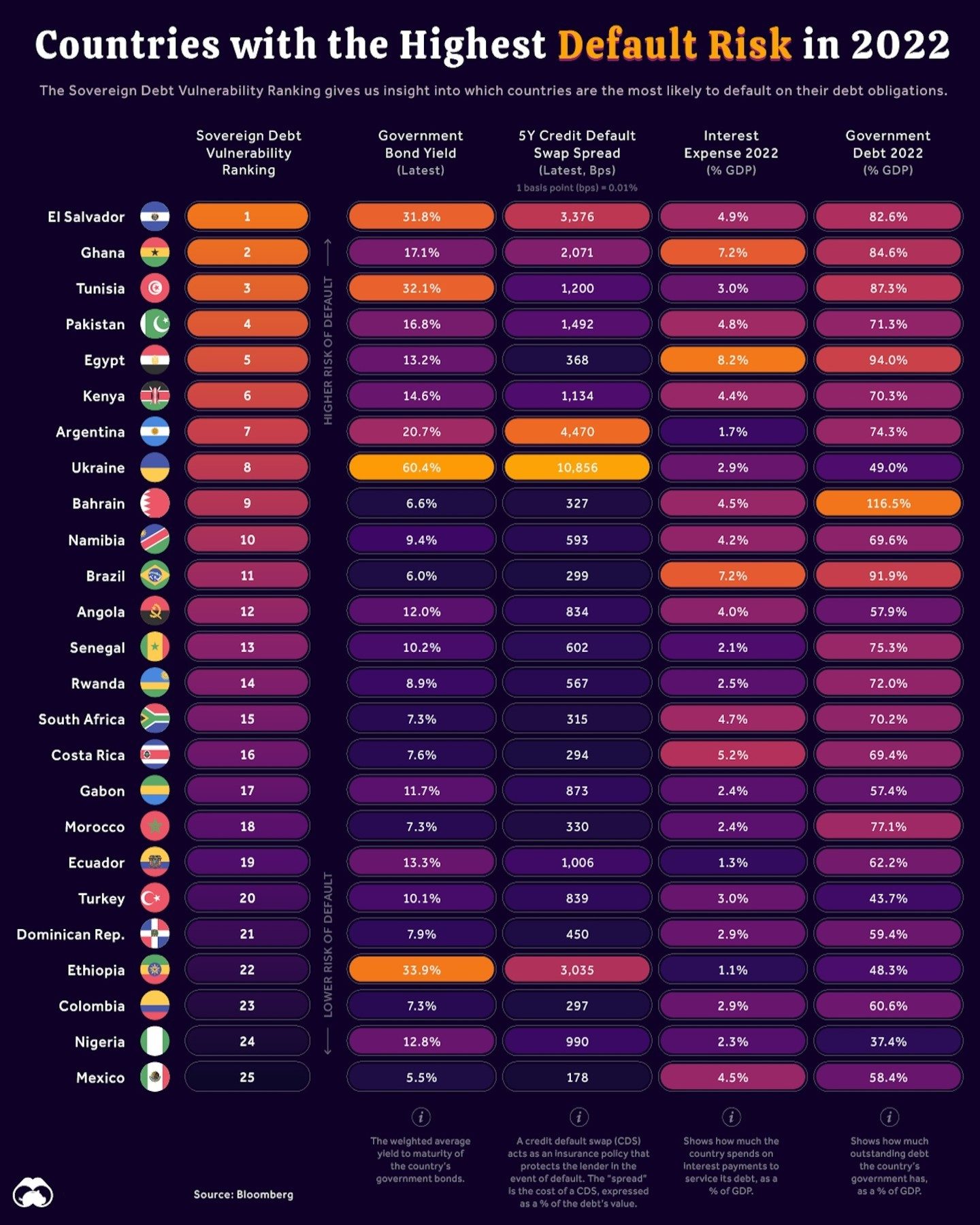
Default Risk: A Global Ranking of Countries
In May 2022, Sri Lanka made headlines as the first of the South Asian nations to default on its debt. The nation's government had a 30-day grace period to cover $78 million in unpaid interest but ultimately failed to meet the obligation. This default not only affects Sri Lanka’s economic future but also raises a critical question: which other countries are at risk of default?
To address this, let's look at the data. Using information from Bloomberg, we can rank countries by their default risk, providing a clearer picture of global economic stability.
Why This Matters
Understanding which countries are at high risk of defaulting on their debt is crucial for investors, policymakers, and economists. High default risk can lead to economic instability, currency depreciation, and social unrest. By identifying these risks, stakeholders can make informed decisions and take steps to mitigate potential impacts.
Global Default Risk Ranking
The Sovereign Debt Vulnerability Ranking is a key indicator of a country's likelihood to default on its debt obligations. This ranking takes into account various financial metrics, including debt-to-GDP ratios, interest expense, and credit default swap spreads.
Top Countries at Risk
El Salvador tops the list with a Sovereign Debt Vulnerability of 31.8%. The country faces significant economic challenges, including high levels of corruption and political instability, which have led to a volatile economic environment.
Ghana follows closely with a default risk of 17.1%. The country has struggled with high inflation, currency depreciation, and a significant debt burden, making it vulnerable to default.
Pakistan and Egypt are also high on the list, with default risks of 15.4% and 14.9%, respectively. Both countries face severe economic pressures, including high inflation, currency volatility, and large current account deficits. These factors increase their default risk.
Ukraine and Argentina are also at high risk, with vulnerabilities of 13.6% and 13.2% respectively. These countries have a history of economic instability, high public debt, and political uncertainty, all of which contribute to their elevated default risks.
Mid-Range Risks
Countries like Brazil, South Africa, and Morocco fall in the mid-range of default risk. Brazil has a vulnerability of 9.3%, while South Africa and Morocco have vulnerabilities of 8.7% and 7.5%, respectively. These countries face moderate economic challenges, including high public debt and inflation, but they have better fiscal and monetary policies compared to the countries with higher risks.
Lower Risks
Mexico has a relatively low default risk of 4.2%, reflecting a more stable economic environment. The country has shown resilience in the face of global economic challenges, maintaining a relatively strong fiscal position.
Key Indicators of Default Risk
Sovereign Debt Vulnerability
This indicator provides a comprehensive assessment of a country's ability to meet its debt obligations. It considers factors such as public debt-to-GDP ratio, fiscal deficit, and external debt.
5Y Credit Default Swap Spread
This metric reflects the market's perception of a country's risk of default. A higher spread indicates a higher perceived risk. The 5Y Credit Default Swap (CDS) spread is a crucial indicator for investors assessing the risk of investing in a country's bonds.
Interest Expense as a Percentage of GDP
This metric shows the proportion of a country's GDP used to pay interest on its debt. A high interest expense relative to GDP can strain a country's finances and increase the risk of default.
Government Bond Yield
The yield on government bonds is another key indicator. Higher yields can indicate that investors demand a higher return to compensate for the increased risk of default.
Practical Tips
For Investors
- Diversify Your Portfolio: Spread your investments across different countries and asset classes to reduce exposure to any single country's default risk.
- Monitor Economic Indicators: Keep an eye on key economic indicators such as the credit default swap spread, interest expense, and government bond yields.
- Stay Informed: Regularly review economic reports and financial news to stay updated on changes in a country's economic health.
For Policymakers
- Fiscal Discipline: Maintain a balanced budget and reduce public debt to lower the risk of default.
- Monetary Policy: Implement prudent monetary policies to control inflation and stabilize the currency.
- Economic Reforms: Implement structural reforms to enhance economic growth and reduce reliance on external financing.
Important Takeaways
- High Default Risk Countries: Countries like El Salvador, Ghana, and Pakistan are at the highest risk of defaulting on their debt.
- Mid-Range Risks: Countries like Brazil, South Africa, and Morocco face moderate risks due to their economic challenges but have better fiscal and monetary policies.
- Lower Risks: Countries like Mexico have lower default risks due to their more stable economic environments.
Conclusion
Default risk is a critical factor to consider when evaluating a country's economic health. By understanding the Sovereign Debt Vulnerability Ranking and other key indicators, investors and policymakers can make informed decisions to mitigate risks and promote economic stability. Countries like El Salvador, Ghana, and Pakistan face significant challenges, while others like Mexico have more stable economic environments. Staying informed and vigilant is key to navigating the complexities of global debt risk.
Watch the Reel
Questions readers ask
Which countries are at the highest risk of debt default in 2022?
As of 2022, countries like El Salvador, Ghana, Pakistan, and Egypt are at the highest risk of defaulting on their debt. In addition, Sri Lanka, which defaulted in 2022, has highlighted the economic instability in the region.
What factors contribute to a country's risk of debt default?
The risk of debt default is influenced by various factors, including economic instability, currency depreciation, and high levels of government debt. For instance, countries with large external debt obligations and limited foreign exchange reserves are more vulnerable to default.
How can investors assess the debt default risk of different countries?
Investors can assess the debt default risk by examining data from reliable sources like Bloomberg, which provides rankings of countries based on their default risk. Factors to consider include the country's debt-to-GDP ratio, interest payments on debt, and overall economic performance.
What are the implications of a sovereign debt default for a country?
A sovereign debt default can have severe consequences for a country, including a loss of market access, increased borrowing costs, and potential downgrades in credit ratings. It also affects the country's economy, leading to reduced investment, inflation, and potential social unrest.
What measures can countries take to mitigate the risk of defaulting on debt?
Countries can take several measures to mitigate the risk of default, such as restructuring their debt through debt swaps, negotiating with creditors, and implementing fiscal reforms. Additionally, seeking financial assistance from international organizations and implementing policies to boost economic growth can also help.
What is the significance of Sri Lanka's debt default in 2022?
Sri Lanka's debt default in 2022 is significant as it highlights the broader economic instability in South Asia. It serves as a warning to other countries in the region and globally, emphasizing the importance of prudent debt management and timely intervention to prevent similar crises.
Recent articles
Fresh deep dives from the latest Reels we unpacked.




Comments
Be the first to comment.