Consumer Class Decline: Countries Facing a Shrinking Consumer Base
The global consumer class is expected to grow by over 100 million people in 2024, yet certain countries are projected to experience a significant decline in their consumer base over the coming years. This decline is primarily attributed to factors such as low birth rates and aging populations, which are reshaping the economic landscapes of these nations.
Context: The Global Shift in Consumer Numbers
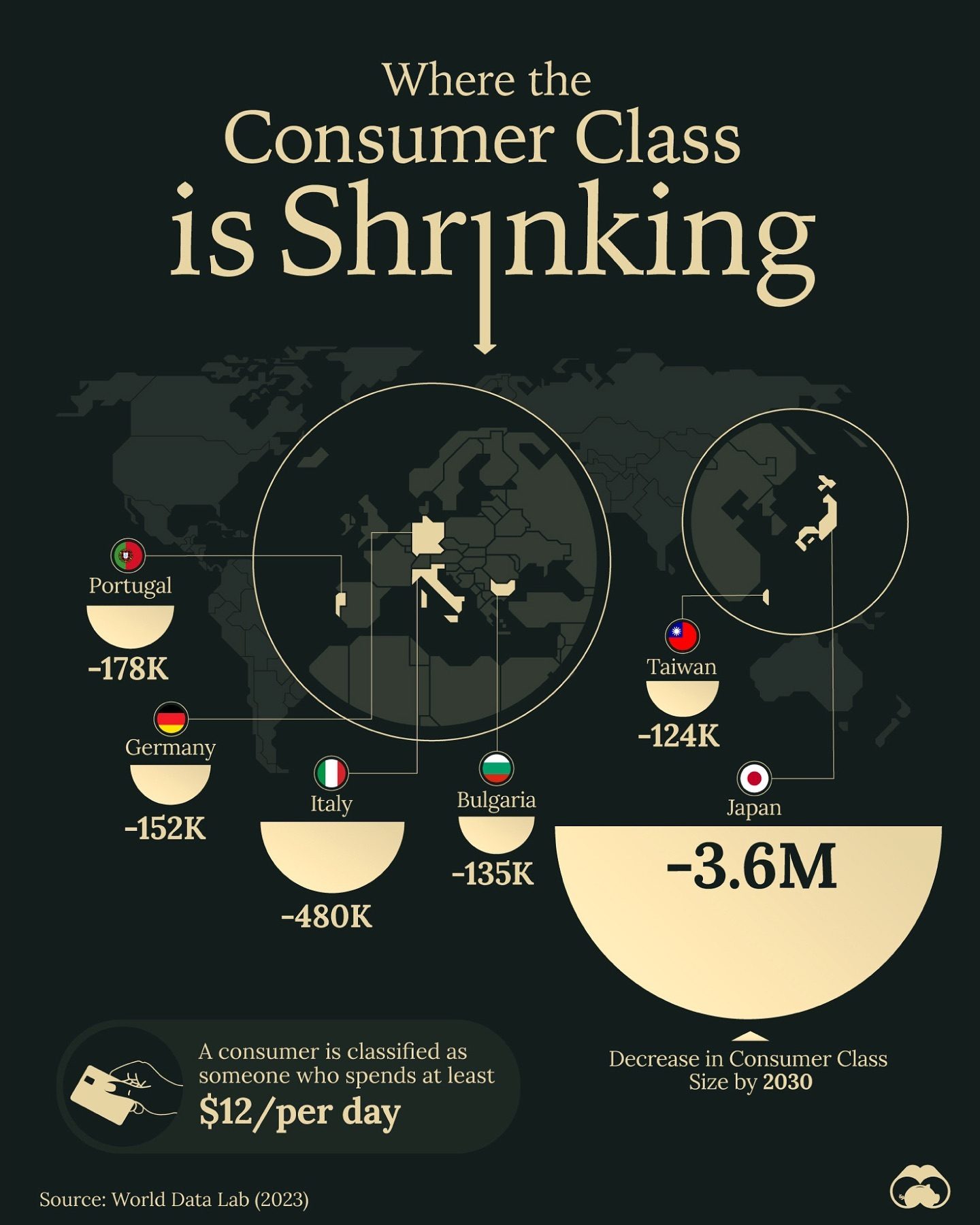
Understanding the dynamics of the consumer class is crucial for economies worldwide. A consumer is defined as an individual who spends at least $12 per day. This threshold helps in categorizing individuals who actively contribute to the economy through their purchasing power. The data for this analysis is sourced from the World Data Lab, providing a reliable foundation for projecting future trends.
Projected Decline in Key Countries
Japan: The Most Significant Decline
Japan is at the forefront of this trend, with an anticipated decrease of 3.6 million consumers by 2030. The primary driver of this decline is the country’s low birth rate, which has led to a diminishing workforce and a shrinking consumer base. This demographic shift poses significant challenges for Japan’s economy, as it relies heavily on domestic consumption.
Europe's Struggling Economies
Several European countries are also expected to see a decline in their consumer class. Portugal is projected to lose 178,000 consumers, Germany 152,000, Italy 480,000, and Bulgaria 135,000. These numbers, while smaller compared to Japan, still represent a notable reduction in economic activity. The aging populations and low fertility rates in these countries are key contributors to this trend. The economic implications include reduced domestic demand, potential labor shortages, and increased pressures on social welfare systems.
Economic and Social Implications
The projected decline in the consumer class has far-reaching implications for these countries. Economically, a smaller consumer base means reduced domestic demand, which can slow economic growth. Businesses may struggle with fewer customers, leading to potential layoffs and reduced investment. Additionally, the strain on social welfare systems increases as the ratio of retirees to workers rises. This demographic shift may necessitate policy changes, including incentives for higher birth rates, immigration reforms, and adjustments to pension and healthcare systems.
Policy Responses and Adaptations
Governments in these affected countries are already exploring various strategies to mitigate the impact of a shrinking consumer class. One approach is to encourage higher birth rates through financial incentives and better support for families. Another strategy is to attract and integrate immigrants to bolster the workforce and consumer base. Additionally, policies aimed at increasing labor participation among women and older adults can help maintain economic productivity.
In Japan, the government has implemented various measures to address the demographic challenge, including promoting flexible work arrangements and providing support for childcare and elder care. These initiatives aim to keep more individuals in the workforce, thereby maintaining consumer spending.
Practical Tips for Businesses and Governments
Businesses operating in countries with a declining consumer class must adapt their strategies to remain viable. Diversifying product offerings and targeting niche markets can help maintain profitability. Additionally, focusing on export markets can provide a stable revenue stream. Government support for innovation and entrepreneurship can foster economic growth despite a shrinking domestic market.
Important Takeaways
The decline in the consumer class in countries like Japan, Portugal, Germany, Italy, and Bulgaria is a multifaceted issue driven by low birth rates and aging populations. The economic implications are significant, impacting domestic demand, labor markets, and social welfare systems. Governments and businesses must adopt proactive strategies to navigate these challenges and maintain economic stability. Policies promoting higher birth rates, immigration, and labor participation, along with business innovations, can help mitigate the effects of a shrinking consumer base.
Conclusion
The projected decline in the consumer class in several countries underscores the need for strategic planning and policy adaptation. While the challenges are substantial, proactive measures can help mitigate the economic impact. By understanding the trends and implementing effective strategies, both governments and businesses can foster resilience and sustainability in the face of demographic shifts.
Watch the Reel
Questions readers ask
Which countries are most affected by a shrinking consumer base due to aging populations and low birth rates?
Countries most affected by a shrinking consumer base include Japan and several European nations. Japan, in particular, has a rapidly aging population and one of the lowest birth rates in the world. In Europe, countries like Portugal and Germany are also experiencing notable declines in their consumer bases due to these demographic shifts.
How does an aging population impact the consumer base?
An aging population impacts the consumer base by reducing the number of individuals who actively contribute to the economy. As the population ages, there are fewer young people entering the workforce and more people retiring, which can lead to a decrease in overall spending and domestic demand.
What are the economic consequences of a shrinking consumer base?
A shrinking consumer base can lead to several economic challenges. These include reduced domestic demand, as there are fewer consumers to drive economic activity. Additionally, labor shortages may arise due to fewer young people entering the workforce, which can strain businesses and slow economic growth.
What is the projected trend for Japan's consumer base in the coming years?
Japan's consumer base is projected to decline significantly due to its aging population and low birth rate. This trend is expected to continue, posing challenges for Japan's economy as domestic demand decreases and labor shortages become more pronounced.
How does the definition of a consumer influence the analysis of consumer trends?
The definition of a consumer, as someone who spends at least $12 per day, helps to identify individuals who actively contribute to the economy. This threshold allows for a more accurate analysis of purchasing power and economic activity, providing a clearer picture of the consumer market and its trends.
What are the projected consumer market trends in Europe by 2030?
By 2030, several European countries are expected to experience a significant decline in their consumer markets. Countries like Germany and Portugal are likely to face economic challenges due to reduced domestic demand and potential labor shortages, reflecting the broader trend of aging populations and low birth rates across the continent.
How does a shrinking consumer base affect domestic demand?
A shrinking consumer base directly affects domestic demand by reducing the number of individuals who are actively spending money within the economy. This decrease in spending can lead to slower economic growth, as businesses experience reduced revenue and may need to scale back operations or lay off employees.
Recent articles
Fresh deep dives from the latest Reels we unpacked.




Comments
Be the first to comment.