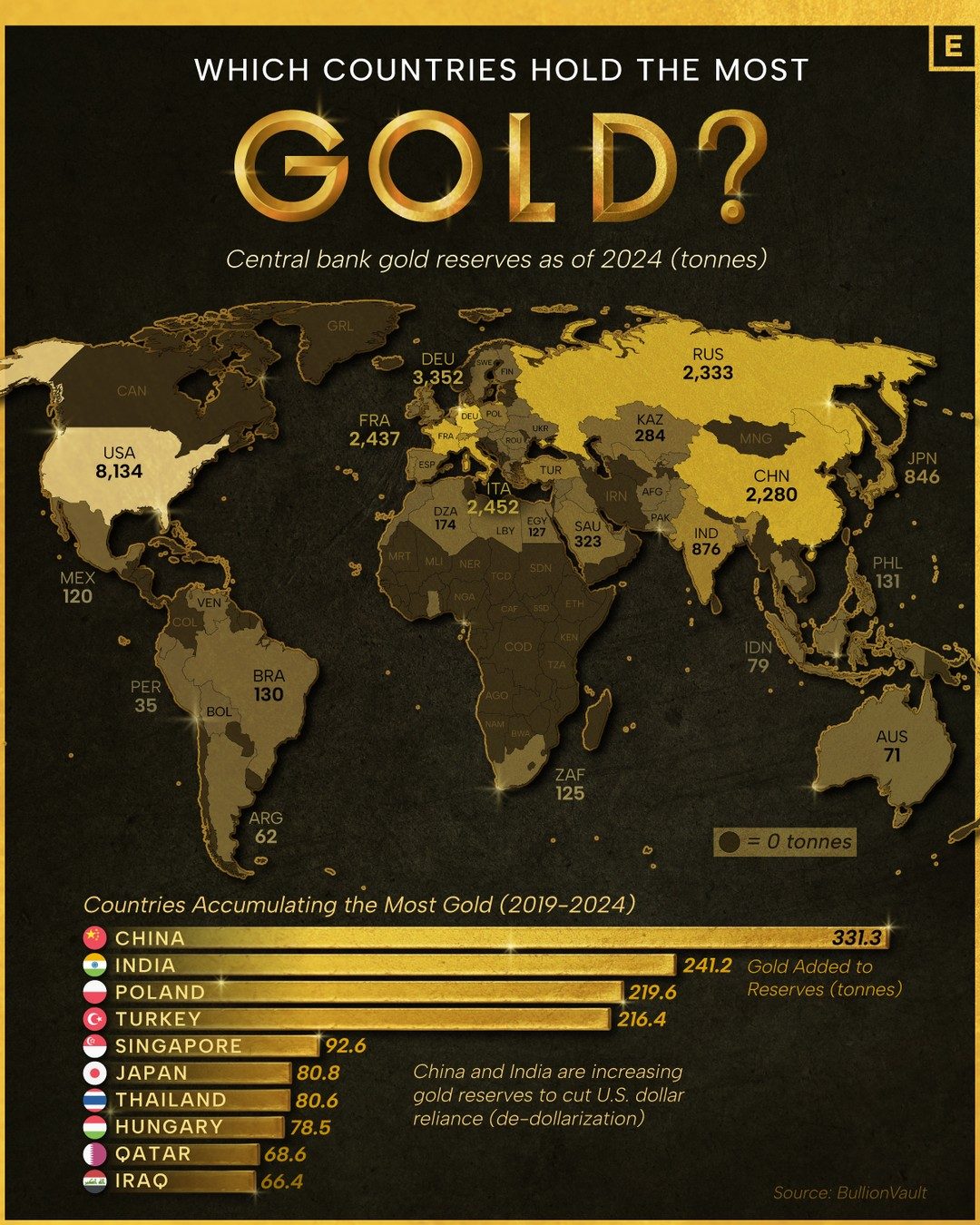
Gold Reserves by Country
Central banks around the world hold substantial gold reserves as a safeguard against economic uncertainties. The United States and European countries together possess over 60% of the world's gold reserves. Meanwhile, emerging economies like China, India, Poland, and Turkey have significantly increased their gold holdings in recent years. Let's explore the dynamics and implications of these gold reserves.
Why This Matters
Gold has long been a symbol of wealth and stability. For central banks, gold reserves serve multiple purposes: they act as a store of value, a hedge against currency fluctuations, and a means to back up financial obligations. Understanding which countries hold the most gold and why they are increasing their reserves provides insights into global economic strategies and geopolitical dynamics.
Main Discussion
Global Distribution of Gold Reserves
As of 2024, the U.S. holds the largest gold reserves at 8,134 tonnes, followed closely by Germany with 3,352 tonnes. Italy and France also have substantial reserves, with 2,452 and 2,333 tonnes, respectively. Together, these countries, along with others in Europe, control a significant portion of the world's gold reserves.
China and India’s Strategic Moves
China has been particularly active in boosting its gold reserves. Between 2019 and 2024, China added 331 tonnes, bringing its total to 2,280 tonnes. This strategic move is part of a broader effort to reduce reliance on the U.S. dollar and diversify its reserve assets. India, too, has been increasing its gold holdings, although the exact figures are not as pronounced as China's. Both countries are engaging in "de-dollarization" by accumulating more gold to strengthen their financial stability and sovereignty.
Other Notable Countries
Poland and Turkey have also made significant strides in increasing their gold reserves. Poland added 241.2 tonnes, while Turkey accumulated 80.8 tonnes between 2019 and 2024. These countries, along with others like Singapore, Japan, and Qatar, are enhancing their gold reserves to bolster their economic resilience and financial security.
The Role of Gold in Central Bank Strategies
Central banks use gold as a key component of their reserve management strategies. Gold's intrinsic value and liquidity make it an attractive asset for stabilizing currencies and managing inflation. Central banks in countries that are rich in gold are concerned about maintaining economic stability, especially in the face of geopolitical tensions and market volatility.
Practical Tips
For Investors
For individual investors, understanding the significance of gold reserves can provide valuable insights. Gold is often seen as a safe-haven asset, especially during times of economic uncertainty. Investors can consider diversifying their portfolios by including gold, either through physical ownership, gold ETFs, or other investment vehicles. Monitoring central bank activities and reserve data can offer clues about future economic trends and potential market movements.
For Policymakers
Policymakers should consider the strategic implications of gold reserves in formulating economic policies. Gold reserves can serve as a buffer against external shocks and provide confidence in the stability of the national currency. Policies that encourage the accumulation of gold reserves can enhance a country's financial resilience and reduce vulnerability to global economic fluctuations.
For Traders
Traders in the commodities market should pay close attention to the movements of gold reserves by central banks. Changes in gold reserves can influence the price of gold and impact related financial instruments. Keeping an eye on central bank activities and economic data can help traders make informed decisions and capitalize on market opportunities.
Important Takeaways
The Strategic Importance of Gold
Gold reserves are a critical component of a country's financial strategy. They provide a stable store of value and a hedge against economic uncertainties. Countries that hold significant gold reserves are better equipped to navigate global economic challenges and maintain financial stability.
The Global Shift in Gold Holdings
The redistribution of gold reserves among countries reflects broader geopolitical and economic shifts. Emerging economies like China and India are increasingly asserting their financial independence by accumulating gold. This trend highlights the evolving dynamics of global financial power and the quest for economic sovereignty.
The Role of Central Banks
Central banks play a pivotal role in managing gold reserves. Their decisions to accumulate or divest gold can have significant implications for global markets and economic stability. Understanding the strategies and motivations behind these decisions is crucial for investors, policymakers, and traders alike.
Conclusion
The global distribution of gold reserves offers a window into the financial strategies of nations. As countries like the U.S. and Germany maintain their dominant positions, emerging economies are actively increasing their gold holdings to bolster their economic resilience and reduce reliance on the U.S. dollar. Whether you are an investor, a policymaker, or a trader, understanding the dynamics of gold reserves can provide valuable insights and guide your decisions in an ever-changing economic landscape.
Watch the Reel
Questions readers ask
Which countries have the most gold reserves in 2023?
The United States and European countries collectively hold over 60% of the world's gold reserves. As of 2023, the U.S. has the most gold reserves, followed by Germany and Italy.
Why are countries like China and India increasing their gold reserves?
China and India have been actively increasing their gold reserves to hedge against economic uncertainties, diversify their assets, and reduce reliance on the U.S. dollar. By 2024, China aims to add 331 tonnes to its gold reserves to enhance financial stability
How have Poland and Turkey boosted their gold reserves between 2019 and 2024?
Both Poland and Turkey have significantly increased their gold holdings. Poland's central bank has been steadily accumulating gold to strengthen its balance sheet, while Turkey has been diversifying its reserves to protect against currency fluctuations and economic sanctions.
What are the benefits for central banks in holding gold reserves?
Central banks hold gold reserves as a store of value, a hedge against currency fluctuations, and a means to back up financial obligations. Gold provides a level of security and stability, especially during times of economic uncertainty.
Recent articles
Fresh deep dives from the latest Reels we unpacked.




Comments
Be the first to comment.