Investment Allocation by Country
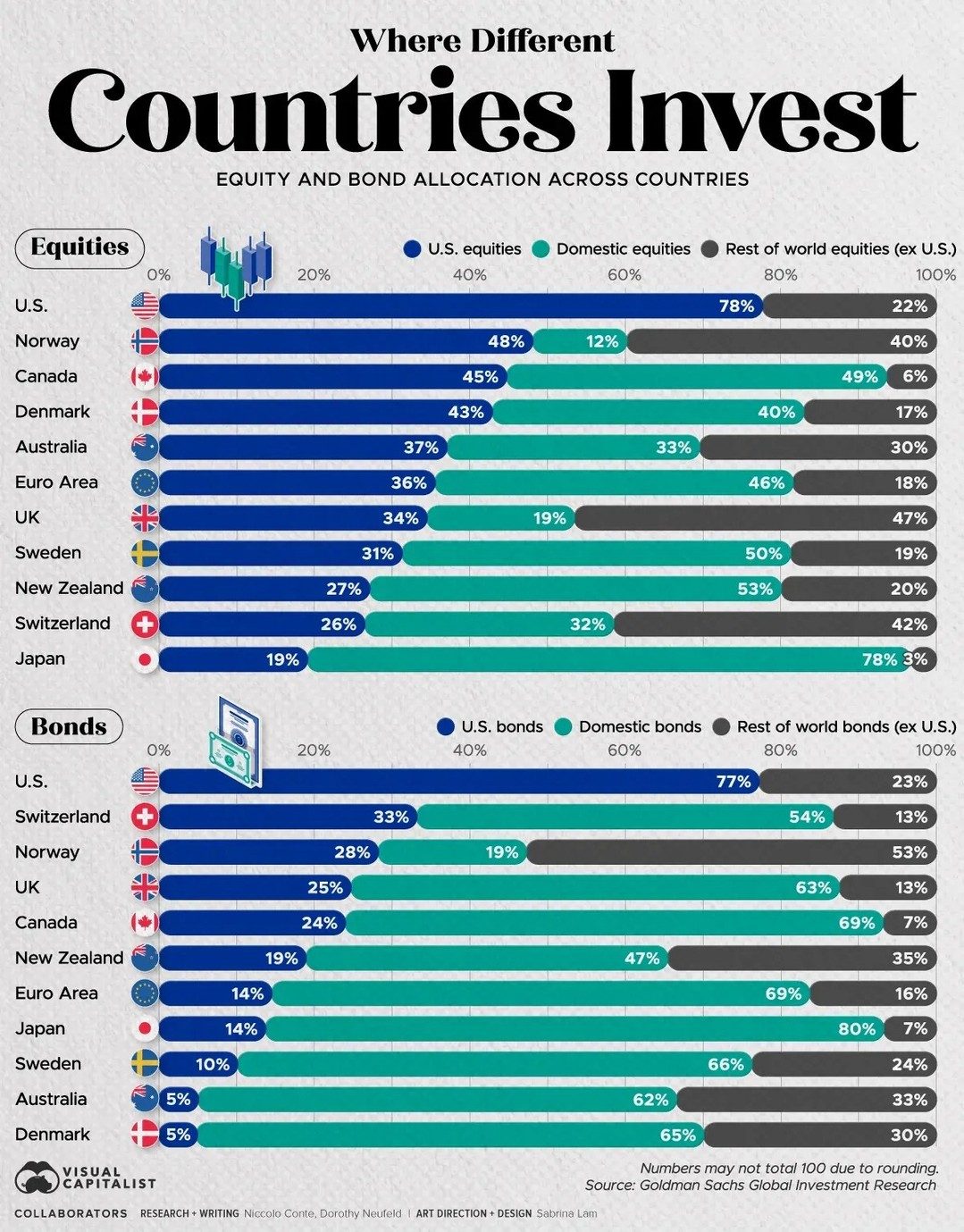
Investment allocation strategies vary greatly among countries, reflecting unique economic conditions, market opportunities, and domestic investment preferences. Understanding how countries allocate their equity and bond portfolios provides valuable insights into global investment trends and strategic decision-making. This data, sourced from Goldman Sachs Global Investment Research, highlights the distinct patterns in investment allocation across various nations.
Context / Why this matters
Global investment allocation is a critical aspect of financial strategy, influencing economic stability, market dynamics, and international trade. By analyzing how countries allocate their equity and bond portfolios, investors and policymakers can gain a deeper understanding of market trends, risk management practices, and opportunities for cross-border investments.
Main discussion
Equity Allocation Across Countries
U.S. Home Bias
U.S. investors exhibit a strong home bias, allocating 78% of their equity portfolios to domestic assets. This preference for domestic investments is driven by familiarity with the local market, regulatory environments, and the perceived lower risk of investing in home-grown companies. The significant allocation to U.S. equities underscores the robustness and attractiveness of the U.S. market as a destination for both domestic and foreign investors.
International Investment in U.S. Equities
Norway and Canada stand out for their substantial investments in U.S. equities, with 48% and 45% of their equity portfolios allocated to U.S. assets, respectively. These countries' significant exposure to the U.S. market reflects the country's economic stability, liquidity, and the diverse opportunities available in the world's largest economy. This international investment in U.S. equities indicates a global recognition of the U.S. market's resilience and potential for growth.
Equity Allocations in Other Countries
Beyond the U.S., Norway, and Canada, other countries show varying degrees of equity allocation to domestic and international markets. For instance, the Euro Area, the UK, and Japan allocate a significant portion of their equity portfolios to domestic assets, reflecting a similar home bias observed in the U.S. These countries' equity allocations underscore the importance of local market conditions and investor preferences in shaping global investment patterns.
Bond Allocation Across Countries
Domestic Bond Allocations
Domestic bonds constitute a large portion of investments in many countries, highlighting the importance of fixed-income assets in diversifying investment portfolios. Countries like the U.S., Euro Area, and Japan allocate a significant portion of their bond portfolios to domestic bonds, driven by factors such as regulatory requirements, liquidity, and the perceived safety of domestic debt instruments.
International Bond Allocations
While domestic bonds remain a significant component of investment portfolios, some countries also allocate a portion of their bond portfolios to international markets. For instance, countries like Norway and Canada, which have substantial investments in U.S. equities, also show a diversified approach to bond allocations, investing in both domestic and international fixed-income assets.
Practical tips
When considering investment allocation strategies, both individual investors and institutional investors can benefit from the following practical tips:
Understand Home Bias
Recognize the home bias in investment allocation and evaluate whether this aligns with your investment goals and risk tolerance. While investing domestically can offer lower risk and familiarity, it may also limit exposure to growth opportunities in international markets.
Diversify Across Geographies
Consider diversifying your portfolio across different geographies to mitigate risk and capitalize on global opportunities. Investing in a mix of domestic and international equities and bonds can provide a balanced approach to portfolio management.
Investigate Market Conditions
Stay updated on market conditions and economic indicators in various countries to make informed investment decisions. Understanding the factors that influence market performance can help in selecting the right investment opportunities.
Important takeaways
Investment allocation strategies are influenced by a variety of factors, including economic conditions, market opportunities, and investor preferences. Understanding these factors can help in making informed investment decisions and developing effective portfolio management strategies.
The significant allocation of U.S. assets in Norway and Canada highlights the attractiveness and resilience of the U.S. market. Additionally, the strong home bias observed in many countries underscores the importance of domestic investments in shaping global investment patterns.
Diversification across different geographies and asset classes can provide a balanced approach to investment allocation, helping to mitigate risk and capitalize on growth opportunities.
Conclusion
A comprehensive understanding of investment allocation strategies across various countries provides valuable insights into global financial trends and strategic decision-making. Whether driven by home bias, market opportunities, or regulatory requirements, the allocation of equity and bond portfolios plays a crucial role in shaping investment outcomes.
By examining the data from Goldman Sachs Global Investment Research, investors and policymakers can gain a deeper understanding of the factors influencing investment allocation and make informed decisions to achieve their financial goals.
Watch the Reel
Questions readers ask
What are the primary factors influencing how countries allocate equities and bonds?
Countries allocate equities and bonds based on their unique economic conditions, market opportunities, and domestic investment preferences. These factors shape each country's investment strategy and influence their portfolio management decisions.
How can understanding global equity allocation benefit investors?
By examining how countries allocate their equity portfolios, investors can gain insights into global investment trends. This information can help investors make informed decisions about where to invest internationally and how to diversify their own portfolios effectively.
What insights does Goldman Sachs Global Investment Research provide about country investment strategies?
Goldman Sachs Global Investment Research offers detailed data on how different countries allocate their equities and bonds. This information reveals distinct patterns and strategies, helping investors and policymakers understand the global investment landscape better.
Why is the allocation between domestic and international bonds important for a country's investment strategy?
The balance between domestic and international bonds in a country's investment portfolio can significantly impact its economic stability and market dynamics. This allocation affects interest rates, currency values, and the overall financial health of the country.
What role do visual aids, like the Visual Capitalist infographic, play in understanding global bond markets?
Visual aids such as the Visual Capitalist infographic provide a clear and concise way to understand complex data on global bond markets. They help illustrate the distribution of bonds across different countries, making it easier to compare and analyze investment strategies worldwide.
What are the benefits of diversifying an investment portfolio with both equities and bonds?
Diversifying an investment portfolio with both equities and bonds can help mitigate risk and maximize returns. Equities offer potential for higher returns, while bonds provide stability and income, creating a balanced investment strategy.
How do country investment allocation strategies impact international equity investing?
Country investment allocation strategies influence international equity investing by shaping market trends and opportunities. Understanding these strategies can help investors identify potential growth areas and make more informed decisions about where to invest globally.
Recent articles
Fresh deep dives from the latest Reels we unpacked.




Comments
Be the first to comment.