The Significance of 'Made in America' and Consumers' Perceptions
The phrase "Made in America" carries significant weight in the minds of consumers, especially as geopolitical dynamics between the United States and China evolve. Over the past few decades, the label "Made in America" has fluctuated in importance, reflecting the shifting economic and political landscapes between the two superpowers. Whether driven by geopolitical tensions, economic concerns, or shifting consumer preferences, the distinction between American-made and Chinese-made products has resurfaced in recent years.
Why This Matters
Understanding consumer views on "Made in America" is crucial for businesses, policymakers, and consumers alike. It influences purchasing decisions, manufacturing strategies, and even diplomatic relations. The distinction between American-made and Chinese-made products extends beyond mere national pride; it encompasses economic stability, job creation, and environmental sustainability.
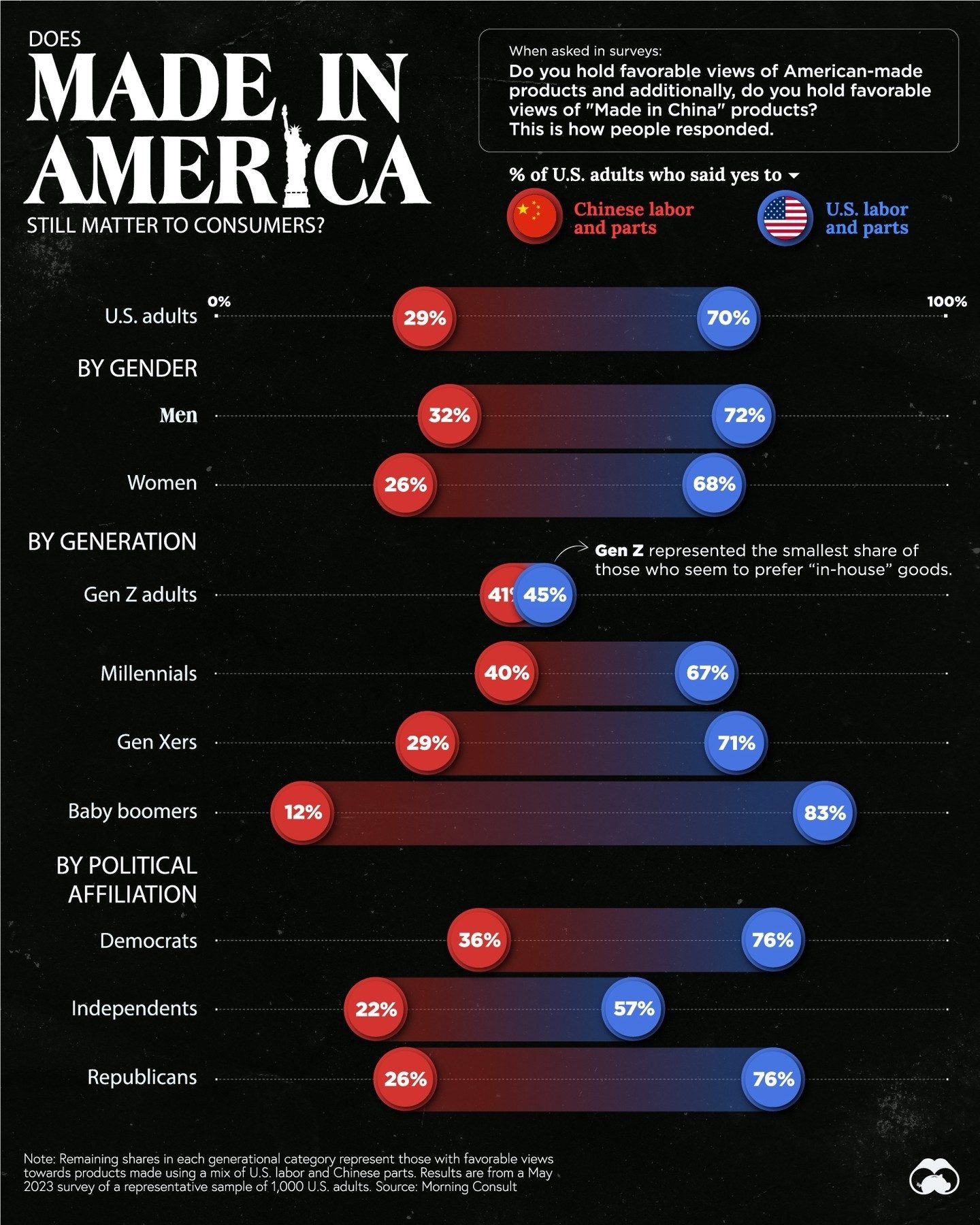
A May 2023 survey of 1,000 U.S. adults revealed intriguing insights into these perceptions. The data, broken down by gender, generation, and political affiliation, provides a nuanced view of consumer attitudes towards products made in America versus those made with Chinese labor and parts.
Consumer Attitudes by Gender
The survey found that men and women hold slightly different views on the importance of "Made in America." According to the data, 32% of men hold favorable views of products made in the U.S. compared to 26% of women. This discrepancy, while not vast, indicates a gendered perspective that could influence product marketing strategies and consumer outreach efforts
Consumer Attitudes by Generation
Generational differences in consumer attitudes are more pronounced. Baby Boomers lead the pack with 83% holding favorable views of American-made products, while Gen Z lags significantly with only 41%. Millennials and Gen Xers fall in the middle, with 40% and 29% respectively. This data suggests that younger generations may be less concerned about the origin of products, potentially due to differing economic contexts, globalization, or varied priorities.
Political Affiliation and Consumer Views
Political affiliation also plays a significant role in shaping consumer views on "Made in America." Republicans show a strong preference for American-made goods, with 76% holding favorable views. Independents follow with 57%, and Democrats trail with 36%. This political divide is notable and could reflect broader ideological differences, such as views on trade, labor practices, or environmental regulations.
The Nuances of 'Made in China' Perceptions
The survey also delved into consumer views on products made with Chinese labor and parts. Overall, 29% of U.S. adults hold favorable views of 'Made in China' products. Interestingly, this figure varies significantly by generation, with 41% of younger generations holding favorable views, compared to 12% among Baby Boomers. This could be attributed to a combination of factors, including affordability, perceived quality, and global supply chain dynamics.
Practical Tips for Businesses
For businesses navigating this complex landscape, understanding these consumer attitudes is crucial. Here are some practical tips:
Highlighting 'Made in America'
For companies emphasizing American production, targeting Baby Boomers and Republicans could yield significant returns. Highlighting American labor and parts in marketing campaigns can resonate strongly with these demographics.
Tailoring to Younger Generations
Younger generations, particularly Gen Z, may require a different approach. Emphasizing sustainability, affordability, and global connectivity might appeal more to these consumers. Mixed labor and parts—a blend of American and Chinese production—could also be a viable strategy.
Gender-Specific Marketing
Given the slight gender differences, businesses might consider gender-specific marketing strategies. For instance, products heavily marketed to men could benefit from a stronger emphasis on "Made in America."
Product Positioning by Political Affiliation
Political affiliation can guide product positioning and brand messaging. For example, products aimed at a Republican consumer base might benefit from a strong "Made in America" narrative, while those targeting Democrats might need a more nuanced approach, focusing on factors like sustainability and affordability.
Important Takeaways
- Gender Differences: Men tend to favor American-made products more than women.
- Generational Divide: Younger generations are less concerned about the origin of products.
- Political Influence: Republicans are more likely to prefer American-made goods, while Democrats are more nuanced in their preferences.
- Chinese Labor and Parts: Younger generations are more open to products made with Chinese labor and parts.
- Nuanced Approaches: Businesses need to tailor their marketing strategies based on demographic and political preferences.
Conclusion
The significance of "Made in America" and consumer perceptions of it are multifaceted and influenced by a variety of factors, including gender, generation, and political affiliation. While American-made products still hold sway, particularly among older generations and Republicans, younger consumers and Democrats exhibit more flexible views. For businesses, understanding these nuances can guide effective marketing strategies, product positioning, and consumer outreach efforts. As the economic and political landscape continues to evolve, staying attuned to these shifting consumer attitudes will be crucial for long-term success.
Watch the Reel
Questions readers ask
How do consumer perceptions of 'Made in America' and 'Made in China' influence buying decisions?
Consumer perceptions of 'Made in America' and 'Made in China' greatly influence buying decisions. Many consumers associate American-made products with higher quality, better sustainability, and support for domestic job creation. In contrast, Chinese products are often seen as more affordable but may raise concerns about quality and labor practices, which can sway purchasing choices.
Why are Baby Boomers more likely to prefer American-made products?
Baby Boomers often prefer American-made products due to a sense of nostalgia and patriotism. Growing up during a time when many goods were manufactured domestically, they tend to associate 'Made in America' with quality and reliability. Additionally, they may be more concerned about the economic impact of their purchases, such as supporting American jobs and industries.
How do economic stability and job creation factor into consumer views on 'Made in America'?
Economic stability and job creation are significant factors in consumer views on 'Made in America.' Many consumers believe that buying American-made products helps stimulate the domestic economy, create jobs, and reduce reliance on foreign manufacturing. This perspective is often fueled by concerns about trade deficits and the desire to support local industries.
What role do sustainability and environmental concerns play in the preference for 'Made in America'?
Sustainability and environmental concerns are increasingly important to consumers when choosing between 'Made in America' and 'Made in China.' Many American-made products are marketed with a focus on sustainable practices, responsible sourcing, and reduced environmental impact. Consumers who prioritize these factors are more likely to opt for American-made goods, believing they contribute to a more sustainable future.
How have geopolitical tensions between the U.S. and China affected consumer views on product origins?
Geopolitical tensions between the U.S. and China have heightened consumer awareness of product origins. Many consumers now consider the political and ethical implications of their purchases, leading to a preference for 'Made in America' as a way to support domestic interests. Conversely, some consumers may avoid Chinese products due to concerns about human rights, intellectual property, or trade policies.
Do American-made products always come at a higher price point compared to Chinese-made products?
American-made products often come at a higher price point due to factors like higher labor costs, stricter regulations, and quality control measures. However, consumers may find the price difference justified by the perceived benefits of American-made products, such as better quality, durability, and support for local economies. Some consumers are willing to pay a premium for these advantages.
How does the perception of American manufacturing quality compare to that of Chinese manufacturing quality?
The perception of American manufacturing quality is generally higher than that of Chinese manufacturing. Consumers often associate 'Made in America' with rigorous quality control standards, attention to detail, and innovation. In contrast, Chinese manufacturing is sometimes viewed with skepticism due to issues like counterfeiting, inconsistent quality, and concerns about labor practices and environmental regulations.
Related deep dives
Similar reads based on topic and creator.




Recent articles
Fresh deep dives from the latest Reels we unpacked.




Comments
Be the first to comment.