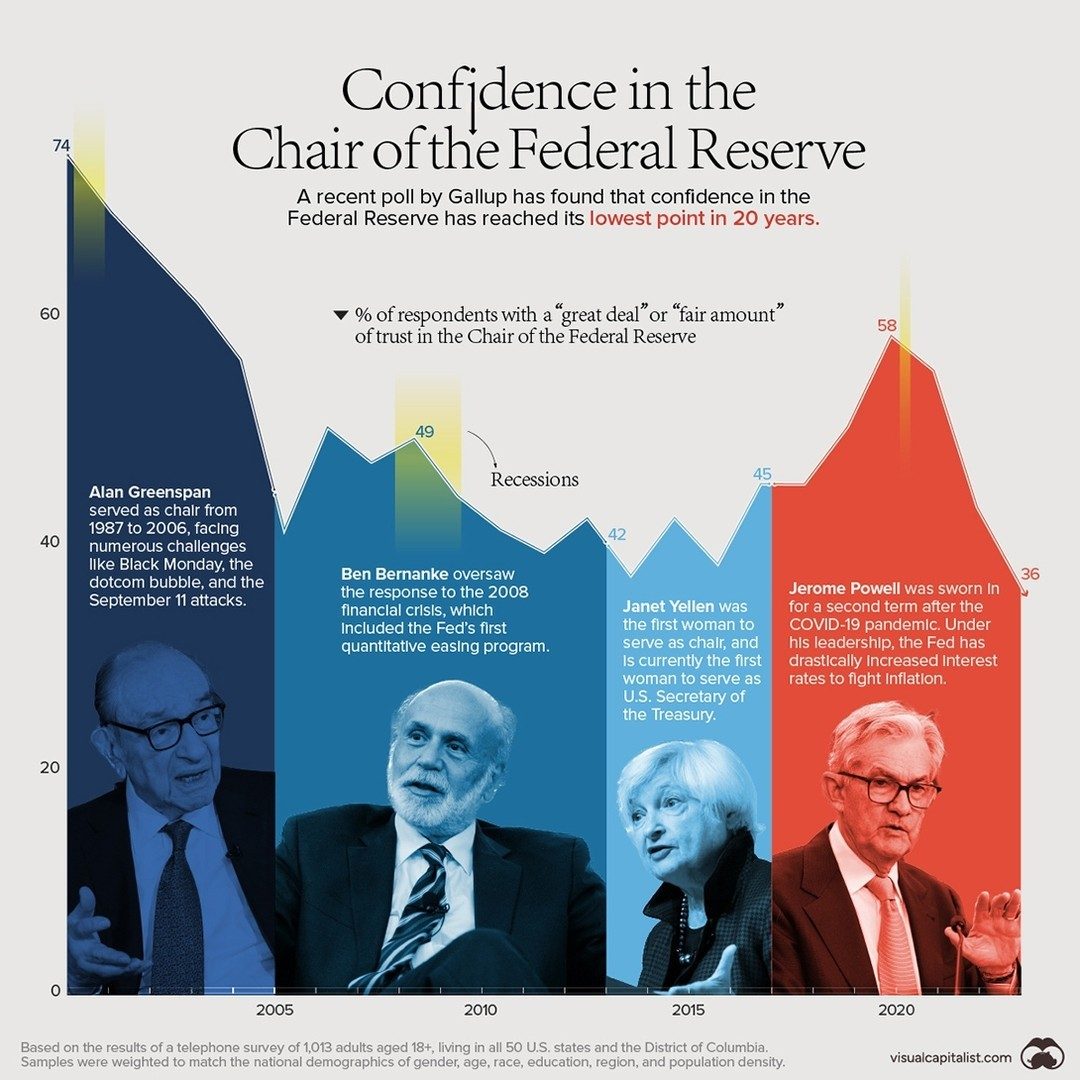
Federal Reserve Chair Confidence
The public's confidence in the Federal Reserve Chairman has fluctuated significantly over the past two decades. Annually, Gallup conducts a survey asking American adults about their confidence in the current Fed Chairman to make the right decisions for the U.S. economy. This data provides valuable insights into the public's trust in the Federal Reserve's leadership amidst various economic challenges.
Context / Why this matters
The Federal Reserve, as the country’s central bank, plays a pivotal role in managing the economy. Its decisions on interest rates, monetary policy, and financial regulations can profoundly impact inflation, employment, and overall economic stability. Public confidence in the Fed Chairman is crucial because it reflects the general public's trust in the institution's ability to navigate economic crises and promote prosperity. Understanding the trends in this confidence can offer a barometer of economic sentiment and potential shifts in public perception of the Fed's effectiveness.
Main discussion
Historical Context
The confidence levels in the Federal Reserve Chairman have historically been influenced by significant economic events and the leadership styles of the individual chairs.
Alan Greenspan (1987-2006) served during some of the most tumultuous times in recent economic history, including Black Monday (the 1987 stock market crash), the dot-com bubble burst, and the aftermath of the September 11 attacks. Despite these challenges, Greenspan maintained relatively high public confidence, largely due to his reputation as a steady hand and his ability to communicate complex economic concepts to the public.
Ben Bernanke (2006-2014) succeeded Greenspan and led the Fed through the 2008 financial crisis, the most severe economic downturn since the Great Depression. Bernanke's implementation of quantitative easing and other unconventional monetary policies helped stabilize the economy, although his tenure was also marked by a gradual decline in public confidence. This period was characterized by the slow recovery from the financial crisis and the onset of the Great Recession, which tested the Fed's ability to restore economic health.
Janet Yellen (2014-2018) became the first woman to serve as Federal Reserve Chair. Her tenure saw a gradual economic recovery from the Great Recession, but it also included the early signs of economic instability that would lead to the COVID-19 pandemic. Yellen's leadership was marked by a focus on full employment and economic equality, which resonated with many Americans.
Jerome Powell (2018-present) took over the Fed during a period of relative economic stability but has faced significant challenges, including the economic fallout from the COVID-19 pandemic and the subsequent rise in inflation. Powell's tenure has been characterized by aggressive interest rate hikes aimed at controlling inflation, which has impacted public confidence in varying ways.
Key Trends in Confidence Levels
Confidence in the Federal Reserve has seen notable fluctuations over the years, with recent surveys indicating a decline to its lowest point in two decades. Several factors contribute to these shifts:
- Economic Performance: During periods of economic growth and stability, public confidence in the Fed tends to rise. Conversely, during economic downturns or periods of uncertainty, confidence tends to waver.
- Communication and Transparency: Effective communication by the Fed Chair can build public trust. When the public feels informed about the Fed's decisions and their rationale, confidence tends to be higher.
- Perceived Effectiveness: The public's perception of the Fed's ability to manage economic challenges also influences confidence levels. When the Fed is seen as successfully navigating crises, public trust increases.
Economic Events and Their Impact
The economic landscape has been marked by several significant events that have influenced public confidence in the Fed.
The 2008 Financial Crisis: This event had a profound impact on public confidence, as the Fed and Bernanke's response to the crisis was closely watched. The implementation of quantitative easing and other unconventional policies helped stabilize the economy but also raised questions about the Fed's long-term strategy.
The Great Recession: The slow recovery from the recession tested the Fed's ability to restore economic health and impacted public confidence. The unemployment rate remained high for an extended period, and many Americans felt the economic recovery was uneven.
The COVID-19 Pandemic: This global crisis saw Powell responding to unprecedented economic challenges, including mass unemployment and supply chain disruptions. The Fed's rapid response, including interest rate cuts and asset purchases, helped stabilize the economy but also raised concerns about inflation and future economic stability.
Practical tips
To stay informed about the Federal Reserve and its impact on the economy, consider the following practical tips:
Stay Informed
Regularly check credible financial news sources and publications like the visualcapitalist.com, which highlight the Federal Reserve's policies and their impact on the economy. This information can help you stay informed about the economic landscape and the Fed's role in shaping it.
Understand Monetary Policy
Familiarize yourself with key concepts in monetary policy, such as interest rates, quantitative easing, and inflation. This knowledge can help you better understand the Fed's decisions and their potential impact on your personal finances and the broader economy.
Follow Economic Indicators
Keep an eye on economic indicators such as unemployment rates, inflation, and GDP growth. These indicators can provide insights into the overall health of the economy and help you gauge the effectiveness of the Fed's policies.
Participate in Surveys
Participating in economic surveys, such as those conducted by Gallup, can provide valuable data on public sentiment and economic confidence. Your input can contribute to a more comprehensive understanding of economic trends and public perceptions.
Engage with Financial Advisors
Consulting with financial advisors can offer personalized insights into how economic policies affect your financial situation. They can help you make informed decisions about investments, savings, and retirement planning.
Important takeaways
The fluctuating confidence in the Federal Reserve reflects the public's complex relationship with the institution and its leadership. Key takeaways include:
- Public trust in the Federal Reserve is influenced by economic performance, communication, and perceived effectiveness.
- Major economic events, such as the 2008 financial crisis and the COVID-19 pandemic, have significantly impacted public confidence.
- The Fed's response to these challenges has varied, with some actions being more effective than others.
- Understanding the trends in confidence levels can provide insights into public sentiment and economic perceptions.
Conclusion
Confidence in the Federal Reserve Chairman has been a dynamic measure of public trust in the institution's ability to navigate economic challenges. The historical context, key trends, and economic events all play a crucial role in shaping public perceptions. Staying informed and engaged with economic trends and the Fed's policies can help individuals better understand and navigate the economic landscape.
Watch the Reel
Questions readers ask
What factors have influenced public confidence in the Federal Reserve Chairman over the past 20 years?
Public confidence in the Federal Reserve Chairman has been shaped by various economic events, including recessions, financial crises, and policy changes. For instance, confidence levels surged during the 2008 financial crisis, reflecting public trust in the Fed's intervention efforts. Conversely, periods of economic instability or perceived mismanagement have led to fluctuations in public confidence.
How does Gallup measure public confidence in the Federal Reserve Chairman?
Gallup conducts an annual survey asking Americans if they have confidence in the Federal Reserve Chairman to make the right decisions for the U.S. economy. The survey results provide a yearly snapshot of public sentiment and trust in the Fed's leadership, which is then used as a barometer of economic sentiment.
Who were the Federal Reserve Chairmen during the past two decades, and how did public opinion vary among them?
The past two decades have seen three Federal Reserve Chairmen: Alan Greenspan, Ben Bernanke, and Janet Yellen. Public opinion varied significantly among them. For example, Greenspan enjoyed high confidence levels throughout his tenure, while Bernanke saw a surge in confidence during the 2008 financial crisis. Yellen's tenure was marked by a steady decline in confidence, reflecting economic uncertainty.
Why is public confidence in the Federal Reserve Chairman important?
Public confidence in the Federal Reserve Chairman is vital as it indicates the level of trust Americans have in the central bank's ability to manage the economy effectively. High confidence levels can foster stability and support for the Fed's policies, while low confidence may lead to skepticism and resistance, complicating the Fed's efforts to maintain economic stability.
How have economic events impacted public trust in the Federal Reserve?
Economic events have significantly impacted public trust in the Federal Reserve. During periods of economic crisis, such as the 2008 financial crisis, public trust tends to increase as the Fed implements measures to stabilize the economy. Conversely, during times of economic uncertainty or perceived policy failures, public trust may decline, reflecting the public's concerns about the Fed's effectiveness.
What role does the Federal Reserve play in the U.S. economy, and how does public confidence affect its actions?
The Federal Reserve plays a crucial role in managing the U.S. economy through monetary policy, interest rate adjustments, and financial regulations. Public confidence in the Fed's leadership influences its ability to implement policies effectively. High confidence levels can bolster the Fed's efforts, while low confidence may necessitate additional communication and transparency to maintain public support.
Recent articles
Fresh deep dives from the latest Reels we unpacked.




Comments
Be the first to comment.