Planetary Orbits
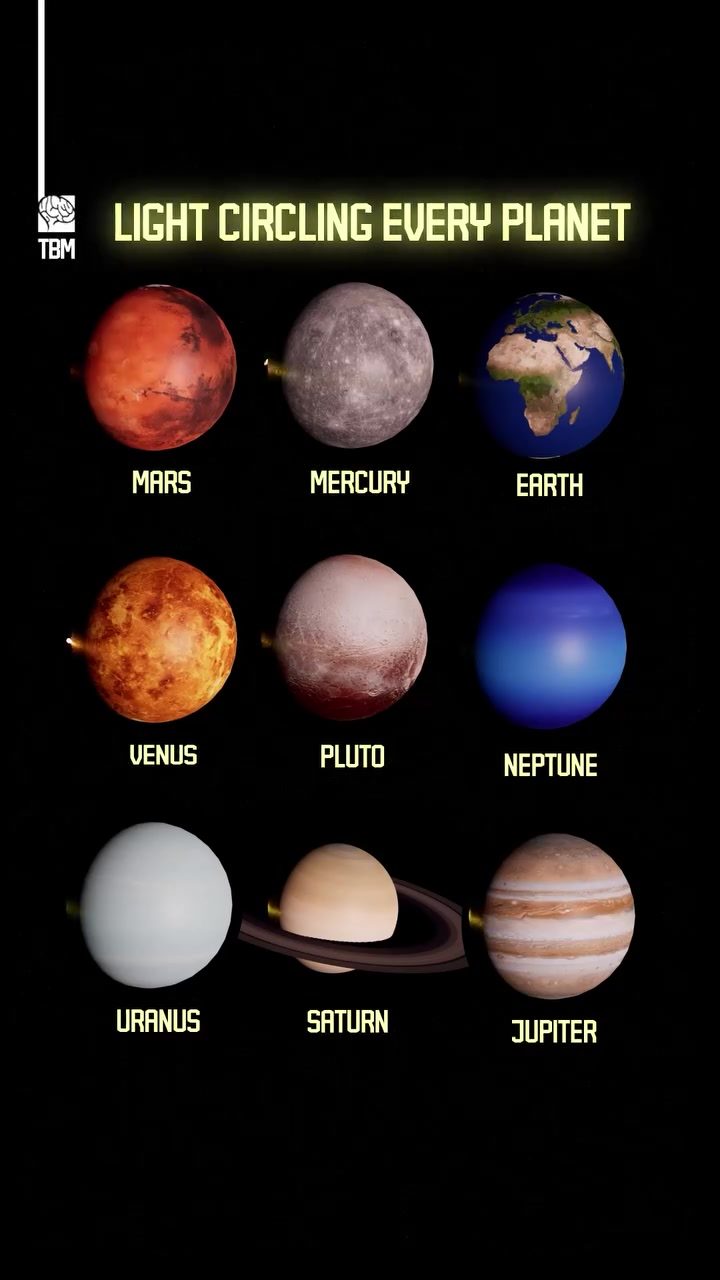
The orbits of the planets in our solar system are a fascinating topic, revealing much about the dynamics and sizes of the planets. The animation by TBM vividly illustrates how many times light could circle each planet, offering a unique perspective on their relative sizes and orbital speeds.
Context: Why This Matters
Understanding planetary orbits is crucial for various fields, including astronomy, astrophysics, and space exploration. By examining how light travels around each planet, we gain insights into their sizes relative to Earth and the vast differences between them. This visual representation helps demystify the complex characteristics of each planet, making it easier to grasp their unique properties.
Main Discussion
The Planets and Their Orbital Speeds
The animation by TBM highlights the orbital speeds of eight planets in our solar system. Each planet is labeled with its name and the number of orbits it completes per second. Let's delve into the specifics:
Mercury
Mercury, the closest planet to the Sun, has the fastest orbital speed at 40.15 orbits per second. Its proximity to the Sun means it experiences the strongest gravitational pull, resulting in a rapid orbit.
Venus
Venus orbits the Sun at 7.89 orbits per second. Although it is closer to the Sun than Earth, its orbital speed is significantly slower than Mercury's, illustrating the inverse relationship between distance and orbital speed.
Earth
Earth orbits the Sun at a moderate speed of 14.1 orbits per second. This speed is crucial for sustaining life, as it maintains a stable climate and day-night cycle.
Mars
Mars, known as the Red Planet, orbits the Sun at 0.82 orbits per second. Its slower speed compared to Earth contributes to its longer year, which is about 687 Earth days.
Jupiter
Jupiter, the largest planet in our solar system, orbits the Sun at a relatively slow speed of 0.027 orbits per second. Its massive size and distance from the Sun result in a longer orbital period.
Saturn
Saturn, known for its stunning rings, orbits the Sun at 0.025 orbits per second. Its slow orbital speed is due to its significant distance from the Sun, contributing to a year that is about 29 Earth years.
Uranus
Uranus orbits the Sun at 0.014 orbits per second. Its slow speed and unique axial tilt make it one of the most intriguing planets to study.
Neptune
Neptune, the farthest planet from the Sun, orbits at 0.011 orbits per second. Its slow orbital speed results in a year that is approximately 165 Earth years.
The Significance of Orbital Speeds
The orbital speeds of the planets provide a wealth of information about their sizes and distances from the Sun. For instance, the closer a planet is to the Sun, the faster its orbital speed due to the stronger gravitational pull. This relationship is fundamental to understanding the dynamics of our solar system.
Practical Tips
Observing Planetary Orbits
Observing the orbits of the planets can be a rewarding hobby for astronomy enthusiasts. Here are some practical tips for getting started:
-
Use a Telescope: A good quality telescope can help you observe the planets more clearly. Look for telescopes with high magnification and aperture.
-
Choose the Right Time: Certain times of the year are better for observing specific planets. For example, Mercury is best observed during its greatest elongation, when it is farthest from the Sun.
-
Use Planet Tracking Apps: Apps like Stellarium, SkySafari, or Star Walk can help you locate planets in the night sky and provide detailed information about their positions.
-
Join Astronomy Clubs: Joining an astronomy club can provide access to advanced telescopes and expertise from experienced astronomers.
-
Record Your Observations: Keeping a log of your observations can help you track the movement of the planets over time and improve your understanding of their orbits.
Understanding Orbital Mechanics
Understanding orbital mechanics can enhance your appreciation of planetary orbits. Here are some key concepts:
-
Kepler's Laws: Johannes Kepler's three laws of planetary motion describe the orbits of the planets. The first law states that planets move in elliptical orbits with the Sun at one focus. The second law states that a line joining a planet and the Sun sweeps out equal areas in equal times. The third law states that the square of the orbital period of a planet is directly proportional to the cube of the semi-major axis of its orbit.
-
Gravitational Forces: The gravitational pull of the Sun and other celestial bodies influences the orbits of the planets. Understanding these forces can help you grasp why planets orbit at different speeds.
-
Escape Velocity: Escape velocity is the speed an object needs to escape the gravitational pull of a celestial body. It varies based on the mass and size of the planet, affecting the dynamics of planetary orbits.
Important Takeaways
-
Relative Orbital Speeds: The animation by TBM clearly shows the vast differences in orbital speeds among the planets, with Mercury being the fastest and Neptune the slowest.
-
Importance of Distance: The distance from the Sun significantly impacts a planet's orbital speed, with closer planets moving faster.
-
Unique Characteristics: Each planet has unique characteristics that contribute to its orbital speed and period.
Conclusion
The animation by TBM provides a captivating visual representation of planetary orbits, showcasing the relative speeds and sizes of the planets in our solar system. By understanding the dynamics of planetary orbits, we gain a deeper appreciation for the intricate balance that sustains life on Earth and the diverse characteristics of the other planets. Whether you're an astronomy enthusiast or simply curious about the cosmos, exploring planetary orbits offers a fascinating journey through our solar system.
Watch the Reel
Questions readers ask
How does the animation by TBM help in understanding planetary sizes?
The animation by TBM uses light to visually represent the size of each planet. By showing how many times light can circle each planet in a given time frame, viewers get a practical sense of their relative sizes. This method offers a clear and engaging way to compare the dimensions of the planets.
What insights can be gained from observing light circling the planets?
By observing the number of times light circles each planet, viewers can understand the vast differences in planetary sizes. This visualization helps to comprehend the relative dimensions of the planets in a more tangible way, bridging the gap between numerical data and real-world understanding.
Why is it important to compare planet orbit speeds and sizes?
Comparing planet orbit speeds and sizes provides valuable information about the dynamics of our solar system. It helps in understanding the gravitational influences and orbital mechanics that govern planetary motion, which is crucial for fields like astronomy, astrophysics, and space exploration.
How does the animation by TBM illustrate the concept of orbital velocity?
The animation by TBM demonstrates orbital velocity by showing how quickly light can circle each planet. This visual representation helps to grasp the speed at which each planet completes one orbit around the Sun, providing a clear comparison of their orbital velocities.
What are the benefits of using light to compare planet sizes and orbital speeds?
Using light to compare planet sizes and orbital speeds offers a straightforward and intuitive method. Light travels at a constant speed, making it an ideal tool for visualizing the differences in planetary sizes and orbital velocities. This approach simplifies the complex data into an engaging and accessible format.
How does the solar system animation by TBM enhance our understanding of planet size and orbit animation?
The solar system animation by TBM provides a dynamic and visually appealing way to learn about planet size and orbit animation. By animating the number of times light circles each planet, it offers a unique perspective on how planet sizes and orbital speeds interact within the solar system.
What is the significance of the relative dimensions of the planets as shown in the animation?
The relative dimensions of the planets shown in the animation highlight the vast differences in size and scale within our solar system. This is particularly useful for understanding the unique characteristics of each planet, such as their gravitational pull, orbital period, and surface area.
Recent articles
Fresh deep dives from the latest Reels we unpacked.




Comments
Be the first to comment.