Chinese Public Opinion on Global Countries and Regions
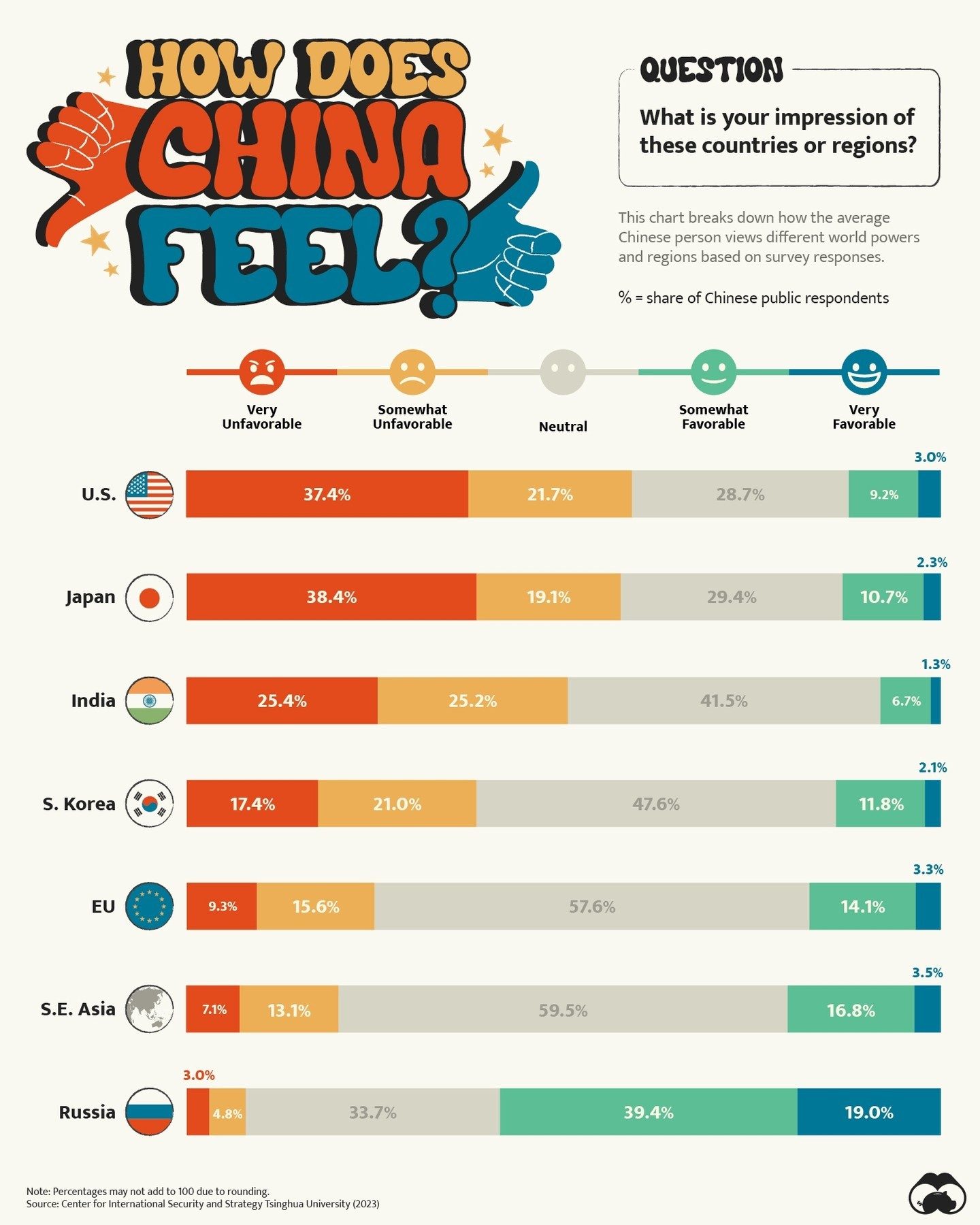
Recent geopolitical tensions, including disputes over Taiwan, the COVID-19 pandemic, trade issues, and the war in Ukraine, have significantly influenced Chinese public sentiment towards other countries. The Center for International Security and Strategy (CISS) at Tsinghua University conducted a survey to gauge Chinese attitudes toward various nations and regions. The results, presented in an informative infographic, reveal nuanced views that reflect a complex interplay of political, economic, and social factors.
Context / Why this matters
Understanding Chinese public opinion is crucial for several reasons. China's global influence continues to grow, making it essential to comprehend how its citizens perceive other countries. These perceptions can shape diplomatic relations, trade agreements, and international cooperation. Additionally, the survey provides insights into how global events, such as the COVID-19 pandemic and geopolitical conflicts, impact public sentiment.
Main discussion
Methodology and Data Source
The survey, conducted by the Center for International Security and Strategy at Tsinghua University, aimed to capture the sentiments of the Chinese public towards various countries and regions. The results are presented as percentages of respondents who hold favorable, unfavorable, or neutral impressions. The data is sourced from a comprehensive survey that reflects the diverse views within the Chinese population.
Key Findings
The survey highlights several key findings:
-
United States: The U.S. received a significant portion of unfavorable responses, with 37.4% of respondents holding an unfavorable impression. This sentiment is likely influenced by ongoing trade disputes, political tensions, and differing stances on global issues.
-
Russia: Russia fares better in the eyes of the Chinese public, with 39.4% expressing favorable views. This positive sentiment can be attributed to shared geopolitical interests and strategic partnerships, particularly in response to Western policies.
-
European Union: The EU receives a high percentage of neutral responses, with 57.6% of respondents neither favorable nor unfavorable. This indicates a more balanced view, possibly due to the EU's complex relationship with China, encompassing both economic cooperation and political disagreements.
Regional Perspectives
-
Asia: Neighboring Asian countries, such as Japan, South Korea, and India, have varied impressions. Japan and South Korea both have significant unfavorable ratings, likely due to historical tensions and current political disputes. India, however, shows a more balanced view, with 28.7% neutral, 31.6% favorable, and 33.7% unfavorable.
-
Southeast Asia: Southeast Asia generally receives favorable or neutral responses, indicating positive or stable relations. This region is crucial for China's economic and diplomatic efforts, and the neutral to favorable sentiment reflects a mutual interest in maintaining good relations.
Practical Tips
For those looking to understand and navigate Chinese public opinion, here are some practical tips:
-
Contextualize Historical and Political Factors: Understand the historical and political contexts that shape Chinese views on different countries. For instance, historical tensions with Japan and South Korea can significantly influence public sentiment.
-
Monitor Geopolitical Developments: Stay informed about current geopolitical events, as they can rapidly shift public opinions. For example, the ongoing war in Ukraine and trade disputes with the U.S. are critical factors.
-
Engage in Cultural and Economic Diplomacy: Building strong cultural and economic ties can foster positive public sentiment. Initiatives that promote mutual understanding and cooperation can help improve perceptions.
-
Leverage Media and Public Relations: Use media and public relations strategies to convey accurate information and address misconceptions. This can help shape a more favorable public image.
Important takeaways
The survey results underscore the importance of recognizing the multifaceted nature of Chinese public opinion. Key takeaways include:
-
Diverse Perspectives: Chinese public opinion is diverse and influenced by a range of factors, including historical context, current geopolitical events, and economic ties.
-
Influence of Global Events: Major global events, such as the COVID-19 pandemic and the war in Ukraine, significantly impact public sentiment towards different countries.
-
Regional Variations: Public opinion varies significantly by region, reflecting the complexities of China's relationships with different parts of the world.
Conclusion
The survey by the Center for International Security and Strategy at Tsinghua University provides valuable insights into Chinese public opinion on various countries and regions. Understanding these sentiments is crucial for navigating international relations, trade agreements, and diplomatic efforts. By recognizing the factors that shape Chinese public opinion, stakeholders can better address concerns, build stronger relationships, and foster mutual understanding.
Watch the Reel
Recent articles
Fresh deep dives from the latest Reels we unpacked.




Comments
Be the first to comment.