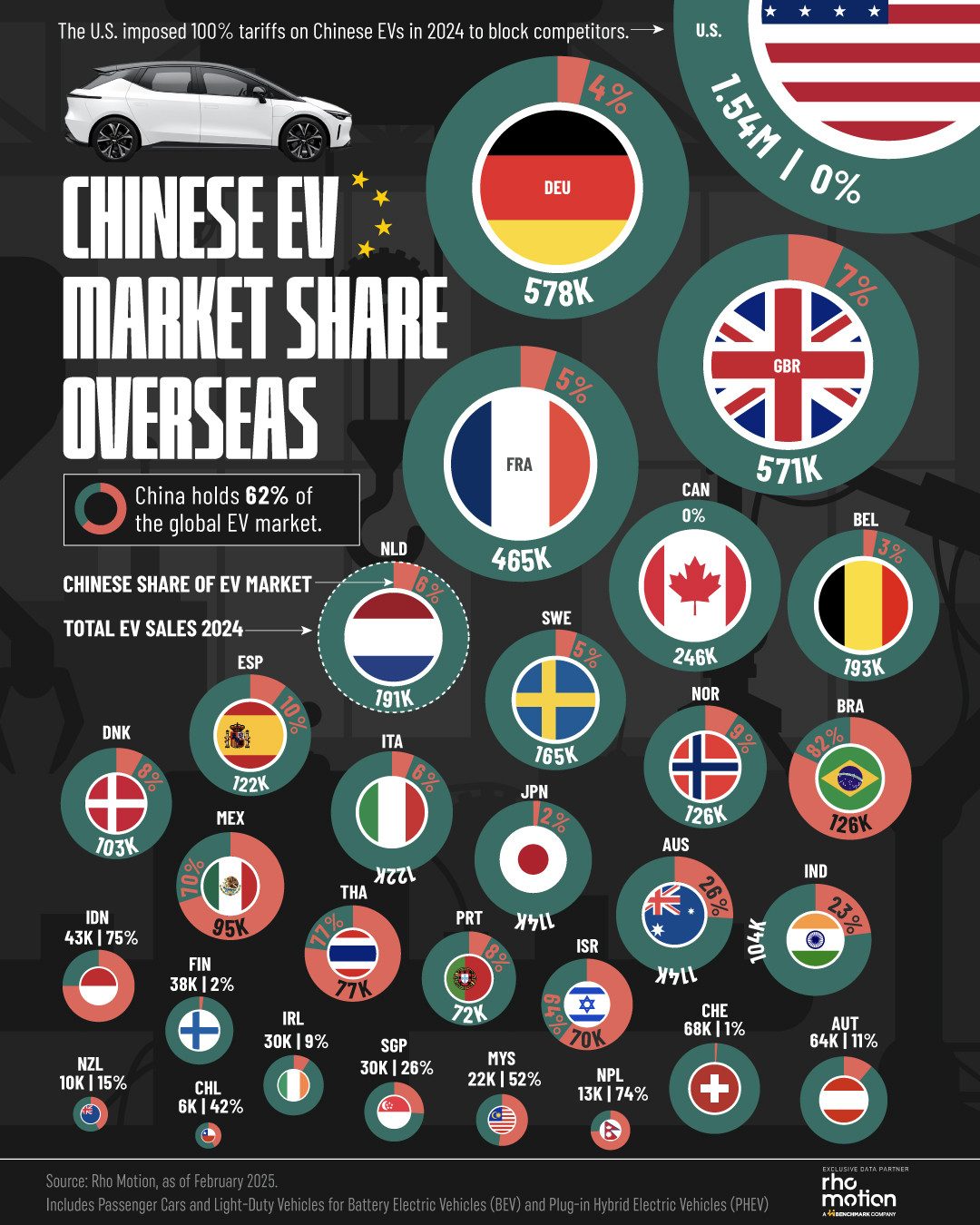
Chinese EV Market Share
In 2024, Chinese brands dominated the global electric vehicle (EV) market, accounting for 62% of all EV sales. This significant market share underscores the growing influence of Chinese EV manufacturers on a global scale. These figures are based on data from Rho Motion, a leading provider of EV market intelligence. Let's delve into the specifics of China's EV market share and its implications for various countries.
Why This Matters
The rising prominence of Chinese EVs in global markets is a pivotal development in the automotive industry. It signifies not only the technological and economic prowess of Chinese manufacturers but also the shifting dynamics of the global EV market. Understanding the market share and sales data of Chinese EVs in different countries can provide valuable insights into consumer preferences, regulatory environments, and the competitive landscape. This knowledge is crucial for stakeholders, including automakers, policymakers, and consumers, as they navigate the rapidly evolving EV landscape.
Chinese EVs Overseas: A Global Perspective
Europe
In Europe, the presence of Chinese EVs is particularly notable. Germany, one of the world's largest automotive markets, saw 4% of its total EV sales coming from Chinese brands, totaling 578,000 units. Great Britain followed closely with 7%, or 571,000 units. This market share is significant, considering the established presence of European automakers and the stringent regulations in these countries. The Netherlands, France, and Belgium also saw substantial market shares of 6%, 5%, and 3% respectively, highlighting the growing acceptance of Chinese EVs in these markets.
Asia-Pacific
The Asia-Pacific region, which includes significant markets like Japan, India, and Australia, shows a varied adoption of Chinese EVs. Australia leads with 26% of its EV sales coming from Chinese brands, totaling 126,000 units. India follows with 23%, or 64,000 units. Japan, on the other hand, has a relatively lower market share of 2%, or 165,000 units. This discrepancy can be attributed to different consumer preferences, regulatory frameworks, and local competition.
North and South America
In North America, the market share of Chinese EVs is relatively lower. Canada, for instance, has a 0% market share, indicating a minimal presence of Chinese EVs. However, the United States, which is not explicitly mentioned in the data, likely plays a significant role in the overall EV market dynamics. In South America, countries like Chile and Brazil show modest market shares of 19% and 1%, respectively, suggesting a growing but still developing market for Chinese EVs.
Other Notable Markets
Several other countries, including Indonesia, Malaysia, and Singapore, show varied market shares. Indonesia leads with 17%, or 43,000 units, followed by Malaysia with 152%, or 22,000 units, and Singapore with 6%, or 30,000 units. These figures indicate a growing interest in Chinese EVs, driven by factors such as affordability, technological advancements, and governmental incentives.
Practical Tips for Navigating the Chinese EV Market
For Consumers
When considering a Chinese EV, consumers should focus on factors such as battery life, charging infrastructure, and after-sales service. Researching the specific models available in your region and checking for consumer reviews can provide valuable insights. Additionally, being aware of local incentives and subsidies for EV purchases can help make an informed decision.
For Automakers
For automakers, understanding the competitive landscape is crucial. This includes not only the market share of Chinese EVs but also the specific models and their features. Collaborating with local partners, leveraging technological advancements, and offering competitive pricing can help in gaining a foothold in these markets.
Important Takeaways
Market Dominance
Chinese brands hold a commanding 62% of the global EV market, highlighting their dominance in the industry. This reflects their ability to produce competitive and innovative products at scale.
Regional Variability
The market share of Chinese EVs varies significantly across different regions. Europe and some Asia-Pacific countries show substantial adoption, while North America and certain South American countries have lower market shares.
Strategic Implications
For automakers and policymakers, understanding the market dynamics of Chinese EVs is essential. This includes recognizing the competitive landscape, consumer preferences, and regulatory environments.
Future Trends
The increasing market share of Chinese EVs suggests a continued trend of growth and adoption. Staying informed about technological advancements, regulatory changes, and consumer trends can help stakeholders navigate this evolving landscape effectively.
Conclusion
The global EV market is undergoing a transformative shift, with Chinese brands playing a pivotal role. The 62% market share of Chinese EVs in 2024 underscores their growing influence and competitiveness. Whether you are a consumer, automaker, or policymaker, staying informed about these market dynamics is essential for making strategic decisions and navigating the evolving landscape of electric vehicles.
Watch the Reel
Questions readers ask
Which data provider reported the 62% market share for Chinese EVs in 2024?
Rho Motion, a leading provider of EV market intelligence, reported that Chinese EV brands accounted for 62% of the global EV market in 2024.
What types of electric vehicles contribute to China's 62% market share?
Chinese EV manufacturers contribute to this market share with a variety of vehicles, including passenger electric vehicles and light electric vehicles, which are key segments in the global market.
How does this market share impact other countries?
The dominance of Chinese EVs influences the automotive landscape in numerous countries, affecting local markets and consumer preferences, as well as encouraging competition and innovation from other manufacturers.
What factors contribute to the success of Chinese EV brands?
Chinese EV brands are successful due to significant investments in technology, competitive pricing, and effective market strategies, which enable them to capture a large share of the global EV market.
What are the implications of China's EV market dominance in 2024?
China's dominance in the EV market indicates a shift in the global automotive industry, highlighting the economic and technological strength of Chinese manufacturers and setting new trends in the global EV market.
Related deep dives
Similar reads based on topic and creator.


Recent articles
Fresh deep dives from the latest Reels we unpacked.




Comments
Be the first to comment.