Global Tech Spending: Trends and Shifts from 2000 to 2023
Global research and development (R&D) spending has undergone significant changes over the past two decades, with notable shifts in the contributions of major countries. This article explores the key trends in global tech spending from 2000 to 2023, with a particular focus on the rising influence of China and the enduring leadership of the United States in this critical arena.
Context: Why This Matters
Understanding the dynamics of global tech spending is crucial for several reasons. Firstly, R&D investment is a key driver of innovation, influencing technological advancements and economic growth. Secondly, the distribution of R&D spending across different countries reflects their strategic priorities and competitiveness in the global tech landscape. Thirdly, the data provides insights into the geopolitical shifts and economic strategies that shape the world of technology today.
Global Tech Spending Trends
The Rise of China
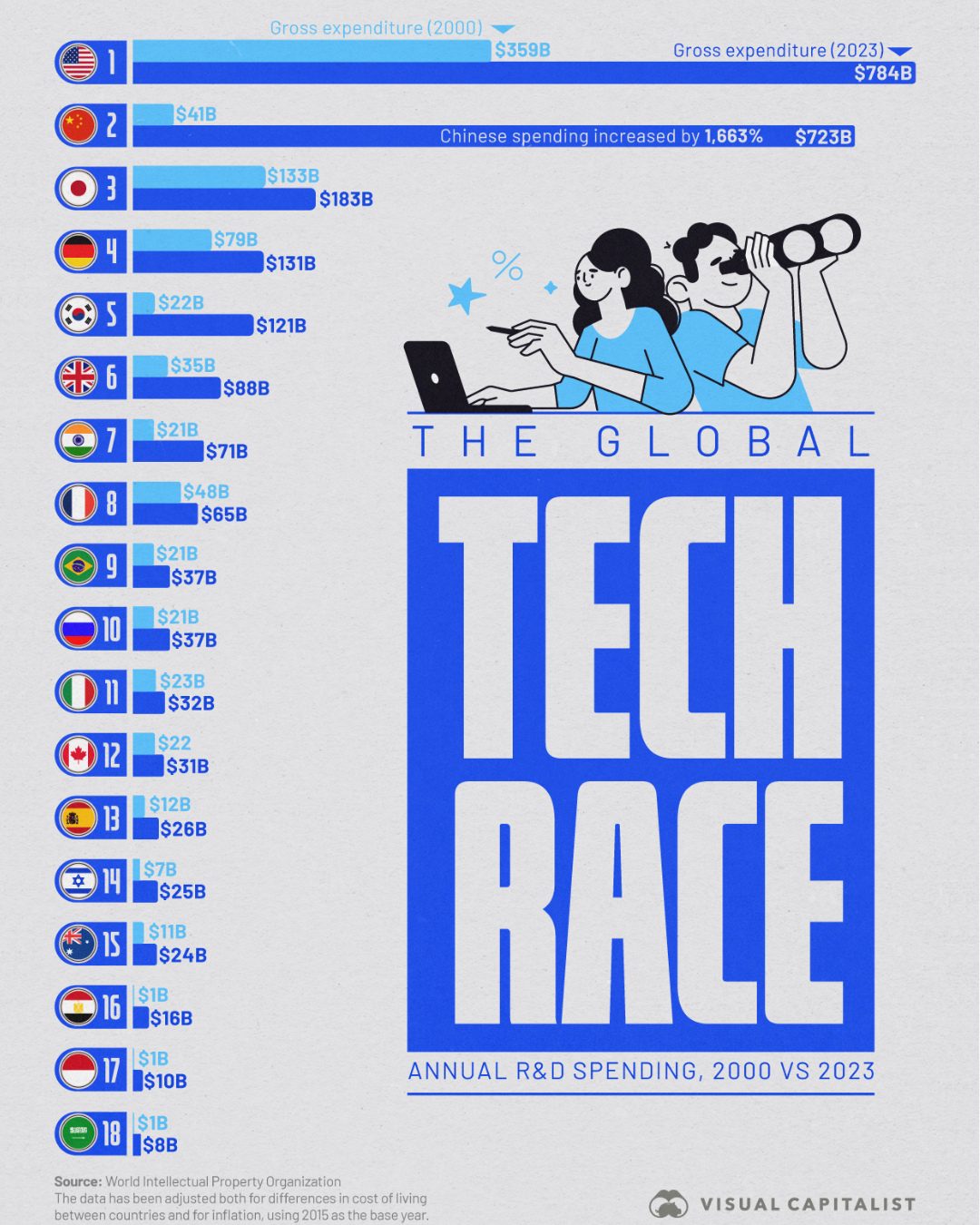
China's rise as a global tech powerhouse is one of the most significant stories in R&D spending. In 2000, China's share of global R&D expenditure was a modest 4%. However, by 2023, this figure had surged to 26%. This dramatic increase underscores China's commitment to becoming a global leader in technology and innovation. The country's R&D expenditure grew by an astonishing 1,663% over this period, highlighting its rapid ascent in the tech arena.
The United States: Still the Leader
Despite China's impressive growth, the United States remains the world's top spender on R&D. In 2023, the U.S. led all countries with a significant lead in R&D spending. However, the gap between the U.S. and China has narrowed considerably. In 2023, China was just $61 billion behind the U.S. in terms of R&D expenditure. This narrowing gap indicates a rapidly changing global tech landscape, with China posing a serious challenge to U.S. dominance.
Other Major Contributors
While China and the United States dominate the headlines, other countries also play significant roles in the global tech race. For instance, Japan, Germany, and South Korea are among the top spenders on R&D. These countries, along with others, contribute substantially to the global tech ecosystem. Their investments in R&D are crucial for fostering innovation and driving technological progress.
Regional Spending Patterns
The spending patterns reveal interesting regional trends. In 2000, the global R&D expenditure was $359 billion, with the U.S. accounting for a substantial portion of this figure. By 2023, the global expenditure had more than doubled to $784 billion, showcasing the increasing importance of R&D in the global economy.
Practical Tips for Navigating the Global Tech Landscape
For businesses and investors, understanding these trends can provide valuable insights and opportunities. Here are a few practical tips:
-
Invest in Innovation: Companies should prioritize R&D investments to stay competitive in the global market. Whether it's through in-house research, partnerships, or acquisitions, investing in innovation is key to long-term success.
-
Monitor Market Trends: Keep a close eye on the R&D spending patterns of major economies. The trends can offer insights into emerging technologies and market shifts, helping businesses make informed decisions.
-
Explore Partnership Opportunities: Collaborate with global tech leaders and emerging innovators. Partnerships can open doors to new markets, technologies, and talent, fostering growth and innovation.
-
Stay Agile: The tech landscape is ever-evolving, and so should your strategies. Be prepared to adapt to new technologies, regulatory environments, and market conditions. Agility is crucial for navigating the dynamic world of global tech.
Important Takeaways
- China's R&D spending has surged dramatically, reflecting its ambition to become a global tech leader.
- The United States remains the top spender on R&D, but the gap with China is closing rapidly.
- Other countries, including Japan, Germany, and South Korea, also play significant roles in the global tech ecosystem.
- Understanding these trends can provide valuable insights for businesses and investors looking to navigate the global tech landscape.
Conclusion
The global tech spending trends from 2000 to 2023 highlight a rapidly evolving landscape, with China's rise and the U.S.'s enduring leadership being the most notable developments. As R&D investments continue to shape the future of technology, businesses and investors must stay informed and adaptable. By understanding these trends and making strategic investments, companies can position themselves for success in an increasingly competitive global tech arena.
Watch the Reel
Questions readers ask
How much has China's R&D spending increased since 2000?
China's R&D spending has grown significantly, from a 4% share of the global total in 2000 to 26% in 2023. This substantial increase highlights China's strategic focus on technological advancement and innovation.
What is the current R&D spending gap between the U.S. and China?
As of 2023, the U.S. maintains a lead of $61 billion in R&D spending over China. This gap, though significant, has narrowed considerably from previous years, reflecting China's rapid growth in this area.
What are the key drivers behind China's rise in R&D spending?
China's surge in R&D spending is driven by its commitment to innovation and technological self-sufficiency. The country aims to reduce its reliance on foreign technology and become a global leader in key tech sectors.
How has the global R&D landscape changed from 2000 to 2023?
The global R&D landscape has seen a notable shift with China's increased investment. While the U.S. remains the leader, China's growing share has significantly altered the dynamics, making it a major player in global tech spending.
What does China's increased R&D spending mean for the global tech industry?
China's increased R&D spending is reshaping the global tech industry by driving innovation and competition. This shift encourages other countries to bolster their own R&D investments to stay competitive.
Which country had the highest R&D expenditure in 2000 and 2023?
The United States had the highest R&D expenditure in both 2000 and 2023. However, China's rapid increase in R&D spending has significantly narrowed the gap between the two countries.
How does China's R&D growth impact its technological advancement?
China's substantial R&D growth is pivotal for its technological advancement. The increased investment enables China to develop cutting-edge technologies, enhance its technological infrastructure, and foster a vibrant innovation ecosystem.
Related deep dives
Similar reads based on topic and creator.


Recent articles
Fresh deep dives from the latest Reels we unpacked.




Comments
Be the first to comment.