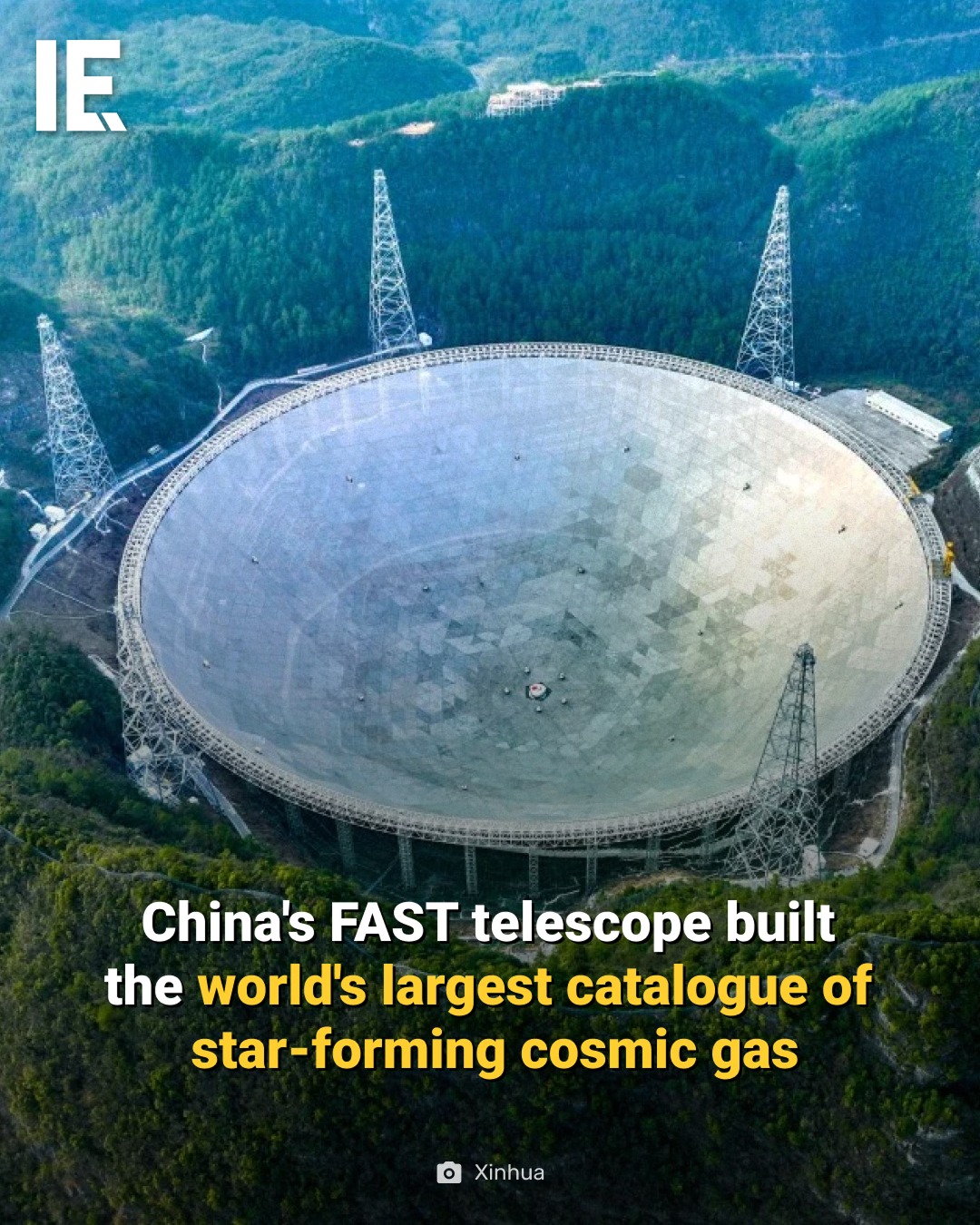
China's FAST telescope has built the world's largest catalogue of star-forming cosmic gas. A marvel of modern astronomical engineering, the Five-hundred-meter Aperture Spherical Telescope (FAST) is nestled within a natural depression in the Guizhou province of southwestern China. Its precise shape and sheer size of 500 meters. The ground-breaking engineering makes FAST the largest non-military radio telescope in the world, surpassing even Puerto Rico's Arecibo Observatory. Its purpose is clear cut. FAST exists to examine the universe using radio waves, particularly to identify and monitor star-forming gases and hydrogen.
The Radio Eye of China
FAST (Five-hundred-meter Aperture Spherical radio Telescope) is a single-aperture spherical radio telescope. Engineers built it from 4,450 triangular panels, each adjustable to focus on a specific point in the sky. This design, made of 4,450 reflective metal triangles that create different curvatures, allows FAST to cover a much larger area than traditional parabolic dish telescopes. It focuses on the signals it receives from 13.73 billion years ago, when the first stars formed. That ancient light forms the signature image that FAST can capture. FAST’s primary mission is to map neutral hydrogen—key to understanding star formation and the distribution of galaxies. By studying the 21-centimeter-hydrogen line, astronomers can create a three-dimensional map of the universe.
Cosmic Gas and the Pulse of the Universe
FAST is part of a growing trend to observe the early universe and star formation. NASA once experimented with a tethered balloon over Antarctica, but FAST has both scale and stability. The telescope's size allows it to capture weaker signals, providing a more comprehensive view of the cosmos. Observing neutral hydrogen—the raw material of stars—helps scientists understand the early universe and the formation of galaxies. The telescope is uniquely situated in a depression surrounded by mountains, shielding it from radio frequency interference (RFI) and creating an ideal environment. Researchers have used it to discover about 100 rapidly rotating neutron stars, which can emit powerful bursts of radiation.
How FAST Works It
FAST's innovative design allows it to focus on a specific point in the sky without moving large structures. This remarkable feat is achieved through a system of cable pulleys that can adjust the curvature of the telescope's 4,450 reflective metal triangles, and then aligns them to focus on a particular point, effectively creating a parabolic dish. Underneath the massive reflector, a combination of fixed and movable detectors, known as feed horns, collect radio waves. The movable feed horns can move up to 150 meters at 200 kilometres per hour and then hone into a specific patch of the night sky. Researchers calibrate the telescope through a complex algorithm that keeps the signals precise. The data collected by FAST is then sent to a correlator. This machine processes the signals to identify the basic information. It can sift through 38 terabytes of data per second. The correlator cleans and subtracts noise before the data passes to a beamformer, which combines signals from the feed horns. This final analysis yields a clear and detailed map of the celestial objects in the telescope's range.
The Longsearch for Star-Birth Cradles
During the first five years of operation, FAST has built an impressive record of discoveries. Its most significant work is to locate hydrogen emissions in distant galaxies. In 2023, FAST's observations aligned with previous ground-based optical telescopes, These observations were key milestones in mapping the early universe. The telescope has also identified 40 new millisecond pulsars, which provide insights into gravitational waves. The FAST telescope works within a significant bandwidth between 70 MHz and 3 GHz. This wide frequency range allows FAST to detect a variety of celestial objects, from nearby stars to distant galaxies and quasars. The telescope’s unique design and the engineering array is the largest and most versatile of its kind.
Installation and Operation
While FAST's impressive technical capabilities are a marvel, the telescope also comes with unique challenges as it lies at the base of the karst depression. The design allows for unprecedented sensitivity, but locating it in a natural "hole" in the ground protects FAST from the RFI. The telescope operates in a mode that is called "drumming" or "pulsing". Its feed mechanism works by spinning in a circular motion, which optimizes the area of sky covered. FAST operates in a mode called "drumming" or "pulsing," where its receiver spins in a circular motion. This pulsating allows the telescope to cover more area quickly.
The ever-increasing radio telescope network
Some telescopes are built on mountaintops, or in space. FAST is an unusual case of a telescope that seems to be buried in the ground. However, FAST doesn’t operate alone in the study of hydrogen distribution. Other telescopes, such as the Australian Square Kilometre Array (ASKAP) Pathfinder and South African MeerKAT, also work towards charting neutral hydrogen. FAST, supported by the Chinese government, is strategically situated in a remote mountain valley in China. It's also among the most impressive radio telescopes in the world. The challenge is that it can only look in one direction at a time. The world's premier radio telescopes have collaborated to build a comprehensive picture of the early universe. FAST and its counterparts share important information about star-forming gas, ensuring that astronomers worldwide benefit from their observations. The network of space telescopes ensures that we gain a wider and more accurate vision of the universe. FAST telescopes have a lifespan of 10-15 years. Before building FAST, state-of-the-art radio telescopes were often smaller, more expensive, and required more energy to operate.
Exploring the Radio Cosmos
FAST operates as the largest key component of China’s National Astronomical Observatories (NAOC). It’s an important part of China's growing space program, which has ambitious plans for lunar exploration, Mars missions, and the search for extraterrestrial life. FAST also plans to study pulsars; Fast’s sensitivity to hydrogen in the early universe allows it to map star-formation. FAST is now a pivot in the investigation into the formation of the universe, from the birth of stars. FAST’s success means the public is likely to see even more maps of star formations in the early universe. The telescope will offer new insights into star formation and the distribution of galaxies.
Watch the Reel
Questions readers ask
How does FAST's design differ from traditional radio telescopes?
FAST is unique because it uses a spherical design made up of 4,450 adjustable triangular panels, unlike traditional parabolic dish telescopes. This design allows FAST to focus on different parts of the sky without moving the entire structure, making it more versatile and efficient.
What specific signals is FAST trying to detect?
FAST is primarily focused on detecting the 21-centimeter-hydrogen line, which helps astronomers map neutral hydrogen in the universe. This hydrogen is crucial for understanding star formation and the distribution of galaxies.
What advantages does FAST's location in Guizhou province offer?
FAST's location in a natural depression surrounded by mountains provides excellent shielding from radio frequency interference (RFI), creating an ideal environment for detecting weak cosmic signals. This setup enhances the telescope's sensitivity and accuracy.
How does FAST compare to the Arecibo Observatory in Puerto Rico?
FAST surpasses the Arecibo Observatory in size and sensitivity, making it the largest non-military radio telescope in the world. Its innovative design and larger aperture allow it to capture weaker signals, providing a more comprehensive view of the cosmos.
What kind of data does FAST collect, and how is it processed?
FAST collects radio wave signals using a combination of fixed and movable feed horns. These signals are then processed by a correlator, which can handle 38 terabytes of data per second, removing noise and preparing the data for analysis.
What significant discoveries has FAST made?
Since its operation, FAST has discovered about 100 rapidly rotating neutron stars, which emit powerful bursts of radiation. These discoveries are crucial for understanding the behavior of these dense, high-energy objects.
Related deep dives
Similar reads based on topic and creator.

Recent articles
Fresh deep dives from the latest Reels we unpacked.




Comments
Be the first to comment.